
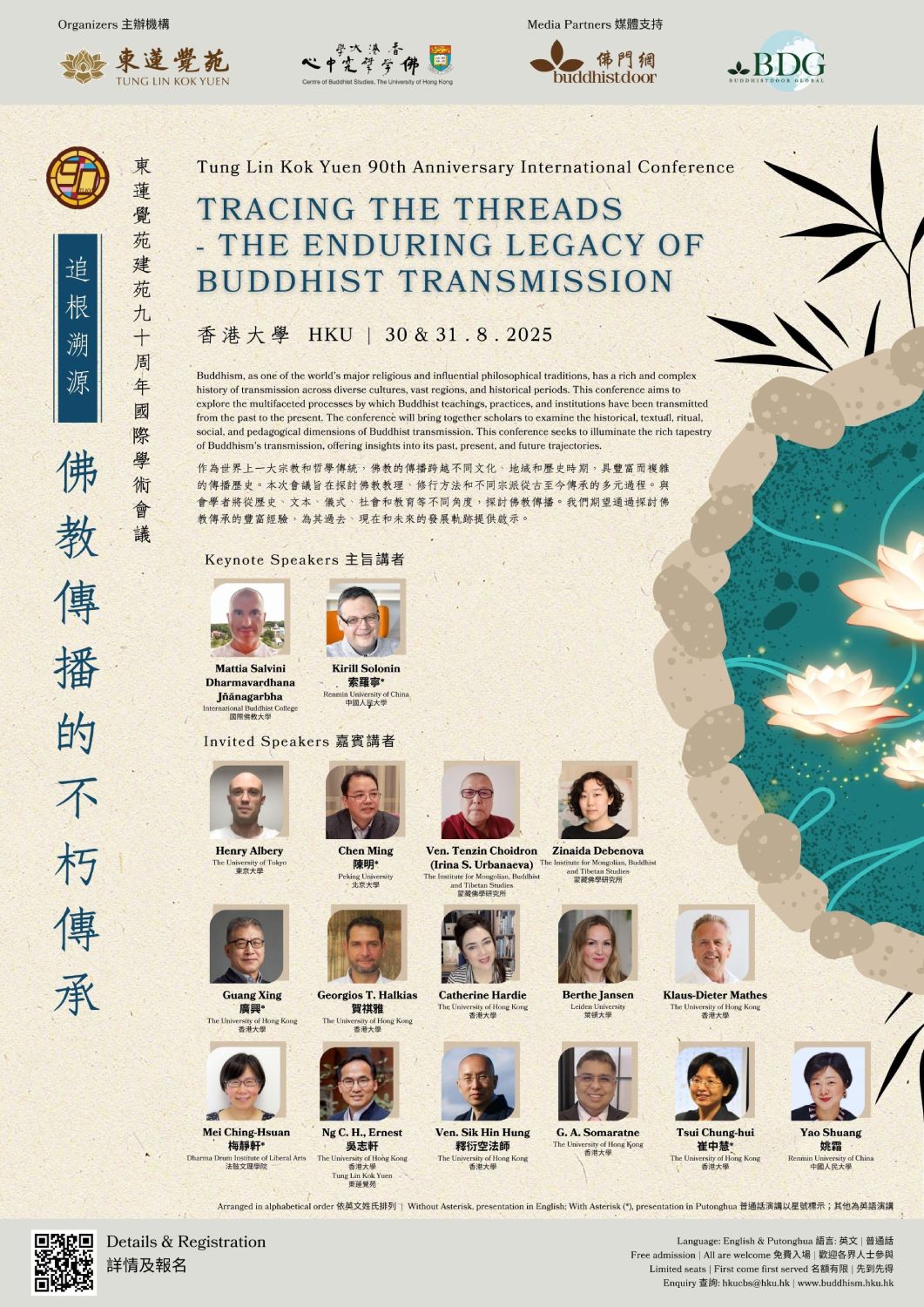
Tung Lin Kok Yuen 90th Anniversary International Conference: The Keynote Speaker Interviews
Held at The University of Hong Kong Centre of Buddhist Studies from 30–31 August 2025, the conference “Tracing the Threads – The Enduring Legacy of Buddhist Transmission” seeks to illuminate the rich tapestry of Buddhism’s transmission, offering insights into its past, present, and future trajectories. The conference was held to commemorate the 90th anniversary of Tung Lin Kok Yuen. In this series we interview the keynote speakers of the conference, professors Mattia Salvini and Kirill Solonin.
I recently visited the Western Xia Imperial Mausoleums, which were inscribed in July as China’s 60th UNESCO World Heritage Site. Despite being looted and emptied of many of their treasures, they remain the most physically intact of a long-lost Buddhist civilization that existed from 1038–1227. And there are still many surviving artifacts and texts that were discovered in Yinchuan and elsewhere, most notably in Khara-Khoto.
Sadly, according to Prof. Kirill Solonin, not only did the all-conquering Mongol Empire wipe out the Western Xia in 1227, but there was an earthquake in 1927 that destroyed the remaining physical remains of the Tanguts in what is now Gansu province, China. Tangut capital Zhongxing Fu (modern Yinchuan) was damaged by two Mongol assaults, while Khara-Khoto, the source of major Tangut acrheological finds, was destroyed in 1372 by the Ming army pursuing Toghon Temür (Yuan Huizong, 1320-1370), the last Yuan emperor, whose troops intended to regroup in an attempt to reconquer China.
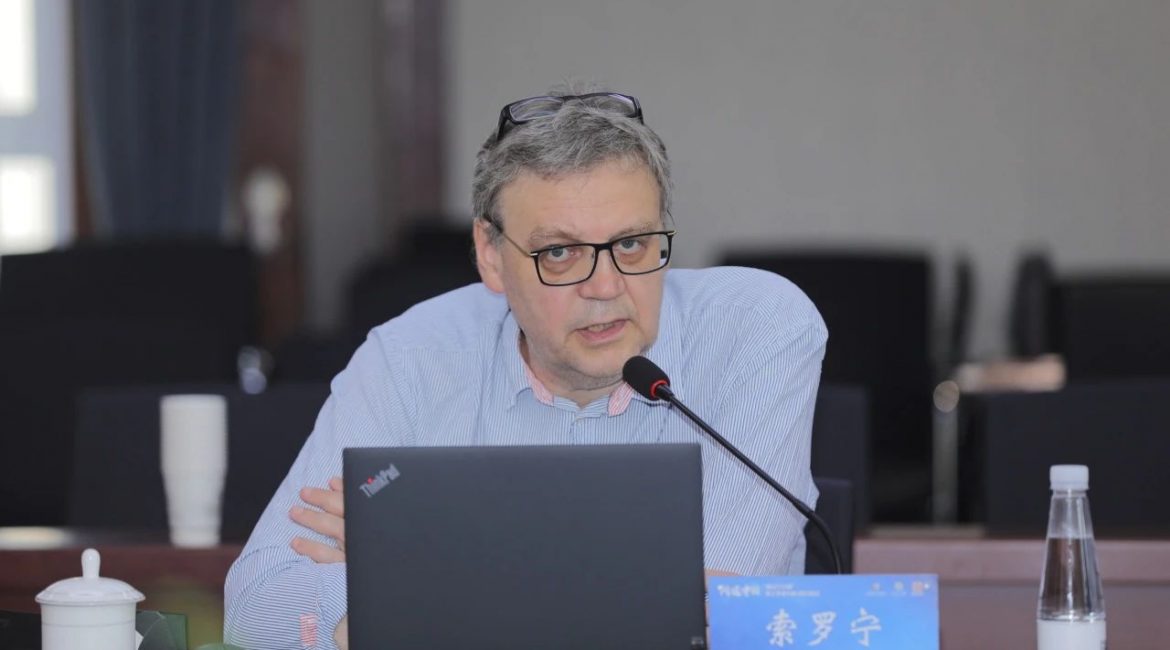
Solonin is professor at Renmin University of China in Beijing. Currently splitting his time between Tokyo and Beijing, he earned his PhD at St. Petersburg University and worked at the Institute for Oriental Manuscript Research, specializing in Buddhism and Tangut language and texts. He has published seminal papers, in both Chinese and English about the history of Tangut Buddhism and Tangut texts. His lecture at HKU CBS looks at how the Tangut texts hitherto discovered can help us understand exactly what teachings and schools were being transmitted in Xixia and in Central Asia from the 11th to the 13th centuries.
“The Tangut Empire should not be seen in isolation from the events happening in Inner Asia before its formation, and during its lifetime,” he suggests. “What I advocate is de-emphasizing the uniqueness of the Tanguts, and in fact to see the Tanguts and their Buddhism in the broader Sinitic and Tibetan contexts. If we Tangutologists can do this, we will be able to help other scholars to understand the true importance of Western Xia.”
Even so, Solonin highlights that there are plenty of mysteries about this civilization: including the very logic and nature of its glyphic writing system. “We still do not know how the actual rationale of how Tangut characters were figured out. They just appear on the scene, pre-baked, so to speak. We know that Tangut language is a Tibeto Burman language, probably related to Gyaronic languages. That is, Tangut language is morphologically richer than Chinese, however, the logographic system of Tangut obviously is due to the Chinese influence.” There are other things that are not so unclear. For example, the turn to Tibetan Buddhism in the latter half of Xixia’s less-than-200-years existence was largely due to historical factors.
“When the ascendant Jurchens (1115–1234) destroyed the Liao (916–1125) and crushed the Northern Song (960–1127), forcing the Chinese court to relocate from Kaifeng to what is nowadays Hangzhou. The Jurchens, or Jin dynasty, blocked the routes between the Xixia and the Southern Song (1127–1279), fearing diplomatic rapprochement and therefore encirclement. Tangut foreign policies and territorial advances shifted towards Tangut Western border: to Amdo and Kham, and indirectly to Ü and Tsang. It is actually in Amdo and Kham where we see the Vajrayana developments that would influence Buddhist movements most in Xixia. Many Buddhist masters that ended up in the Tangut court came from those regions,” says Solonin. Therefore, understanding of Tibetan Buddhism in Xixia requires a study of Amdo and Khams Buddhism.
“When we look at the textual clusters of the first century of the Tangut Empire’s existence, we can conclude that the Avataṃsaka Sutra (Huayan jing) was popular and therefore it was highly likely that the Huayan teaching had an influential presence in Xixia,” he continues. “But thanks to the Tibetan records—we do not have native Tangut sources to speak for themselves—we know that various sub groups of the Kagyu tradition of Gampopa (1079 –1153) was circulating in Xixia. Gampopa was an influential figure among the Tanguts. We suggest that specific outlook of Tibetan Buddhism in Xixia was determined by the combination of Kadampa teachings and Mahāmudrā instructions. Our current research indicates that Tangut were influenced by the tradition of Tibetan scholasticism originating from the Sangphu Neuthok (gsang phu ne’u thog) tradition.”
Sangphu Neuthok was a Kadampa monastery founded Ngok Lekpé Sherab, one of the three great disciples of Bengali scholar Atisha, who contributed greatly to the second diffusion of Tibetan Buddhism. Lekpé Sherab’s nephew, Ngok Loden Sherab (blo ldan shes rab) was created this lineage of scholasticism. Many of important Tangut texts, including Shantideva’s Bodhicaryavatara proceed from the revised Tibetan translations prepared by Loden Sherab. One can speculate that the Kadampa tradition of Xixia was therefore reproducing the Sangphu Neuthok transmission.
“Figures of Indian Mahāsiddhas were popular among the Tangut: so far there are several versions of Tangut Mahāsiddha lineages preserved in Tangut, however we have problem identifying these in Tibetan and Indic sources. Tibetan Madhyamika and Sinitic Huayan thought formed the foundation of the Tangut doctrinal learning. We also know that memebers of Lama Zhang or Zhang Yudrakpa (founder of the Tselpa Kagyu) lineage, came over to Xixia, especially in the latter days of the empire. There are exceptions to this general picture,” qualifies Solonin, “where we see translations of the Hevajra Tantra, associated with the lineage of Ram Glu gong, which is not very well known from the mainstream Tibetan sources.”
Despite his deep immersion in the Tangut texts and histories, Solonin in some ways goes against some of the current trends on Tangut studies: for example, he disputes the idea that the Mongols inherited or assimilated the worship of Mahakala from the Tanguts, arguing that the evidence just isn’t there: while there are exemplars of Mahakala texts in Tibetan and Chinese from Khara-Khoto, there are almost none relevant Tangut text. He also thinks that the ecclesiastical structure of the Tangut court was fundamentally different from that of the Yuan, which elevated the imperial preceptor to a level of administrative authority in the empire by Kublai Khan’s time.
“The Imperial Preceptor in the Yuan had his own seal. He could issue orders and directives. The preceding imperial preceptors of the Tanguts seem to have been glorified personal chaplains of the imperial family, while the State Preceptors seem to have had bureaus working under them. Nevertheless, both configurations of imperial preceptors would have carried out important rituals for the imperial family.”
The picture emerging from my conversation with Solonin is a Tangut Empire that was steeped in both philosophical sophistication as well as ritual-heavy magic, including the worship of Vajravārāhī, Cakrasaṃvara, and others. For Solonin, understanding the broader Sinitic and Tibetan context for the development of “Tangut Buddhism” remains a priority, because the reality is that there was no such thing as Tangut Buddhism: “They didn’t have time to nurture a truly native expression of Buddhism, because their civilization lasted for less than two centuries,” he reflects. Rather, Buddhism in Xixia was a part of the historical process of dissemination of Sinitic and Tibetan Buddhism outside the Central Plains and Tibet proper. In that sense, Buddhism in the Western Xia has lived on and thrived.
Related features from BDG
Book Review: Curses of the Kingdom of Xixia
Related blog posts from BDG
“Buddhists should embrace Buddhist thinking for the Saddharma to stand a chance”: Dharmavardhana Jñānagarbha’s Proposal for a More Inclusive Academia
Primeval Dreaming: Sun Deities of the Helan Mountains and the Western Xia
The Imperial Tombs of Western Xia are only just revealing their secrets
Tangut Time
Tracing the Threads – The Enduring Legacy of Buddhist Transmission