

“Love is blind, and lovers cannot see / The pretty follies that themselves commit,” says Jessica in Shakespeare’s The Merchant of Venice.
Modern culture treats sudden, all-consuming romantic attraction as the clearest proof of a destined connection. Cinematic tropes pushed by Hollywood, pop culture, and social media for decades push this illusion of a single love, a soul mate, that brings “love at first sight.” People are encouraged to chase the rush of early infatuation as evidence of true love. The faster the spark, the more meaningful it seems. But this seemingly magical moment often conceals an ancient, more volatile dynamic—one shaped by Western cultural history and by universal emotional patterns that are not always wholesome. The spark may feel like alchemy, but as we shall explore, it could really be projection and craving.
The Western ideal of romantic love as an elevating, overwhelming passion reaches back to the twelfth-to-fifteenth century troubadour traditions of courtly love in France. Before that era, most European marriages, especially among the literate nobility, served family alliances and property stability rather than emotional fulfilment. But this changed with the introduction of chivalric ideals into the knightly and royal circles of Europe. Chivalry, especially by the time of Chrétien de Troyes and the re-invention of the Arthurian romances, evolved into a virtue that also included devotion to a lady. The troubadours redefined love as a noble, often painful devotion that transcended ordinary life. This beloved lady was distant, idealised, sometimes unattainable (Lancelot’s love Guinivere was, after all, King Arthur’s wife); longing itself became a kind of refinement.
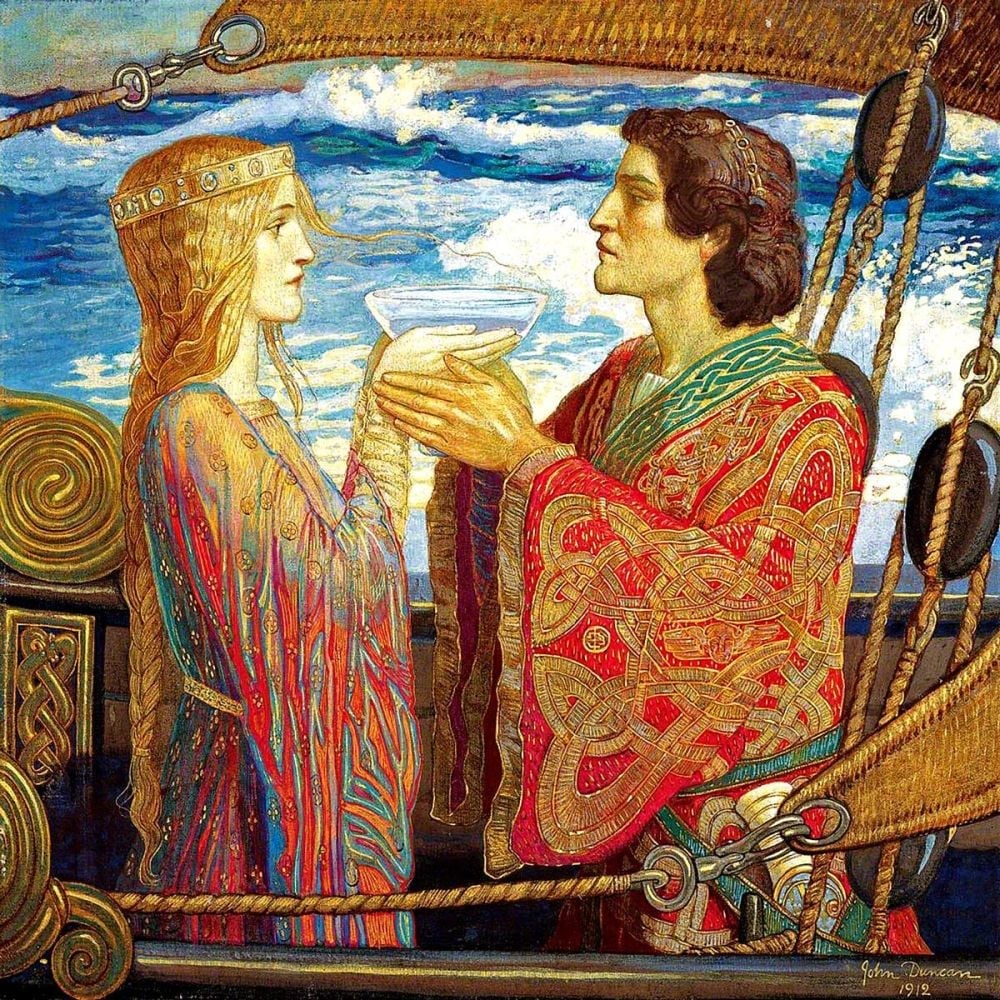
This narrative of chivalric love spread across the Continent and later merged with nineteenth-century Romanticism, which celebrated intense feeling, individual experience, and the sublime. Together, these currents cemented the belief that love should be the central foundation of a life partnership. This history explains why sudden intensity feels not merely pleasant but meaningful or even fated.
From a Tibetan Buddhist tantric perspective, however, this kind of instant, gripping attachment is a klesha-driven love bond. It is fuelled by the mental poisons of craving, ignorance, and projected longing rather than by steady, clear mutual care. It ignites quickly, feels intensely personal, and often collapses just as quickly as it arose. What remains can be sleeplessness, lost focus, and even physical distress when the mind cannot release its fixed grasp on the idealized image of the beloved. The Other is not their own sovereign and autonomous being, but rather a canvas onto which we project our fantasies and expectations.
Recognizing this pattern does not dismiss genuine connection. It invites people to pause and observe what they’re getting into. It asks whether the feeling comes from shared respect and steady understanding, or from the ancient, seductive myth that a sudden intense fire equals a long-lasting love.
In Tibetan Buddhist practice, people caught in this klesha-fuelled romantic grip often show distinct physical and emotional signs beyond ordinary heartache. They may struggle with persistent insomnia, scattered thoughts that loop back to the person, loss of appetite, or unexplained bodily tension. They may check messages compulsively, replay conversations, and mistake anxiety for intimacy. In severe cases, stress-induced illness such as respiratory inflammation may appear, as unrelenting attachment drains subtle life energy. The mind stays fixed on an idealised projection, unable to ground itself in present reality, turning a short encounter into an all-consuming mental burden.

In the short-term, targeted pujas offer immediate ways to help dissolve these behavioral patterns. Pujas dedicated to Mahakala cut through obsessive clinging and clear the obstructive emotional fog that clouds our otherwise sensible judgment. It helps the person step back from the urge to overthink or chase the lost connection. Vajrakilaya pujas sever the sharp, sudden karmic knots tied to the abrupt end of the bond, dissolving the ache that lingers in our chest. And Yamantaka pujas burn through deep-seated craving and restore balance to both mind and body, easing the physical symptoms triggered by suppressed grief.
These rituals don’t magically erase our memory, but instead function as supports for inner work: they give form to the intention to release, cut, and purify our relationships. Of course, we should always anchor our minds with gentle mindfulness of the breath. The person can gradually separate their own peace of mind from the memory of the fleeting infatuation. The instant romantic spark people chase as destiny is often just a klesha-fuelled mirage. The pujas do not “fix” the lost relationship. They free the person from being trapped by their own clinging.
Once the emotional knot is cut, we stop seeing the end of the encounter as a personal failure. Instead, we recognize it as a chance to let go of the craving that was weighing on us. We can move back to a steadily happy daily life instead of coming back to what could have been again and again. The other person won’t return, but our mind will return to itself. Indeed, we can even sincerely express gratitude for what that encounter really was: a pleasurable meeting that was not meant to last, which is the way of all things. When that can be accepted, emotional attachment can be released, along with all regret, longing, and other emotions associated with the encounter.

The allure of that sudden romantic fire has never fully faded from Western culture. It’s woven into songs, films, novels, and many dating apps. But the tantric framework gives a practical alternative. Instead of mourning the end of a short, intense bond, people can use the pujas to untie attachment at its root, not merely soothe surface pain. Over time, this lets them tell the difference between infatuation’s rush and steady, truly loving connection. Future relationships can then grow from clarity rather than craving. They can include passion without being ruled by it, and intimacy without the fear of losing a fantasy. That is the quiet, lasting shift the practice brings, far beyond any single romantic encounter.
We shouldn’t reject love or become cynical. We should see that love and attachment are different, even when they look the same in the beginning. We should reorient towards love that does not depend on the drama of capture and loss. The myth of instant alchemy says that two people are transformed into one by a single spark forever. But deeper work is required for love to work. What matters is whether the mind can remain clear, the heart can remain kind, and the connection can be built in the open without the fever of clinging.
When that becomes possible, the end of an infatuation is no longer a tragedy. It is simply the storm clearing into a clear blue sky. The goal is not to stop feeling all desire, but to stop letting desire decide what is true or lasting, and who we become when it inevitably passes.