
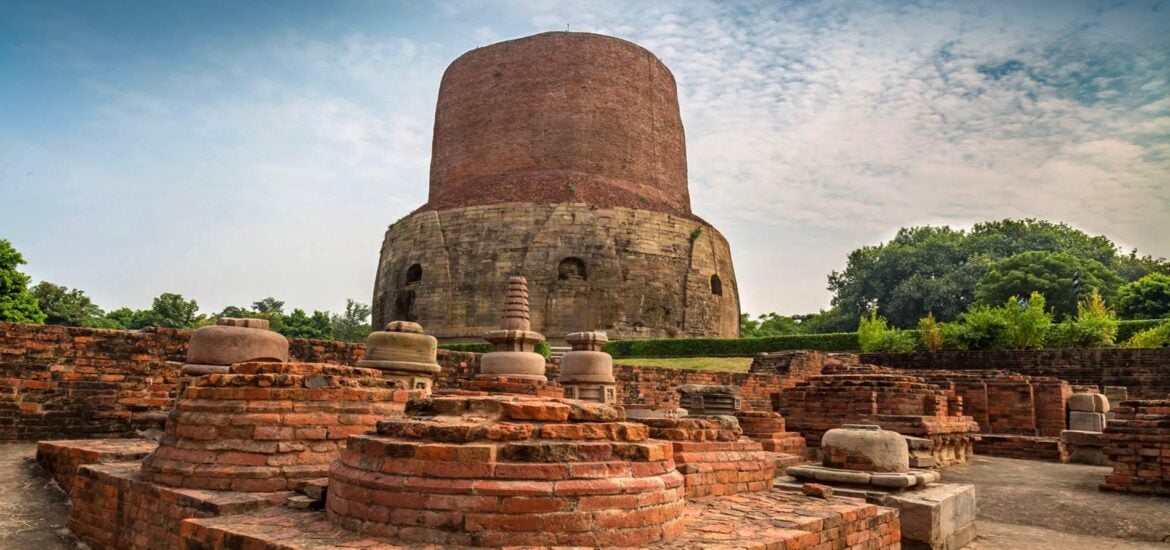
Sarnath deer still whisper the Dharma
As all monasteries are celebrating the Buddha’s First Turning of the Wheel, I recall that day sitting on the grass of the Deer Park, feeding lettuce to deer who seemed utterly unfazed by the heat. Their breath brushed my fingers, gentle and deliberate, as if they had all the time in the world. In a way, they did. Their ancestors had walked this same ground when a wandering teacher first spoke to five men beneath a fig tree—2,600 years ago.
If human existence is a labyrinth of existential anxiety and desire, then the First Turning of the Wheel at Sarnath was the world’s most enduring roadmap out of both through the Four Noble Truths and the Noble Eightfold Path. It was a clinical diagnosis of suffering and its cure.
To understand why this moment still matters, you have to zoom out. In Buddhist tradition, the historical Buddha turned the Wheel three times: first, the foundational ethics at Sarnath; second, the radical teachings on emptiness; third, the luminous nature of mind. Think of it as a mandala—concentric circles of wisdom building upon one another.
But it all began here, on this dusty patch, with just five listeners.
Middle Way: The roadmap to enlightenment
Prof. Mehar Negi settled beside me under the gnarled fig tree. A soft-spoken scholar with decades of Sarnath in his bones, he pointed a weathered finger toward a patch of grass no different from any other. “Right there,” he said quietly. “That is where the Awakened One gave his first sermon.”
I squinted through the glare. Scattered around us, half-buried in the earth, were freshly excavated stone statues. Fragments of Buddha heads, broken torsos, delicately carved lotus pedestals. They had been buried for centuries, exhumed by archaeologists and left here in the open, still caked in ancient soil. They sat beside us like silent witnesses, emerging from the dust just as the teaching had emerged from obscurity.
I closed my eyes and let the blur of time collapse. I saw the five ascetics—the Buddha’s former companions who had abandoned him in disgust when he gave up starvation. They had vowed to snub him. Yet when his silhouette appeared on the horizon, radiant and unshakable, they broke their pact. They rose. They listened. And his first words cut straight to the heart: Avoid the two extremes. Sensual indulgence is base; self-mortification is painful. Walk the Middle Way.
No gods. No miracles. Just a roadmap drawn in the dust.
The butterfly effect: Xuanzang’s amazement
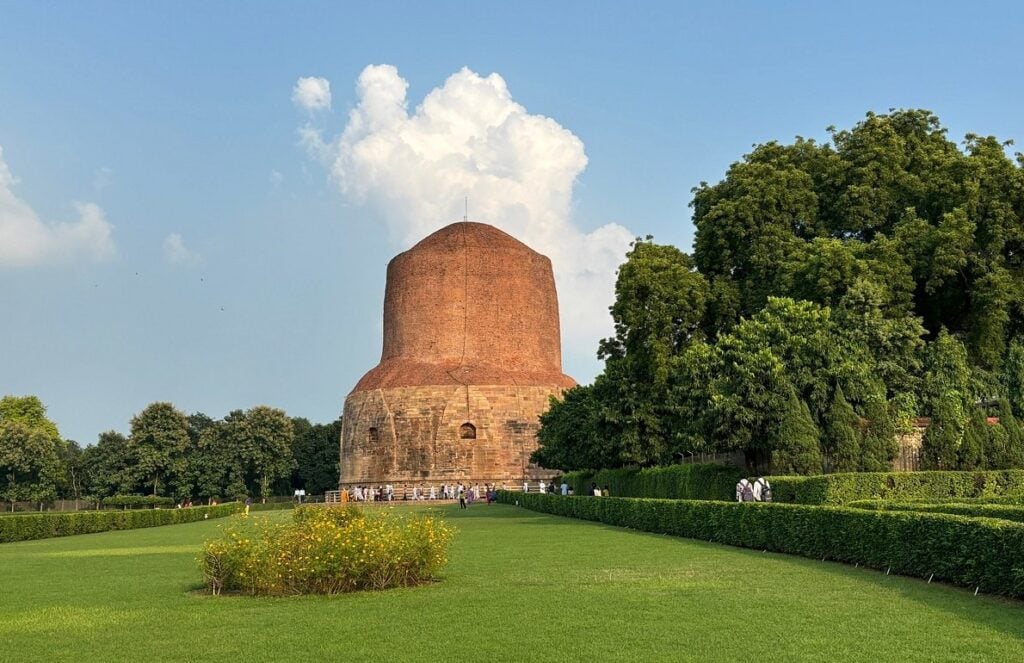
I looked up at the towering Dhamek Stupa, its massive brick face glowing in the afternoon light. Beside it stood the broken shaft of the Ashoka Pillar, defaced but still defiant. Emperor Ashoka erected it in the 3rd century BCE to mark this sacred ground. Centuries later, Xuanzang—the Tang dynasty translator-monk who crossed deserts and mountains to reach this spot—described what he saw: “Proceeding northeast from the Varāṇasī River for over ten li, one arrives at the Deer Park Monastery. . . Multi-storied pavilions and double-eaved halls exhibited beauty that exhausted the rules of architecture. The monks numbered fifteen hundred.”
Fifteen hundred monks. All because of one afternoon under a fig tree. That is the butterfly effect—a single flap of wings in a dusty park, and the Dharma swept across Asia, changing the genetic code of human consciousness forever.
I glanced back at the deer grazing peacefully, their soft eyes watching me with ancient calm. The Bodhisattva was once a deer-king in this very forest, offering his own life to save a pregnant doe. Maybe compassion doesn’t just pass through texts; maybe it seeps into the soil and spirit of a place, passed down through generations—even into these gentle creatures nibbling lettuce from my hand.
The roadmap for a fractured world
So how does this ancient roadmap speak to us now—drowning in digital noise, climate grief, and political despair?
First, the Middle Way is our antidote to polarization. We lurch between hustle-culture burnout and cynical detachment. The Buddha says: sustainable effort lies in the center—engagement without grasping, ambition without destruction.
Second, the Four Truths are the ultimate therapy. Call it dukkha, call it anxiety—the diagnosis holds. Name the pain. Trace it to craving. Believe it can end. Walk the path.
Third, compassion is the final metamorphosis. The deer-king and the Buddha teach us that liberation is never solitary. We are freed only when we free others.
I turned to Professor Negi as the sun dipped lower. “Do you think he felt lonely,” I asked, “speaking to just five men in the middle of nowhere?”
He smiled. “Perhaps. But he knew the wheel, once turned, doesn’t need a crowd to roll.”
I rose and touched the sun-baked soil one last time. The excavated statues sat beside us—broken, buried, quietly resurrected. Like the teaching itself. Twenty-six centuries later, the wheel is still turning. The butterfly is still flying. And the roadmap he drew that day is still the only one that can lead us home.