
By HE Sangay Dorji
Introduction to the Twelve Deeds of the Buddha and the Five Great Events
Among the twelve months of the year, the month of Saga Dawa is exceptionally sacred because five of the Buddha’s major deeds occurred on the same lunar day, the fifteenth day of the fourth lunar month. For this reason, it is considered an extraordinarily blessed and auspicious time.
Any virtuous actions performed during this period such as practicing Dharma, making offerings, circumambulating sacred objects, going on pilgrimage, lighting butter lamps, reciting prayers, and engaging in acts of merit—are said to generate immeasurably greater merit than at ordinary times, multiplied many millions of times.
Therefore, practitioners are encouraged to make the best possible use of this holy occasion by engaging in virtuous deeds and Dharma practice.
More important than merely observing external rituals is remembering that this is a festival commemorating the Buddha. By reflecting upon the Buddha’s life and deeds, we develop gratitude toward him and deepen our faith and devotion.
One should recite the Buddha’s practice texts, praises, and mantras while generating bodhicitta the aspiration that all sentient beings, especially one’s kind parents and all beings throughout space, may be freed from suffering, purified of negative karma and obscurations, and attain complete enlightenment.
While reciting the Buddha’s mantra, one should visualize Buddha Shakyamuni in the sky before oneself, surrounded by countless bodhisattvas. Rays of blessing light emanate from the Buddha, purifying all beings and bringing them to the state of Buddhahood. After the recitation, the Buddha dissolves into light and merges into oneself, and one rests briefly in a clear and serene meditative state. Finally, one dedicates the accumulated merit and makes aspirations for the welfare of all beings.
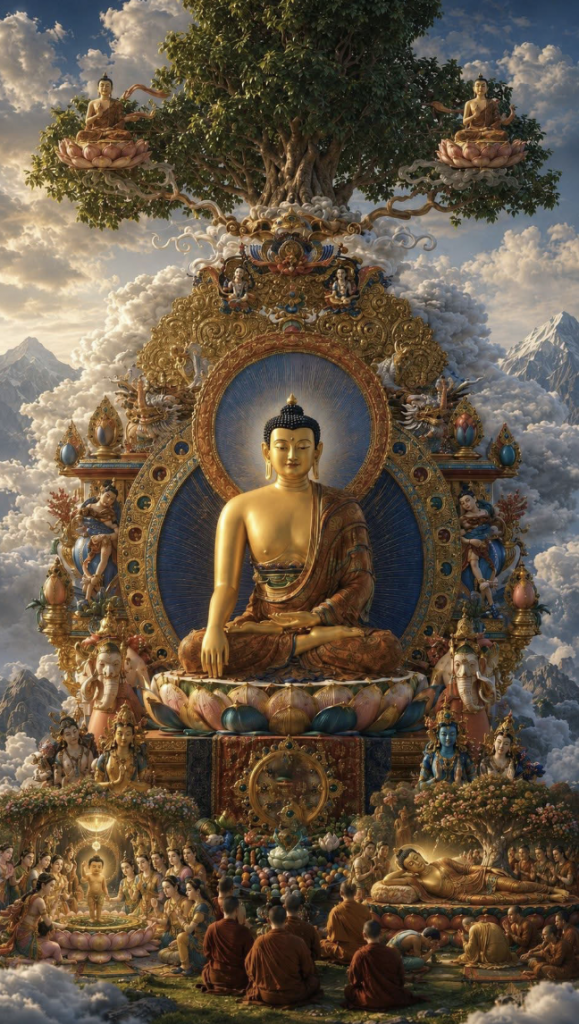
The Twelve Deeds of Buddha Shakyamuni
1. Dwelling in Tushita Heaven
The future Buddha resided in Tushita Heaven as the Bodhisattva White Banner (Dampa Tokkarpo), teaching the gods as the regent of Buddha Kashyapa.
2. Descent into the Womb
When the time came to tame beings in this world, he descended from Tushita in the form of a six-tusked white elephant and entered the womb of Queen Maya, wife of King Śuddhodana, on the fifteenth day of Saga Dawa.
3. Birth at Lumbini
Having perfected all the marks and signs of enlightenment within his mother’s womb, he was born in Lumbini Garden from Queen Maya’s right side. Upon birth, he took seven steps in each of the four directions, lotus flowers blossoming beneath his feet, and proclaimed:
“I am supreme in this world.”
He was named Siddhartha (Dönkün Drubpa), meaning “Accomplisher of All Aims.”
4. Mastery of the Arts and Sciences
As he grew up, he mastered writing, mathematics, arts, and all branches of knowledge, surpassing even his teachers.
5. Royal Life and Marriage
Following the custom of previous Buddhas, he accepted marriage. At age seventeen he won contests of skill and married Princess Yaśodharā and other royal consorts, living amid great royal luxury until age twenty-nine.
6. Renunciation
After seeing the sufferings of old age, sickness, and death, and witnessing the serenity of a renunciant, he developed deep renunciation. With his father’s permission, he left palace life and entered the homeless life of a spiritual seeker.
7. Six Years of Ascetic Practice
On the banks of the Nairañjanā River he practiced severe austerities for six years, subsisting on almost nothing, thereby demonstrating complete renunciation and spiritual discipline.
8. Taking the Seat of Enlightenment
At age thirty-five, after accepting milk-rice offered by the maiden Sujātā, he proceeded to Bodh Gaya. Receiving kusa grass from a grass seller, he spread it beneath the Bodhi Tree and made the famous vow:
“Even if this body withers away,
Until I attain unsurpassed enlightenment,
I shall not rise from this seat.”
9. Defeating Māra
Māra and his vast armies attempted to prevent his enlightenment through fear, temptations, and attacks. Remaining unmoved in profound lovingkindness and meditation, the Bodhisattva transformed all weapons into showers of flowers and achieved victory over Māra.
10. Enlightenment
On the fifteenth day of Saga Dawa, during the dawn hours, he realized the wisdom of dependent origination and attained complete and perfect Buddhahood beneath the Bodhi Tree.
11. Turning the Wheel of Dharma
After enlightenment, he remained silent for seven weeks. Following the earnest requests of Brahmā and Indra, he taught the Dharma, setting in motion the Three Turnings of the Wheel of Dharma and expounding the eighty-four thousand collections of teachings.
12. Passing into Parinirvāṇa
After a life devoted to benefiting beings through his enlightened body, speech, mind, qualities, and activities, he entrusted his teachings to Mahākāśyapa and his disciples. At the age of eighty, on the fifteenth day of Saga Dawa, he displayed the passing into Parinirvāṇa at Kuśinagara.
Preservation of the Buddha’s Teachings
After the Buddha’s Parinirvāṇa, his lineage successors, the Seven Patriarchs, the Sixteen Arhats, and many great scholars and accomplished masters of India, Tibet, Bhutan, and other Buddhist lands preserved, upheld, and spread the precious teachings. Through their efforts, the Buddha Dharma continues to flourish in the world today.
The Five Great Events of Saga Dawa
The Saga Dawa Festival commemorates five principal deeds of the Buddha that all occurred on the fifteenth day of the fourth lunar month:
1. Descent into the womb of Queen Maya
2. Birth at Lumbini
3. Defeat of Māra
4. Attainment of Enlightenment
5. Parinirvāṇa
Because these five great events occurred on the same sacred day, it is known as the “Festival of the Fivefold Auspicious Coincidence” (Düchen Nga Dzom) and is regarded as one of the most important and merit-multiplying holy days in the Buddhist calendar.
May all beings accumulate merit, purify obscurations, and attain perfect enlightenment.