
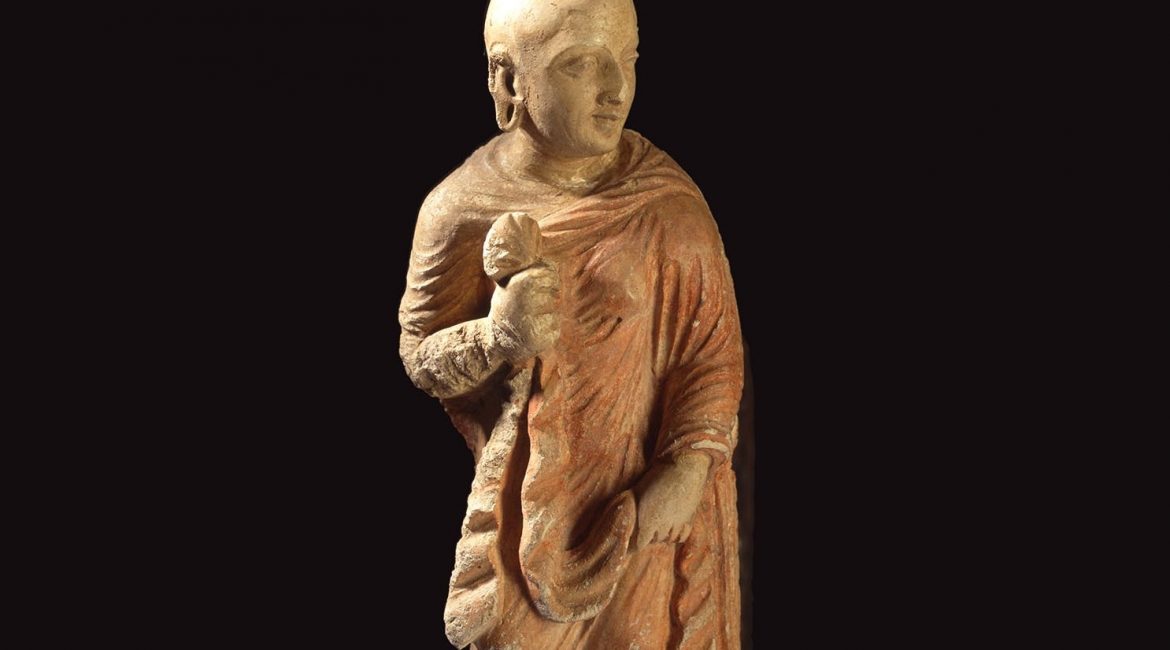
If the Greek sculptor Pygmalion had been living in Greek-influenced Gandhara, he might just have sculpted the sublime, beautiful statuette of a shaven Buddhist nun, which is the subject of a 2024 paper by Giovanni Verardi and Bhikkhuni Dhammadinna. Rather than falling in love with her, I suspect he might have engendered an overwhelming sense of pure devotion to her, and perhaps the Buddha, not Aphrodite, would have brought this sculpted nun to life to teach and guide Pygmalion.
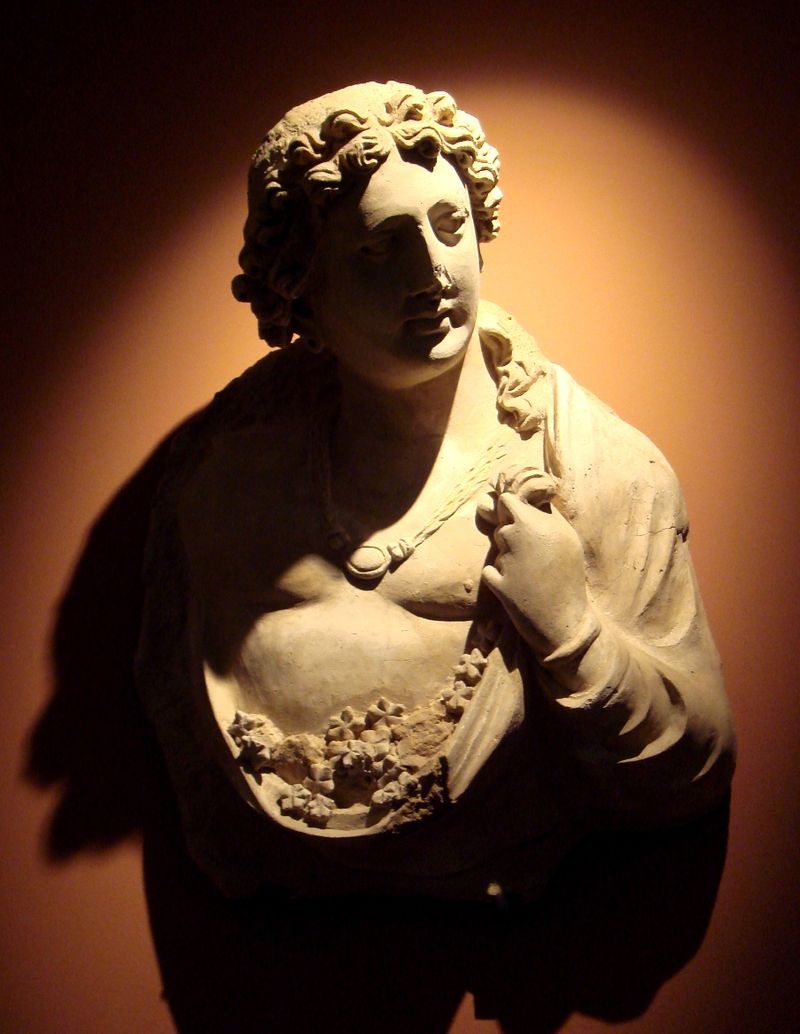
Gandhara captures the imagination of Buddhists and lovers of world history like few other regions. Part of the Gandhara region was Hadda, located near modern Jalalabad in eastern Afghanistan. As one of the most important centers of Buddhism in Gandhara from the 1st to the 8th centuries, Hadda’s most obvious visual legacy is, apart from the beautiful remnants of stupas and monasteries like Chakhil-i-Ghoundi, Tapa Shotor, and Tapa Kalan (which would have served as hubs of worship, meditation, and education), is the fusion of Hellenistic, Indian, and Central Asian artistic traditions. Stucco was a medium that allowed for intricate detailing. From statues to friezes, Buddhist artists blended Hellenistic realism such as naturalistic drapery and facial features with Indian symbolism.
On display at the Civico Museo Archeologico (Civic Archeological Museum) in Milan, the nun I wish to highlight is an exquisitely serene, approachable female monastic. It is impossible to tell her seniority in the sangha, or even her identity. Like a Greek statue emerging from the mists of history, the nun is shrouded in mystery, her owners from yore unknown. Her provenance is equally bamboozling, although the paper’s authors have made some compelling suggestions.
The paper describes this extraordinary piece of Buddhist art as such: “The statuette, of unknown provenance and acquired through purchase in Milan, measures 26 x 10 x 7.6 cm. Its lowermost part just below the rim of her upper robe—ankles and feet—is missing.” (Verardi and Dhammadinna 2024, 179) Curiously, the official Civico Museo Archeologico webpage that highlights the figure incorrectly sexes it as a male monk (with the title even being “Monaco” or “Monk,”), when it is obviously a female nun.
Ven. Dhammadinna and Dr. Verardi correctly point out: “The two means available to convey her identity as a nun, rather than a monk, were pointers to her different body shape and close-up details of her monastic attire. As to her body shape, the coroplast chose to reveal, however discretely, the presence of female breasts.” (Verardi and Dhammadinna 2024, 181)
Where did it come from? Dhammadinna and Dr. Verardi suggest: “On account of its material and stylistic aspects considered in comparison with the stucco production in the area, the large site of Hadda and locations of related production might be the place of origin of the statuette, which might date from just after the second century AD, or, more likely, later.” (Verardi and Dhammadinna 2024, 180)

The authors of the paper do a deep dive into the robes of the nun, and whether it aligns with what we know bhikshunis wore, based on historical analyses of the Vinayas. Hadda would be a good place to explore more of how the Vinaya might have shaped monastic life, especially since the Bhikṣuṇī-Prakīrṇaka of the Mahāsāṃghika-Lokottaravāda could have been influential among some nunneries in the area.
Much of the region, which Chinese pilgrim-monk Xuanzang called “Nagarahara,” has been obliterated due to tragedies like the Soviet-Afghan War of the 1980s, civil wars, and Taliban campaigns initiated in a misguided, anti-iconoclastic frenzy in the 1990s and 2000s. This included the fanatical and deliberate targeting of Buddhist relics, and our Nun of Milan could have well been one of many that were destroyed had it not mysteriously, and fortuitously, ended up in Italian hands.
Among the hundreds of monasteries and thousands of monastics that Xuanzang evoked in his accounts, amidst the faint memory of Indian monks, Central Asian caravanserai and camels, and Chinese pilgrims, the soft chanting of women like the Nun of Milan lingers like a soft echo, a voice amidst the sandscapes.
See more
Monaco (Civico Museo Archeologico)
Reference
Giovanni Verardi and Bhikkhuni Dhammadinna. 2024. “The nun of Milan: A Gandharan bhikṣuṇī figurine in the Civico Museo Archeologico,” in Annual Report of The International Research Institute for Advanced Buddhology at Soka University for the Academic Year 2023 Volume XXVII. Tokyo: The International Research Institute for Advanced Buddhology, 179–86.