
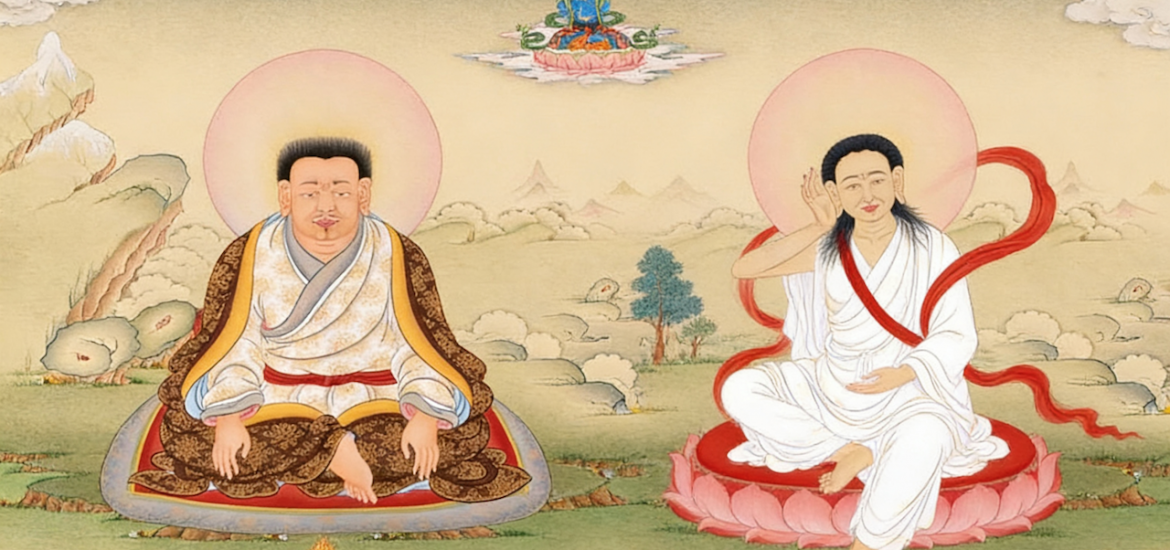
March 2026 holds profound significance for Vajrayana Buddhism, as it marks the back-to-back Parinirvana anniversaries of two of its most pivotal figures. The great yogi Milarepa entered Parinirvana on March 2, and his venerable guru Marpa had entered Parinirvana on March 3. This unparalleled guru-disciple pair redefined the very foundation of Tibetan Buddhism, carrying forward a sacred lineage that transformed the spiritual landscape of Tibet.
Marpa (1012–97) stands as a cornerstone of Tibetan Buddhist transmission, a fearless translator and master whose spiritual journey began at the iconic Nalanda University, the ancient heart of Buddhist learning in India. He ventured three perilous times across the treacherous Himalayan mountain range to study under Naropa, Nalanda’s most revered sage, receiving the complete and unbroken Vajrayana teachings, including the precious Mahamudra and Hevajra Tantra lineages. Marpa dedicated his life to translating these sacred Indian Buddhist texts from Sanskrit into Tibetan, preserving the authentic teachings for future generations and laying the textual bedrock of Tibetan Vajrayana Buddhism. He was not just a teacher, but a vital bridge connecting Indian Buddhist wisdom to Tibet, ensuring these profound doctrines took root in the Himalayan region.
It was this priceless transmission that Marpa bestowed upon his most devoted disciple, Milarepa (1040–1123). A former sorcerer burdened by heavy karmic sin, Milarepa sought purification at Marpa’s feet, enduring eleven years of grueling, unrelenting trials—building and dismantling stone towers, enduring hunger and hardship—tests designed to purify his negative karma and prepare him for the ultimate teachings. Unlike the Western philosophical pair Plato and Aristotle, where Aristotle later diverged from his mentor’s ideas, Milarepa’s devotion to Marpa remained unshakable through every suffering. He accepted his guru’s guidance with absolute faith, never questioning or straying from the path.
This unwavering devotion bore fruit: Milarepa became the embodiment of Marpa’s teachings, retreating to mountain caves, surviving on nettle soup, and attaining full enlightenment. His Hundred Thousand Songs, spontaneous poetic verses of spiritual realization, made the profound Vajrayana teachings accessible to all Tibetans, transcending class and scholarly boundaries, and spreading the lineage far and wide. Marpa’s act of bringing Naropa’s teachings from Nalanda, translating the sacred texts, and training Milarepa created an unbroken lineage that became the core of the Kagyu school, one of the four major traditions of Tibetan Buddhism.
Together, Marpa and Milarepa shaped Tibetan Buddhism’s identity: Marpa as the translator and lineage holder who brought authentic Indian Buddhism to Tibet, and Milarepa as the realized yogi who lived and propagated those teachings, making them a living, breathing part of Tibetan spiritual life. Their bond stands as the ultimate ideal of guru-disciple devotion in Tibetan Buddhism, a legacy that continues to guide practitioners across the world to this day.