
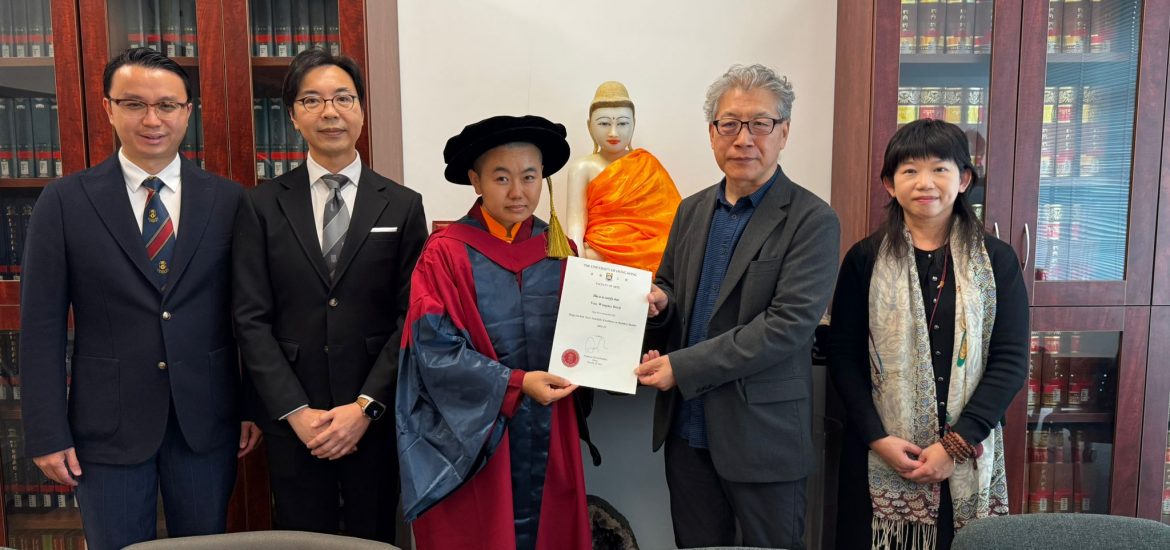
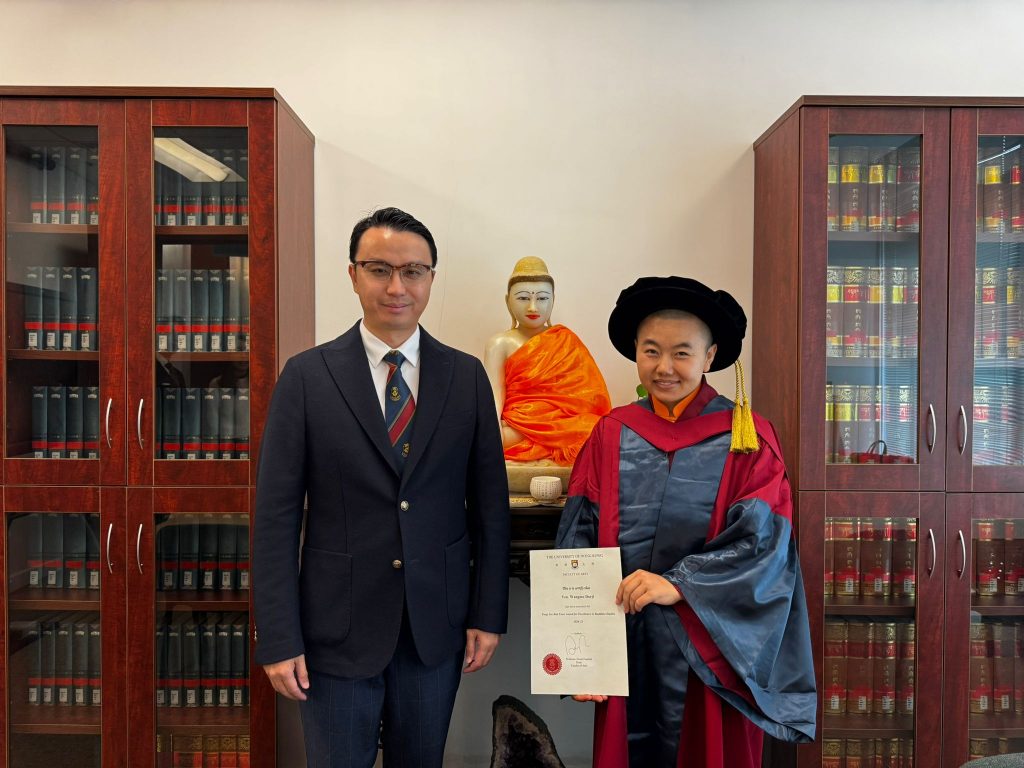
Ven. Wangmo Dorji—now Dr. Ven. Wangmo Dorji—was a shy and quiet female monastic when she first set foot in the classrooms and corridors of the Centre of Buddhist Studies at the University of Hong Kong. She is an ani in the Peling (pad gling chos rgyud) Dzogchen lineage, and missed out on the recent women’s ordination in her home country from 15–19 November, which was presided over His Holiness the Je Khenpo as part of the Global Peace Prayer Festival. She was absent for a good reason: she has been in the final stages of the confirmation of her doctoral degree, an on top of that she was conferred this year’s Tung Lin Kok Yuen Award for Academic Excellence.
I visited her during her award reception at CBS to discuss her recently thesis, The Transmission of Dzogchen in the Tradition of Pema Lingpa: An Annotated English Translation and Critical Edition of The History of Transmission Lineage. This text in question is found in the fourth volume of Pema Lingpa’s collection within a larger volume called The Gathering of Samantabhadra’s Intention (Kun bzang dgongs ‘dus), and it is largely unexplored in academic literature. The History of Transmission Lineage is a short text that contains the pedagogical genealogy of the Peling Dzogchen tradition, which was established by Pema Lingpa (1450–1521), who is not only the foremost master of Bhutan but also a prime treasure revealer (tertön) of the Nyingma school.
Pema Lingpa established the Peling tradition in the fifteenth century, which dates back to Garab Dorji, the first historical figure in the Dzogchen tradition. Although his dates are uncertain, he was a nomad from Oddiyana, the legendary heartland of tantric Buddhism, and said to be the first human to receive the complete direct transmission teachings of the Sutrayana, Tantrayana, and Dzogchen. In turn, Garab Dorji directly transmitted these teachings to the de facto founder of Vajrayana, Padmasambhava. The current lineage holder is His Eminence the 9th Gangteng Tulku, Kunzang Rigdzin Pema Namgyal.
“There are many people in and outside of Bhutan who are interested in Dzogchen practice, but don’t know much about the lineage. They are actually public, but the lineage is little-known and often just a brief preamble in most classes, with little thought given by the practitioners to the lineage’s significance,” said Ven. Wangmo. “If you don’t know the lineage and where it comes from, it is problematic because we are practicing something without knowing its source. The masters often will offer some kind of story to explain the lineage, but I grew interested in the reliability and authenticity of the historical lineage. So I set off to study it.”
I posed to her the common question of how she resolves the tension between being an “insider” practitioner and an “outsider” scholar, despite this being a simplified dichotomy. “At first it was a bit difficult for me,” she conceded, “to bring historical criticism to the narrative history of the Peling lineage. So, what about historical authenticity? It is difficult to conclude one way or another for various reasons, and I would say the same for all the terma or treasure texts. We are in the 21st century, talking about texts that were ‘hidden’ in the eighth or ninth centuries and ‘revealed’ in the fourteenth or fifteenth centuries.” This presents a doubly difficult historical context, in which centuries have passed during the interval between the time the text was apparently created or irrupts into history, and the time it was made public knowledge. And we haven’t even begun to speak of the lineage itself, and how it was passed down and replicated.
Sharing a laugh, Ven. Wangmo insists that “spiritually,” as a monastic, the transmission, empowerment, and practice of the text is perfectly legitimate and leads to realization. The role of faith will always be critical, even for a scholar interrogating the object of faith. There were other difficulties. “Even finding a reliable version to translate was hard. So as I did my PhD, I discovered that there are many different versions of manuscripts, stored at many monasteries across Bhutan. There were 11 versions of The History of Transmission Lineage.” She based her critical edition on Dudjom Rinpoche’s edition, which included important passages not found in other recensions.
Part of Ven. Wangmo’s fieldwork during her doctorate was to travel across Bhutan, finding as many extant recensions of the manuscript in question. This was harder than one might think, since monasteries holding terma texts are secretive about sharing their manuscripts. “Some texts are sealed by the government or abbots, so they’re hard to get to. I travelled to both eastern and western Bhutan in order to be able to fulfil my research questions.”
Fresh from her graduation, Ven. Wangmo encourages her fellow female monastics (around 270 at her nunnery) to try applying to study scholarships. “I like to show them that the world is a big place, and that learning in academic environment can bring benefit to both the monastics and to society.” She feels that her thesis, insofar that it reveals much needed critical information about the Peling lineage, makes such a contribution. She has received many requests from practitioners and monastics to read her paper. “I always ask my fellow female monastics to learn outside of Bhutan. They are not so confident, like I once was, and it’s very difficult for us to come out of our shells. But I am proof that we can indeed do it, and when we do, we can be as accomplished scholars as any at a global level.”