
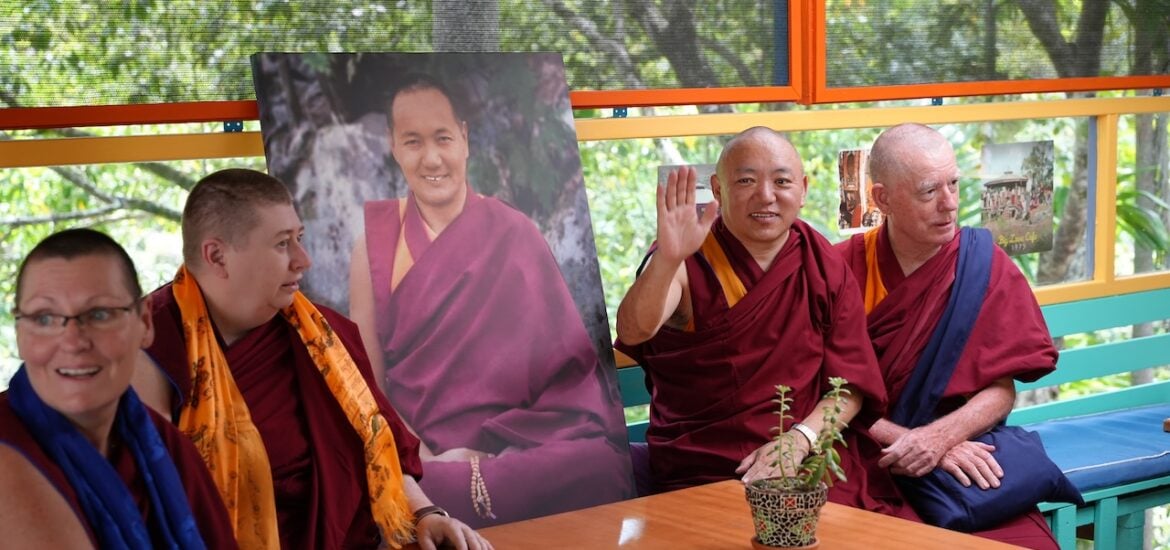
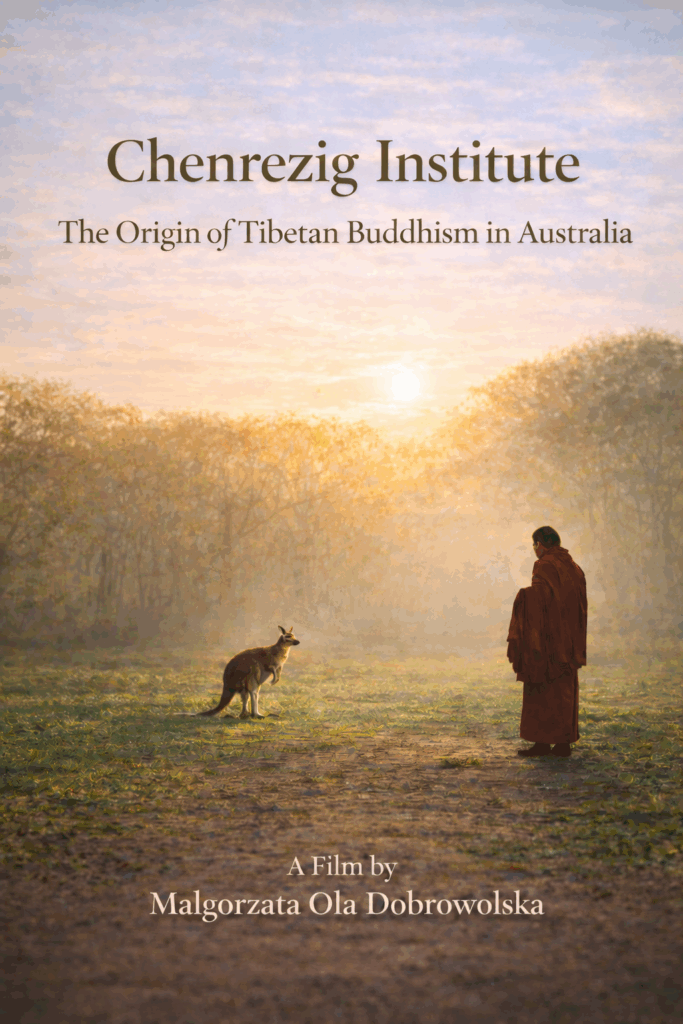
Chenrezig Institute: The Origin of Tibetan Buddhism in Australia is a feature-length documentary by Małgorzata Ola Dobrowolska, which charts the establishment of the first Vajrayana Buddhist center in Australia in the 1960s and 70s. The new movie won the Winner Award in the Spiritual Film category at the Love Peace and Freedom Film Festival in Naples in August. It will also be screened in person at the 13th Global Conference on Buddhism Kraków, Poland on 6–8 November 2026.
BDG: In selecting the interviewees and “protagonists” of the movie, including Ven. Thubten Chokyi, Kathy Vichta and so on, how did you balance their personal stories of disillusionment with mainstream society with how Chenrezig Centre and, indeed, Tibetan Buddhism, is all about reorienting and reintegrating the non-self to a transcendent, interconnected whole?
MOD: Before answering this question, I would like to make one clarification. I am careful about making assumptions about the inner motivations of the people featured in the film. Not all of them identify with the hippie movement, and each person came to Buddhism in their own unique way. The best way to understand their journeys is to listen to their own words in the documentary. What I can offer are some general observations based on my research, my interviews, and my own four years of living at Chenrezig Institute.
What interested me most was not what these people were leaving behind, but what they were trying to build.
When we think about the counterculture of the 1960s and 1970s, we often associate it with freedom, adventure, sex, drugs, and rock and roll. For me, this is one of the most interesting contrasts in the story. Many of these young people began by searching for freedom, adventure, and new experiences. Yet what they eventually found was a spiritual path that required commitment, discipline, responsibility, and service to others.
As Garrey Foulkes describes it in the film:
“We were the so-called children of the 60s. So we were living in our late teens and early 20s in a very, very exciting time to be alive. Like everything was changing. It was incredibly interesting and exciting. We were traveling a lot. We were experimenting with all sorts of alternative things. (…) So it’s been a very great pleasure to have had the extraordinary good fortune to meet with these Lamas and to meet with people who had not only the wisdom but the skill to change the lives of very radical young men and women who grew up in the 60s.”
As Kathy Vichta describes it in the film:
“It was colourful in the early days. I mean, this was the ’70s, when there were a lot of hippies. And the kind of people who were interested in Buddhism were probably more alternative people. (…) But there were some amazingly devoted people who came. People who would just give up their lives. We used to joke that it was the only place where you paid to work all day long, every day, because nobody got paid for a very long time. No one. Even the people who worked full-time. Nobody got paid because we just didn’t have any money.”
I can also relate to this on a personal level. One of the reasons I left Poland and bought a one-way ticket to Australia was that I was searching for something deeper than the mainstream way of life.
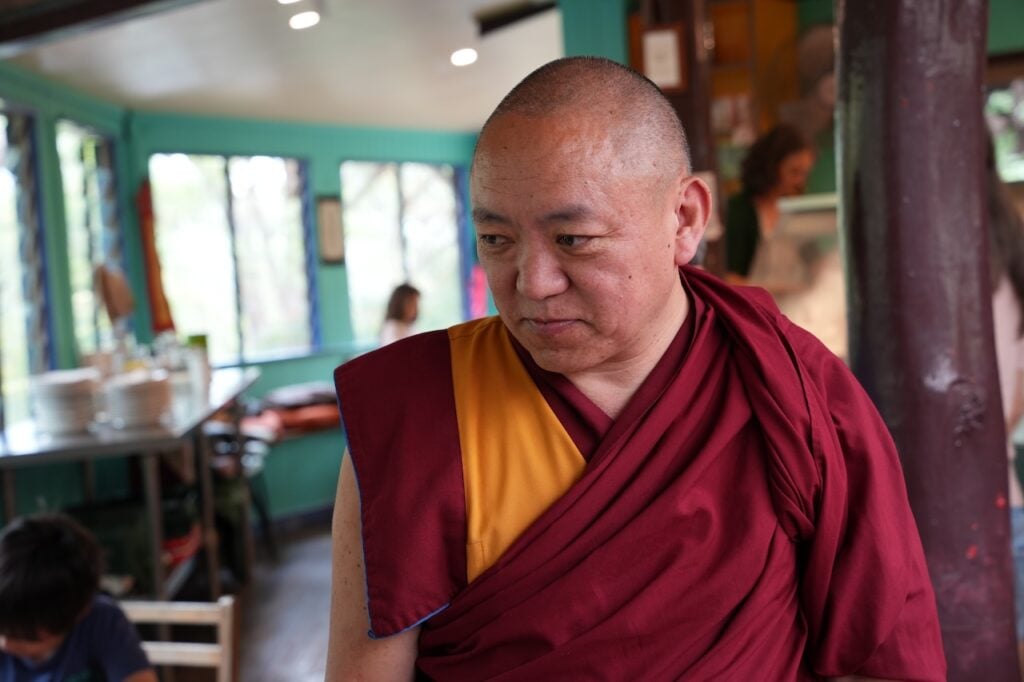
What surprised me when I arrived at Chenrezig Institute was the amount of work required to sustain such a centre. Organising teachings, maintaining the facilities, caring for visitors, cooking meals, running events, and preserving the teachings require an enormous amount of effort. During my four years there, I probably worked harder than at any other time in my life. Laypeople, nuns, and monks all contributed to keeping the centre running.
For me, this was perhaps the most tangible expression of the Buddhist teachings on interdependence. The centre exists because of the efforts of countless people. No single person created it. It is the result of thousands of acts of generosity, dedication, and cooperation over more than fifty years.
At the same time, my experience also taught me that these teachings are not abstract ideals that are simply achieved once and for all. They are something we continually try to practise. Like any human community, Chenrezig Institute is made up of ordinary people, each with their own strengths, limitations, aspirations, and challenges. The interesting question for me was never whether we perfectly embody the teachings, but how we try to bring those teachings into everyday life.
This is why I was drawn to this story. It is not simply a story about people rejecting mainstream society. It is a story about people attempting to create a community based on values such as wisdom and compassion, and about what happens when those ideals are tested in real life over decades.
As Ven. Kartson says in the film: “Our goal is to develop a heart with compassion and to be of benefit to others.”
BDG: Visually, how did you capture the contrast between the seekers’ rejection of conventional lifestyles and the creation of a new spiritual environment? Were there specific cinematographic techniques—framing, light, or landscape—that you used to evoke the sense of an alternative world being built?
MOD: In the film, I used many archival photographs generously shared by the Lama Yeshe Wisdom Archive and Chenrezig Institute. For me, they were a true treasure trove of knowledge and a powerful way to capture the spirit of the 1970s.
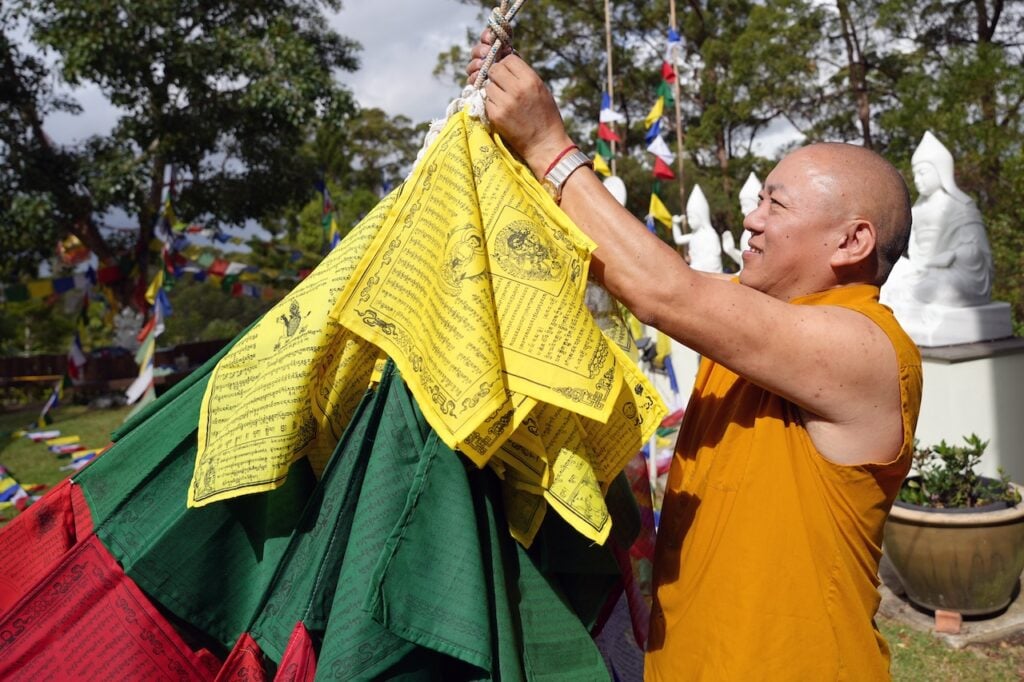
I juxtapose these archival images, which document the organic beginnings of the institute, with footage that I filmed myself of contemporary life at Chenrezig Institute. The first course took place in 1974. It was organised by Kathy and Tom Vichta and attracted around 200 participants. The course lasted for a month. People lived in tents and in simple huts they had built themselves. These archival images are contrasted with scenes of the institute today: the beautiful Garden of Enlightenment, the gompa, the café, and the life of the contemporary community.
Because I lived at Chenrezig Institute for four years, I was able to film not only the buildings and landscapes but also the everyday life of the community. I think this visual contrast tells its own story. Through these images, viewers can see what grew out of those early efforts. What began with tents, simple buildings, and a handful of idealistic seekers has become a thriving spiritual centre that has endured for more than fifty years.