
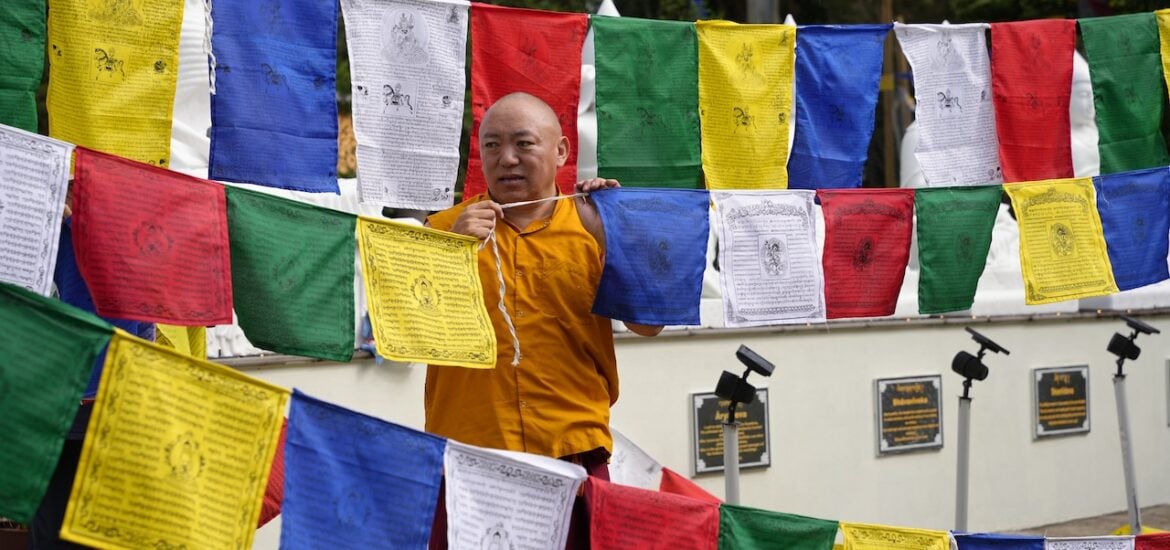
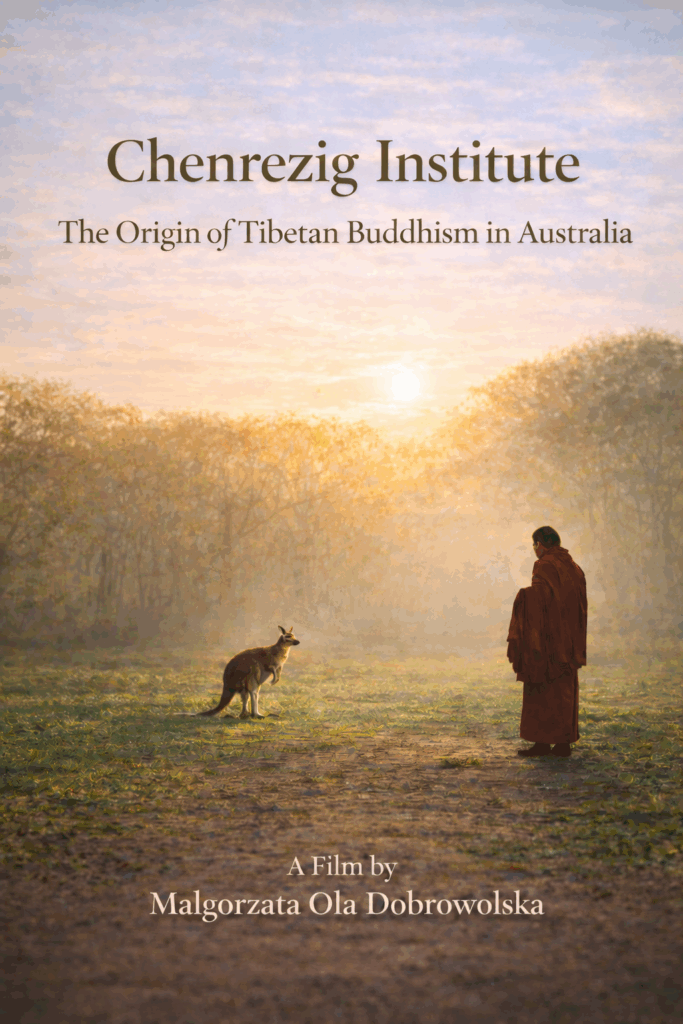
Chenrezig Institute: The Origin of Tibetan Buddhism in Australia is a feature-length documentary by Małgorzata Ola Dobrowolska, which charts the establishment of the first Vajrayana Buddhist center in Australia in the 1960s and 70s. The new movie won the Winner Award in the Spiritual Film category at the Love Peace and Freedom Film Festival in Naples in August. It will also be screened in person at the 13th Global Conference on Buddhism Kraków, Poland on 6–8 November 2026.
BDG: With reference to Buddhism spreading in Australia, itself a specific country in the broader “West,” how did you use this case study to explore broader questions about cultural transplantation—what happens when seekers import a spiritual tradition to redefine their identity and community?
MOD: Perhaps it would be best if I could provide a few illustrative examples.
Arrival: Ordinary people, extraordinary impact
One of the things that inspired me most while making this film was meeting ordinary people who ended up making extraordinary history. These are the people who became the protagonists of the film, and I felt very privileged not only to interview them but also to spend time with them and hear their stories firsthand.
I was particularly touched by the story of Kathy and Tom Vichta, who were among the four donors of the land on which Chenrezig Institute was established. What strikes me about their story is how much can begin with a single, simple question.
After attending a teaching at Kopan Monastery in Nepal, Tom asked Lama Yeshe:
“Would you be interested in coming to Australia?”
Lama Yeshe replied:
“Give me a ticket and I’ll be there.”
Fifty years later, we can see the consequences of that conversation. One question eventually contributed to the establishment of the first Tibetan Buddhist centre in Australia, which has influenced thousands of lives and played an important role in the development of Tibetan Buddhism in the West.
When we read history books, we often learn about major movements and historical forces. We know about the Hippie Trail, the counterculture movement, and the spread of Eastern spirituality to the West. But what interested me was how these large historical changes actually happened in practice. What were the small steps, personal decisions, and human encounters that made them possible?
Through the stories of people like Tom and Kathy, I wanted to show that history is often shaped by ordinary people taking brave steps. In the film, Kathy describes how they organized the first Tibetan Buddhist course in Australia in 1974, managing to arrange a retreat for around 200 people and helping to create the conditions for Tibetan Buddhism to take root in Australia.
What I find inspiring about this story is that it reminds us that ordinary people can have an extraordinary impact on the world. Today, many people feel powerless or do not believe they can influence the course of events. Yet the history of Chenrezig Institute shows the opposite. It shows how individual actions, when combined with a larger movement, can create consequences far beyond what anyone could have imagined at the time.
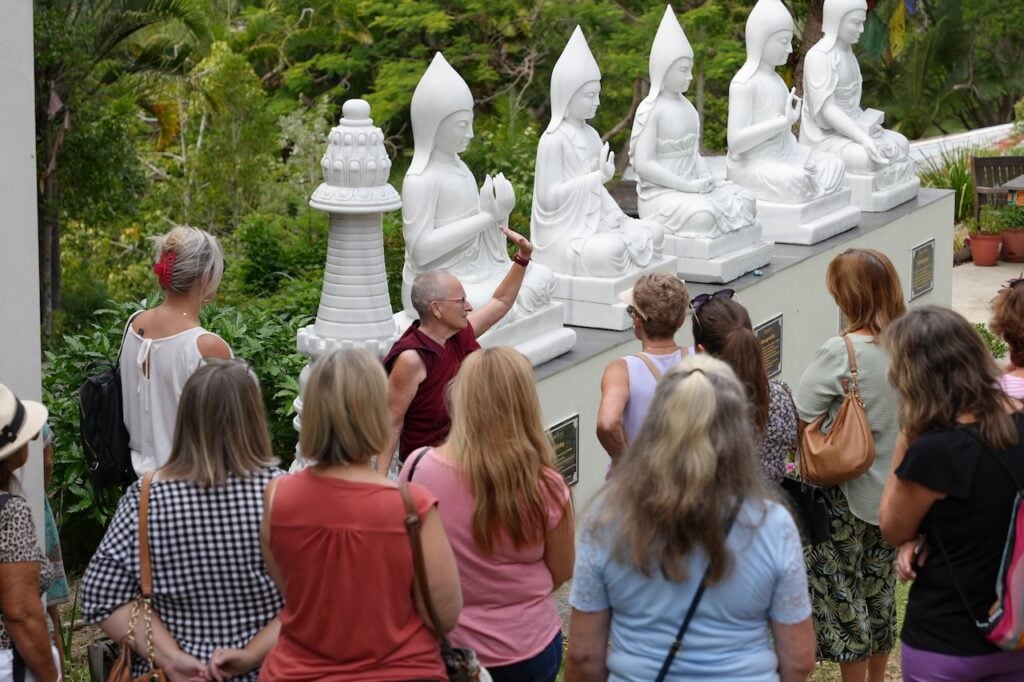
Another aspect that fascinates me is that this was very much a grassroots movement. In many earlier chapters of Buddhist history, the spread of Buddhism was often supported by kings, political leaders, or state institutions. In Tibet, for example, Buddhism was introduced with the support of kings and royal patronage.
The story of Chenrezig Institute is very different. Here, it was not kings or governments who brought Tibetan Buddhism to Australia. It was travellers, seekers, volunteers, and ordinary people who encountered these teachings and felt inspired to share them with others. That contrast is something I find deeply moving and one of the reasons I wanted to tell this story.
A king in a palace versus a hippie in a van
Often when I think about this historical contrast, an image comes to my mind: a powerful king living in a palace versus a hippie traveling in a van.
In the 8th century, the Tibetan king Trisong Detsen invited powerful masters from India, such as the abbot Shantarakshita and the great yogi Padmasambhava (Guru Rinpoche). They ordained the first Tibetan monks and founded the first monastery (Samye), giving birth to what we know today as Tibetan Buddhism. In Australia, it was Tom Vichta, who was traveling the world with Kathy and their little baby in a van, who invited Lama Yeshe, giving birth to what we know today as Tibetan Buddhism in Australia.
As Venerable Robina, one of the protagonists in the film, said: “The Tibetans got it from India, and they were able to internalize it in their culture. So, we need to do the same thing.”
The Spiritual Revolution of the 1960s and 70s: A Community Born from the Meeting of East and West
This all happened during a unique moment in history. The 1960s and 70s saw an unprecedented movement of young Western seekers travelling through Asia along what later became known as the Hippie Trail.
In many ways, it was a grassroots spiritual revolution. People were not waiting for institutions, governments, or religious authorities to introduce new ideas. They were discovering them directly through travel, personal encounters, and lived experience.
Ideas that had once been largely confined to particular regions of Asia suddenly began spreading across the world at remarkable speed.
If we take a moment to reflect on the title, it already tells us a great deal about the story: Chenrezig Institute: The Origin of Tibetan Buddhism in Australia.
The title itself contains an extraordinary convergence of cultures and histories. Tibetan Buddhism, a spiritual tradition that developed in Tibet, was introduced to Australia largely through Western seekers inspired by the counterculture movement. And all of this unfolded on First Nations land, which already held its own spiritual traditions and history stretching back tens of thousands of years.
I often wished I had been alive during those times. I’m sure I would have become a hippie. I would have travelled the Hippie Trail, meeting spiritual teachers and fellow seekers along the way, discovering ancient wisdom traditions that were just beginning to find their way into Western culture.
Whatever the case, I feel that the spirit of those years still lives on in many of us. We are living not only with the cultural but also the spiritual legacy of the 1960s and 70s. It was during that period that Buddhism, yoga, meditation, and Eastern philosophies began to enter Western consciousness on an unprecedented scale. The Hippie Trail, often called a spiritual pilgrimage, became one of the great bridges through which this exchange took place.
Like any revolution, the counterculture had its shadows and contradictions. Yet it also opened doors that transformed the spiritual landscape of the West in ways that continue to shape our lives today.
Making this film allowed me to reconnect with that deep longing and to witness, first-hand, a community born from that extraordinary meeting of East and West. It gave me the opportunity to look closely at one of the living legacies of that era: a community that emerged from a generation of seekers searching for something beyond the values of mainstream society and finding it in the teachings of Tibetan Buddhism.
First Nations Country
From the very beginning, I was deeply interested in the heritage of the land on which Chenrezig Institute stands, acknowledging it as First Nations Country. I was acutely aware that we were living on Country with a history stretching back over 65,000 years, home to the oldest continuous living culture on Earth, with extraordinarily rich and deep spiritual traditions.
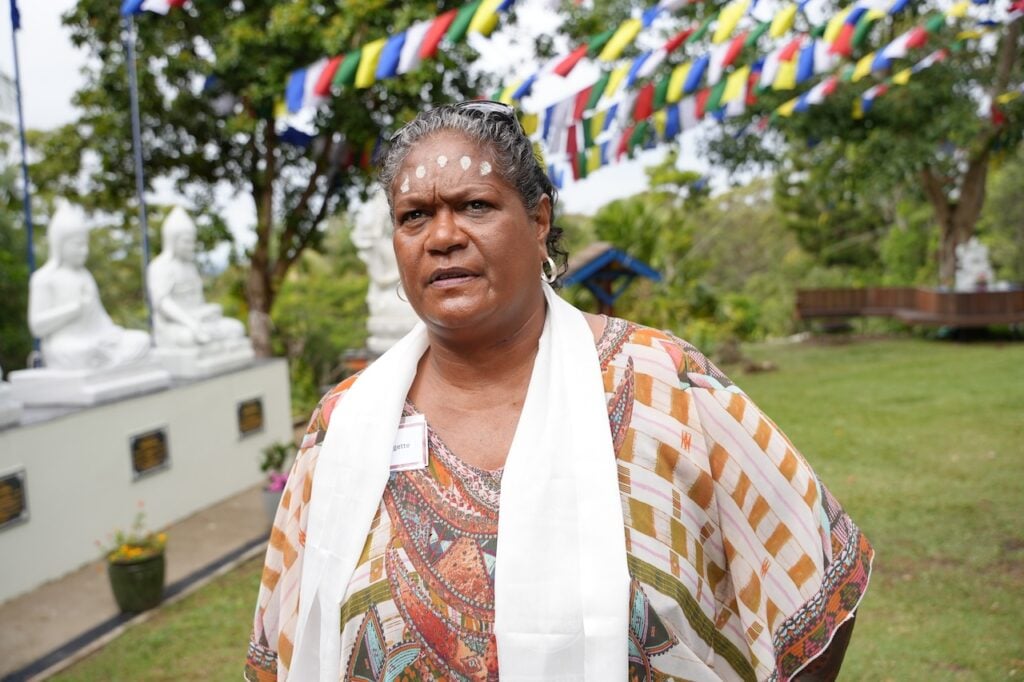
I wanted to learn the story of this land from a Traditional Custodian connected to it, but finding the right person required time and patience. It took me about two years of attending First Nations events, connecting with community members, and seeking someone who could share this perspective.
Finally, I met Aunty Bridgette Chilly Davis, a Law Lore Woman of the Mooloolah Kabi Kabi, who generously shared this history in an interview. I was deeply grateful that, in the final days of my four-year stay at Chenrezig Institute, I was able to listen to and record this vital part of the narrative from an esteemed Traditional Custodian.
Including the First Nations history of Country in the film was essential to me as a way of paying respect to this sacred culture. It also gave me a much deeper understanding of the dynamics within the Chenrezig Institute community itself.
Full ordination for women
Another important aspect of the transmission of Tibetan Buddhism to the West is the issue of full ordination for women. For me, this is one of the most interesting examples of what happens when a spiritual tradition moves from one cultural context to another.
The counterculture movement of the 1960s and 1970s was not only about spirituality; it was also closely connected to broader social movements, including the women’s movement and the growing push for equality between men and women. When Western seekers encountered Tibetan Buddhism, they also encountered a tradition that had developed within a very different cultural context.
For centuries, an institutional and widely recognized lineage of full ordination for nuns (gelongma or bhikṣuṇī) was unavailable within the Tibetan Buddhism tradition. As one of the nun in my film shares, even the most experienced, dedicated, and scholarly women can spend their entire lives at the “novice” level, regardless of their realization or leadership roles. To receive full ordination, pioneers like Venerable Robina Courtin historically had to step outside the Tibetan lineage and travel to East Asia to receive vows within the Chinese Dharmaguptaka tradition.
While historic breakthroughs have occurred recently within the broader Himalayan world, most notably the landmark mass bhikṣuṇī ordinations in Bhutan in 2022 and 2025, these events remain a localized exception under the specific authority of the Bhutanese lineage. They do not signify a universal acceptance across all schools of Tibetan Buddhism. Within many traditions, including the one followed by Chenrezig Institute, the institutional resolution remains a complex and unresolved challenge, requiring immense patience from Western and Himalayan women alike.
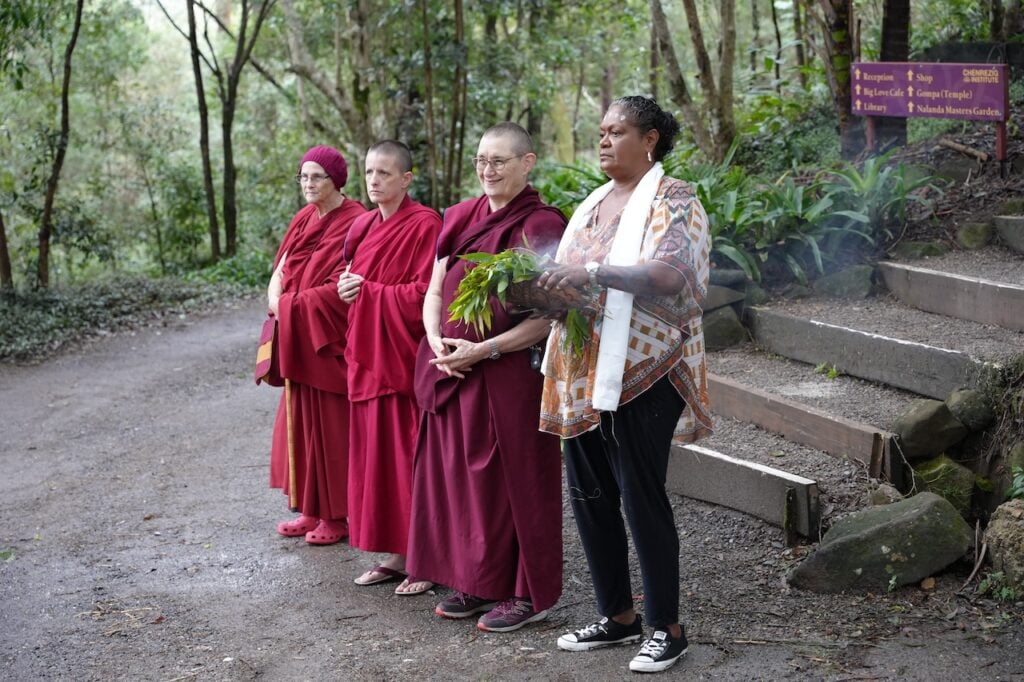
Many people are surprised to learn that full ordination for women was historically missing from the institutional landscape of the Tibetan tradition. Because there are nuns wearing robes and living monastic lives, many assume that women and men have exactly the same opportunities within the monastic system. In reality, the situation is more complex.
I felt it was crucial to include this topic in the film because it represents a much broader question: how can an ancient spiritual tradition adapt to new cultural realities while remaining true to its roots? For me, this is not simply a debate about rules or institutions. It is one of the most important questions raised by the transmission of Tibetan Buddhism into Western societies.
Strong Role of Women
Another aspect of the story that I felt was important to highlight was the role of women in the transmission of Tibetan Buddhism to the West.
When we think about this history, we usually think of great teachers such as Lama Yeshe and Lama Zopa Rinpoche. But while making the film, I became increasingly aware of how important women were in making this story possible.
Lama Yeshe’s first Western student was Zina Rachevsky, a Russian-born French-American socialite, film actress, and later a Gelug Tibetan Buddhist nun. She played a key role in introducing Lama Yeshe and Lama Zopa Rinpoche to Western students.
I was also deeply moved by the story of Ven. Anila Ann McNeil. Shortly after the first course and the consecration of the land of Chenrezig Institute, Lama Yeshe asked her to stay and be a teacher. As Tom Vichta recalls in the film, he offered her a more comfortable place to live, but she replied:
“Tom, it’s never going to happen if we do that. We have to start here, and we have to be here.”
So, she remained there with a group of hippies, living without water or electricity and helping to build the community and develop Chenrezig Institute.
For me, these stories highlight something that is often overlooked. We all know the names of Lama Yeshe and Lama Zopa Rinpoche, and rightly so. But the growth of the early FPMT community also depended on the dedication, courage, and hard work of many women. Without them, this story would have looked very different.
Małgorzata Ola Dobrowolska is a Polish documentary filmmaker whose work explores themes of spirituality, culture, and social transformation. She lived and worked at Chenrezig Institute in Australia for four years, where she served as Multimedia Coordinator and documented the community’s history in the film Chenrezig Institute: The Origin of Tibetan Buddhism in Australia.Her award-winning feature-length documentary, Bhikkhunī – Buddhism, Sri Lanka, Revolution, explores the revival of women’s ordination in Theravāda Buddhism.