
By Rebecca Wong, Himalayan Correspondent
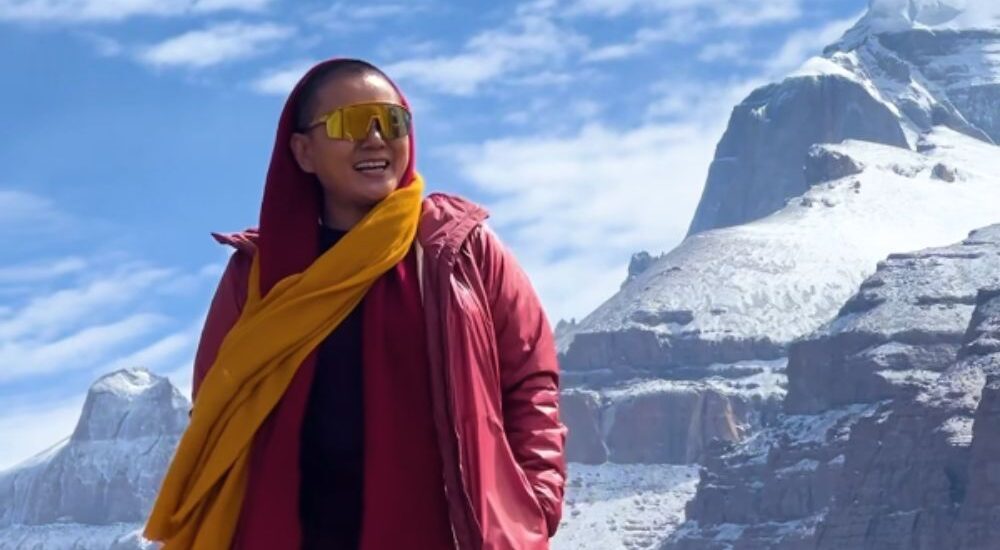
From my desk overlooking the ocean in this red hot summer, I watch the screen, mesmerised. There she is—Ani Choying Drolma, the world‑famous singing nun—circling the sacred slopes of Mount Kailash in this once‑in‑a‑lifetime Fire Horse year. I am not there. My feet are planted firmly by the salty shore, but my heart—my heart is tracing every step she takes, because I have walked that path before. Twenty‑four years ago, in the Water Horse year of 2002, I stood where she stands now. And now, as her voice rises through the thin Himalayan air, it carries the echo of the humming I left behind on that mountain.
Just weeks ago, Ani Choying was traversing the length of Nepal, from Mechi in the east to Mahakali in the west, as part of the “Mechi‑Mahakali National Rescue Journey.” Under her foundation, she and 26 volunteers rescued over 159 street‑dependent people, offering them shelter, dignity and a second chance. “There is no greater religion than serving humanity,” she said. Now, having fulfilled her earthly duty, she has turned her gaze skyward—to the mountain that calls every pilgrim home.
And this is no ordinary year. The Fire Horse year comes only once in 60 years, an ultra‑rare convergence within the 12‑year Tibetan animal cycle. Tibetan Buddhists believe that a single kora (circumambulation) in any Horse year multiplies its merit twelve‑fold—but in a Fire Horse, that power is magnified beyond measure. Pilgrims from across the Himalayas have flocked to Kailash, calling 2026 the “Mahakumbh of the Himalayas.” For many, one circuit now is worth a lifetime of prayers.
Three angles of Kailash reveal themselves to the pilgrim—physical, historical and sacred.
Physically, the mountain is the epicenter of Asia’s lifeblood. Four of the continent’s mightiest rivers—the Indus, the Sutlej, the Brahmaputra and the Karnali—have their sources within its shadow. From this single pyramid of snow and stone, water flows to nourish half a billion souls. Ancient peoples called it the “navel of the world.”
Historically, Kailash bears the scar of a cosmic clash. Hindu scripture tells of Ravana, the demon king of Lanka, who tried to uproot the mountain. But Lord Shiva, who resides there with Parvati, pressed Kailash back into the earth and pinned Ravana beneath it. The deep gash on Kailash’s southern face is said to be the mark of that divine struggle—good against evil, carved into the rock for eternity.
Spiritually, for Tibetan Buddhists, Kailash is Mount Meru—the axis of the universe, the centre around which all creation revolves. The sun is Kailash; the moon is Lake Manasarovar. Together they embody wisdom and compassion. Kailash is also seen as Mount Mercury, a bridge between heaven and earth, the abode of Chakrasamvara.
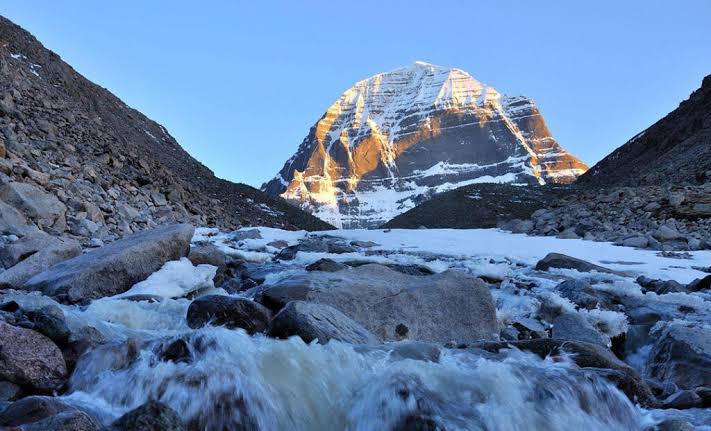
Twenty‑four years ago, I was young, my heart full of questions, my mind full of noise. I climbed toward Drolma La Pass at 5,630 meters—the highest point of the 52‑kilometer kora. The air was so thin that every breath felt like a prayer. But the sound that filled that semi‑heavenly space was not struggle—it was devotion.
Om mani padme hum.
Thousands of pilgrims chanted together, their voices rising like incense to the white clouds. And there, unmistakably above my head, I saw them—divine bodhisattvas sitting on those clouds, their mandalas glowing with impossible colours. The sun blazed directly overhead, its light so bright it seemed to shine through me, clearing every shadow I had ever carried. The snow under my feet melted all my fears. What was left was just me—pure, empty. That single kora, in that Water Horse year, was said to cleanse the sins of a lifetime. I did not fully understand it then. I only felt it—in my bones, in my breath, in the tears that froze on my cheeks.
Now, from this humid heat, I watch Ani Choying walk that same path. Her voice—that unmistakable, angelic chant—fills the live broadcast from Kailash. And as she sings, I hear something else: the faint hum of all those who came before her, including me. The humming I left on the mountain 24 years ago is still there, caught in the prayer flags, woven into the wind. She is not singing alone; she is singing with every pilgrim who ever circled that sacred peak—and I am among them, even from this distance by the sea.
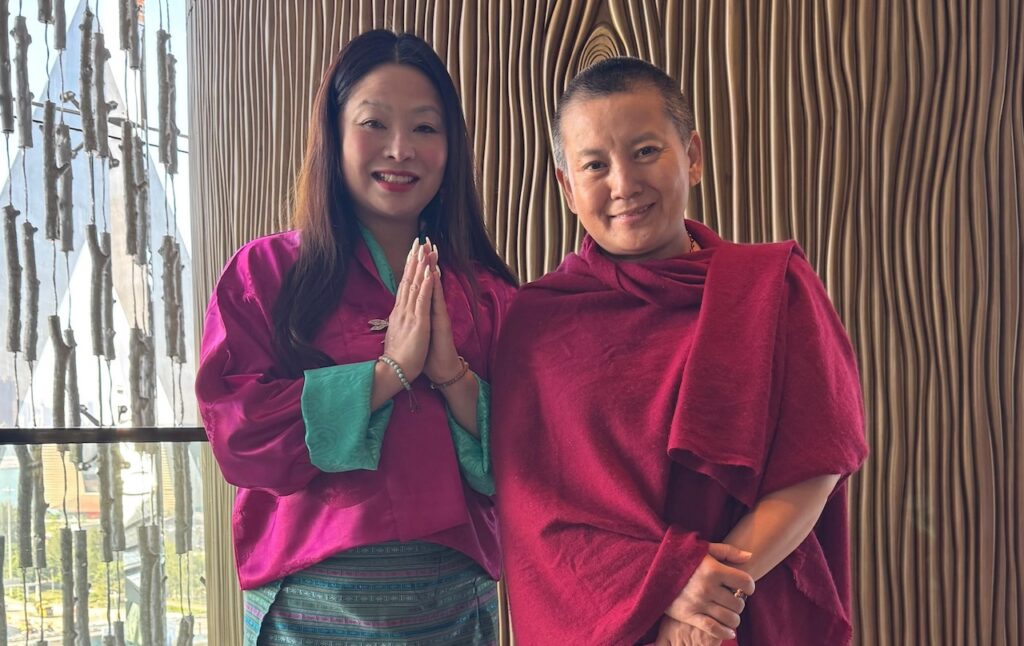
At Drolma La, Ani pauses. Instead of leaving behind a scarf or a flag, she reaches into her bag and takes out a handful of food. With a gentle smile, she scatters it onto the snow for the birds—the hardy ravens and snow finches that have accompanied every pilgrim on this kora, their own calls mingling with the chants of the faithful. They have been here since the beginning, witnessing devotion, meeting each circumambulator with their fluttering wings. Ani offers them this small act of kindness—a reminder that even the smallest beings are part of this sacred circle. The birds descend, pecking at the grains, and for a moment, their chorus rises to meet her song.
Below, Lake Manasarovar gleams like a mirror. Above, Kailash stands eternal.
I close my eyes and listen. Her voice echoes my humming—and in that echo, I am there again. The ocean breeze carries her chant across the miles, and even here, in the heat of summer, I feel the cold snow beneath my feet, the sun melting all my shadows.
Om mani padme hum.
Related features from BDG
Ani Choying Drolma: The Song of Dharma Meets Humanitarian Action