
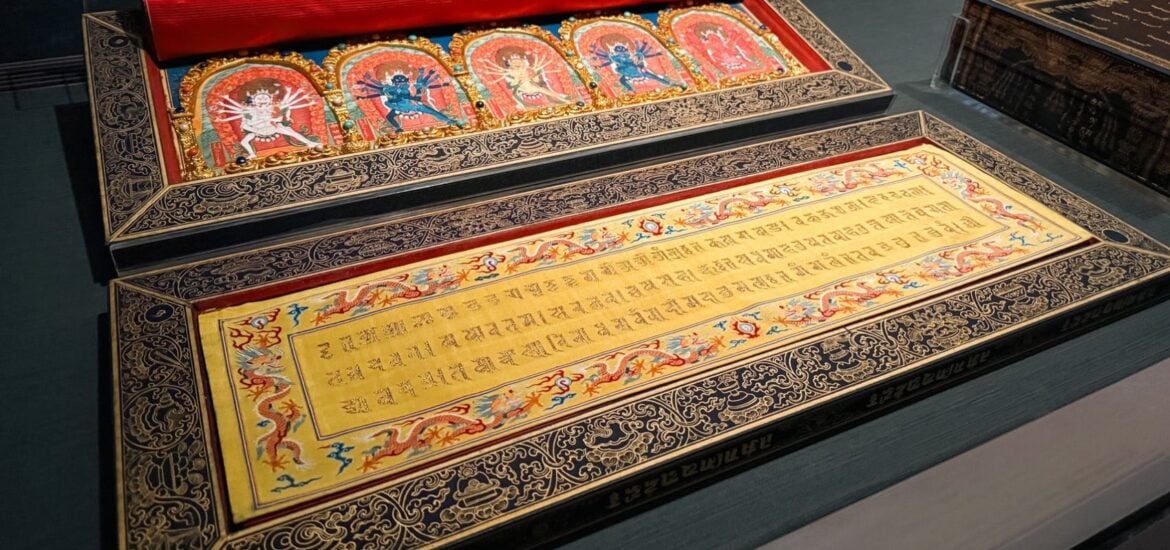
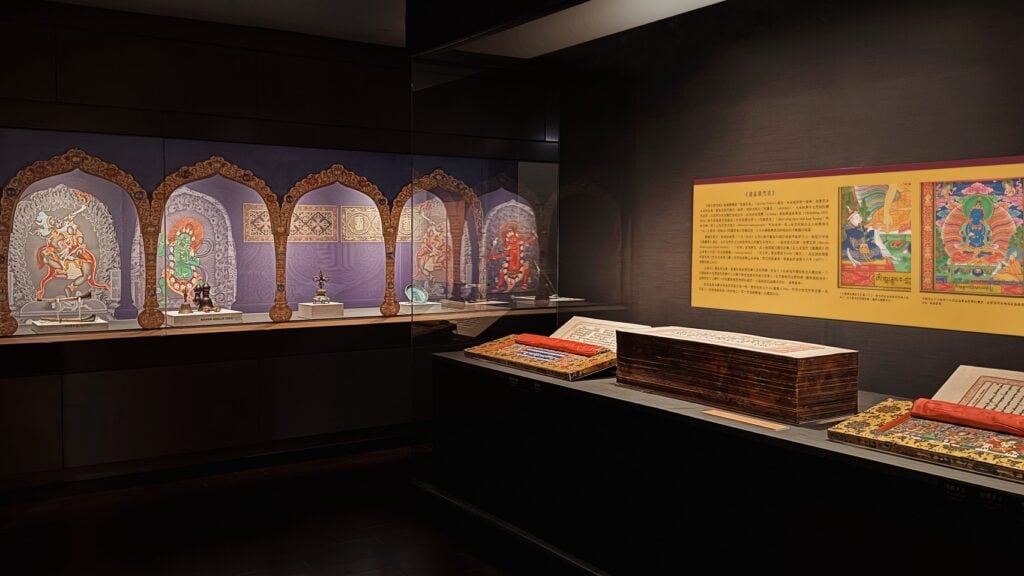
In 1667, at the age of fifty-four, the Grand Empress Dowager Xiaozhuang (1613–88) (born Bumbutai of the Mongol Khorchin tribe, grandmother of the Kangxi Emperor) commissioned one of the most magnificent Buddhist scriptures ever created. The result was the Tibetan Dragon Canon (longzangjing), a 108-volume Kangyur written in gold ink on indigo-dyed paper, completed in 1669 at a cost of over 400,000 taels of silver, with more than 170 monks and master artisans summoned to the Forbidden City for its creation. It is currently on display until 8 November at the National Palace Museum in Taipei, and is the Museum’s most popular exhibit currently (with lines of visitors waiting over three hours to see it).
Conventional scholars and historians often frame the Tibetan Dragon Canon within the context of Qing imperial politics: a tool to “consolidate the political and religious alliance between the Tibetan, Manchus and Mongols. It was, as the cliché goes, “a grand project” to “consecrate early Qing dynasty power.” But does this reading too convenient? Too political?
Let’s look closer at the evidence. . . and get to the heart of the woman who ordered it.
A tradition of royal female piety
The Empress was hardly the first royal woman to commission sacred texts. In the Tang dynasty, Empress Wu Zetian commissioned the copying of thousands of Diamond Sutras and Lotus Sutras for her deceased parents. In the long-lost Western Xia empire, exemplary members of the imperial household like Empress Luo and Empress Wang both sponsored the translation and copying of entire Buddhist canons.
These were acts of merit-making, the accumulation of spiritual capital through devotion to the Three Jewels. In Buddhist tradition, copying sutras, building stupas, gilding statues, and commissioning thangkas are all recognized paths to accumulate merit for Buddhist patrons.
But Xiaozhuang’s Kangyur is something else entirely.

An artistic masterpiece of unparalleled splendor
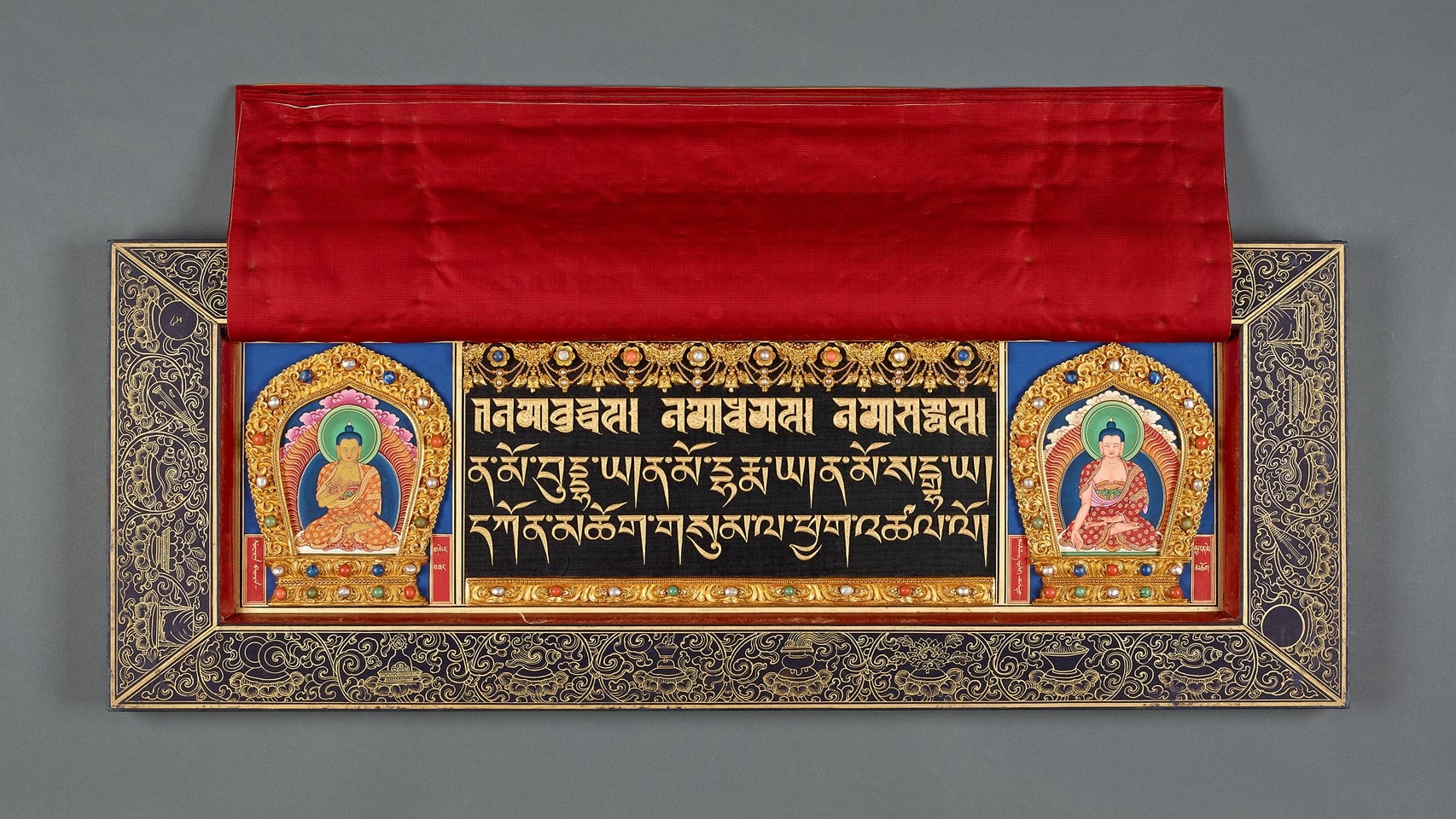
The artistic execution alone suggests something deeply personal. According the National Palace Museum curator Liu Kuo-Wei, the calligraphy is believed to come from the Amdo region of Tibet, renowned for its distinctive script. The paintings on the protective boards are attributed to the Menri school—widely considered the finest tradition in Tibetan painting, founded by Menthangpa in the mid-fifteenth century also known as the Lhasa school. Every detail speaks of superlative craftsmanship: the gold ink on exquisite blue paper, the protective boards inlaid with pearls, coral, lapis lazuli, jade and turquoise, the deities surrounded by Golden Arches like palatial halos, the jeweled necklaces and yingluo (ornamental garlands) adorning the sacred figures. The entire Kangyur is wrapped in three layers of yellow silk brocade embroidered with seven-clawed dragons, then bound with five-color binding cords. It is, as the curators themselves admit, the grandest imperial Kangyurs ever exist.
Hidden in the “holy of holies”
A basic observation undermines the political interpretation: this treasure never seems to have been displayed. According to curator Liu Kwok-wei, there is no record of the Dragon Canon being exhibited or shown publicly after the Empress’s death. It was rediscovered only after surviving a palace fire, stored in the Empress’s private quarters at Cining Palace. The canon was housed alongside a life-sized golden statue of Shakyamuni, the walls lined with hanging thangkas. This was not a reception hall for visiting dignitaries. It was an altar—a private shrine.
If the Kangyur were meant to impress Mongolian and Tibetan nobles, to convince them of Qing benevolence and strength, would it not have made far more sense to build a great white stupa in Beijing, or a replica of Ganden Monastery where all could see, touch, and visit? Would it not have been displayed at the annual royal hunts where all tribal leaders gathered? There are no records of any such display.
The Empress’s palace was off-limits to men; only eunuchs could enter. Placing the Kangyur in this part of the Forbidden City was like hiding it in the holy of holies of an Egyptian temple: reachable only by the divine.
A grandmother’s heart
Xiaozhuang was a Mongol woman who had entered the Manchu court as a teenager, borne a son who became emperor, guided a grandson who would become one of China’s greatest rulers. By 1667, she was a grandmother of fifty-four, a widow who had outlived her husband and seen her son die young. What did she want? What did she need?
She wanted to pay homage to the Three Jewels in the most magnificent way imaginable. She wanted to say: “Throughout history, many have revered You, but I am the fondest of them all.” She understood that there are 84,000 ways to practice the Dharma, and she chose to copy the Kangyur in gold, adorn it with the most precious jewels she could find, and store it within her own palace, where she could protect it and be protected by it.
In the West, we have female art patrons like Peggy Guggenheim, but their devotion is to art itself. Xiaozhuang’s devotion was close to her heart, inward, and deeply personal.
This Kangyur was not a political tool. It was a grandmother’s prayer, an empress’s offering, a woman’s intimate conversation with the divine: hidden from the world, meant only for the eyes of the Buddhas.