
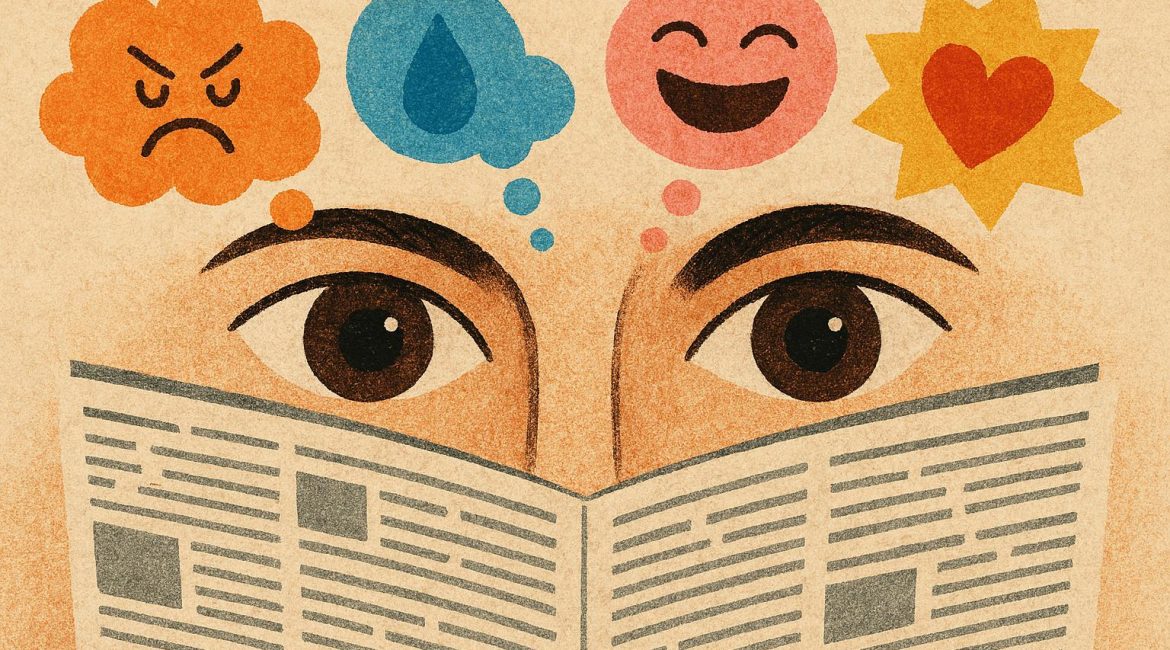
Reading the news away from my home country jolted my perspective in ways I could never have foreseen otherwise. It was like when monks vanish into the forest—not to hide, but to strip away distractions and confront the raw realities of life.
I thought I understood the world, but I didn’t.
Stepping back revealed new ways of seeing—not just the world, but myself.
If you’ve ever felt a quiet unrest after scrolling through the news, you know the peculiar sensation—like carrying a weight that didn’t exist before, even though nothing around you has changed.
We begin with the simple, innocent thought that we should stay informed. Yet more often than not we stumble away with a restless mind—the flicker of headlines still burning in our minds long after the screen fades to black.
The news is engineered to capture our urgent attention. It hurls us into a sea of fear, anger, and division. We grasp at promises of safety, shove aside what unsettles us, and confuse fragments for the whole.
The lowest-quality news—much of what churns endlessly on cable—focuses our gaze on the immediacy of the moment. It rarely compels us to consider the long arc of history. Instead, it stokes greed, anger, and delusion because those are the emotions that captivate us and keep the revenue flowing.
And yet, there is another way of seeing.
I’ve learned this on my travels across the world—literally breaking bread with strangers and sitting together in silent ease together. The distance conjured by a headline evaporates when we share in food, laughter, or silence. The “other” turns into a neighbor. The stranger reveals their true humanness.
We begin to see not just a face, but a living strand woven into the colorful cloth of humanity.
And when the heart opens further, a deeper truth rises: the person we brand as “enemy” today may once have been our brother, sister, parent, or child in another life—and could step into that role again in the future. Across lifetimes, our bonds extend and connect us in ways unseen.
A revered Ajahn once urged his students to ask: “Might the opposite be true?” That small question pries open the locked door of insight. It invites us to explore the space where nuance lives, where reality refuses to crudely sketch out the people for the headlines.
With this awareness, we begin to see differently. We seek out stories that acknowledge rather than inflame.
Letting go of compulsive news checking doesn’t mean abandoning the world’s suffering. It means arriving at it with a mind anchored and a heart unbounded.
We remember that the stories flashing on-screen aren’t faraway dramas. They are our stories—braided into the same human thread we’ve been weaving for lifetimes.
Releasing our grip on the endless current of toxic emotions with perspective, we rediscover the stillness inside.
Each person possesses a complexity that scripts fail to recognize. Rare are pure villains or flawless heroes. We each carry lights and shadows.
Yet the news—and politicians—often flatten us into cardboard cutouts that are built to serve agendas and sharpen divides.
When we meet each other as we are, we stand beyond those easy judgments. We look into one another’s faces without the filter of stories.
Yes, ultimately each of us must walk our own path and awaken through our own effort. No one can take that journey for us.
But it begins with a profound understanding of humanity, so we can truly comprehend the suffering we aim to free ourselves from.
And when we can see one another fully, awakening no longer feels abstract. It feels necessary. Urgent. Alive. Real.
Through that seeing, a quiet compassion takes root—quietly shaping the way we live, the way we encounter each other, and the way we walk our path.