
Hong Kong is rapidly positioning itself as a center for art, from its much-vaunted West Kowloon Cultural District to its attempt to attract big dealers, fairs, and expos to the city. Sometimes overlooked is the fact that these global trends and nodes are completely dependent on the inspiration and hard work of local people.
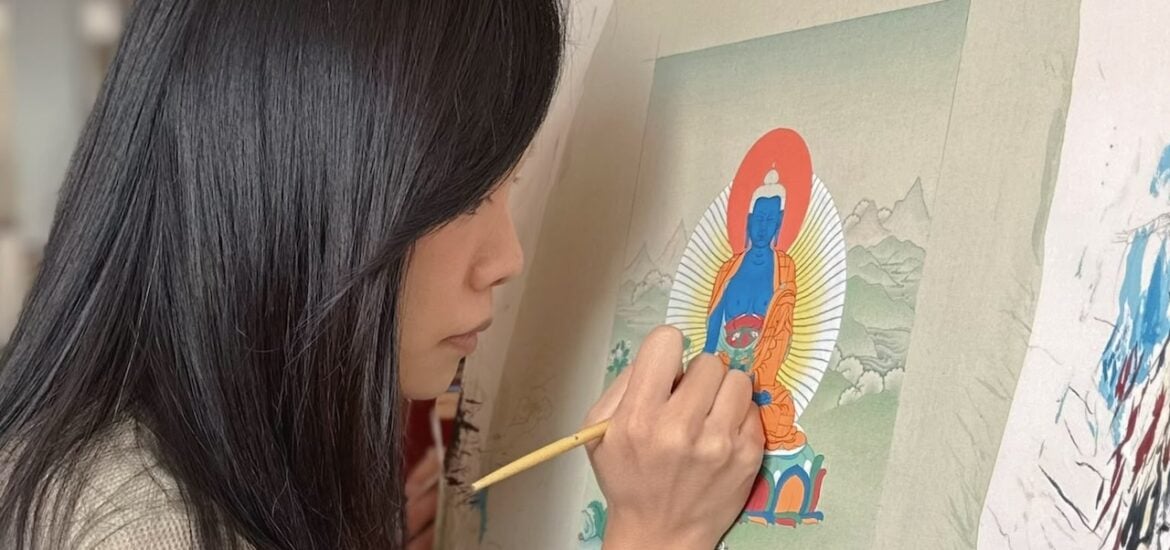
One exemplary instance is Chantal Fok Wai-chung, who has devoted herself to one of Buddhism’s most contemplative artistic traditions: the art of Tibetan thangka painting. Trained as a contemporary artist but deeply immersed in Buddhism and Himalayan artistic traditions, Fok occupies a unique position among Hong Kong’s cultural landscape, serving simultaneously as an artist, educator, and cultural bridge.
Fok graduated from the Chinese University of Hong Kong, where she earned a First Class Honours in Fine Arts. She later completed a Master of Arts in Fine Arts and pursued a Master of Buddhist Studies at the University of Hong Kong. Her artistic path took a decisive turn in 2014 when she travelled to Shangri-La in Yunnan to study traditional thangka painting.
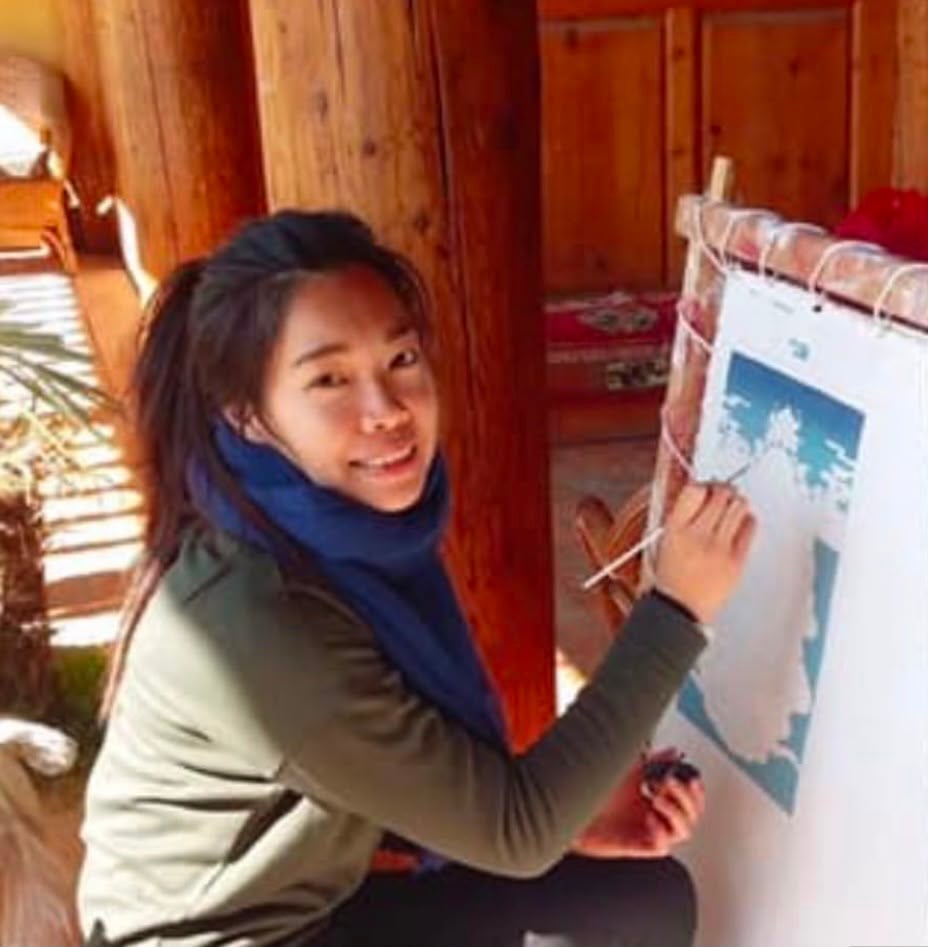
What began as an internship (although she was already a Buddhist) evolved into years of repeated journeys to Yunnan. Initially drawn in by artistic fascination, she later came to see thangkas as visual embodiments of Buddhist teachings. Her specific styles encompass not only the Regong and Shangri-La traditions, but also influences from Nepalese thangka styles.
Fok navigates two worlds: fidelity to the vocabulary of traditional thangka art, and her modern artistic education rooted in the cosmopolitan city of Hong Kong. Unlike many contemporary artists who appropriate Buddhist imagery merely for aesthetic purposes, Fok approaches thangkas as a living sacred tradition. She presents thangkas not as an exotic relic to be enjoyed or fetishized, but as a traditional and spiritual medium that can speaki to contemporary audiences.
“Traditionally, thangka painting is governed by precise iconographic rules inherited through a master’s lineage. This is what I was taught. I spent hours upon hours on getting right the proportions of a Buddha’s face, the positioning of the hands, the exact shade of colours, and even the surrounding motifs. All these are guided by established measurements and doctrinal meaning,” she said.
Her training included every stage of production: stretching and preparing the canvas, grinding mineral pigments, drafting sacred figures, and mastering the intricate, symmetrical lines and grids. She prefers hand-prepared surfaces and natural mineral pigments, which are time-tested methods that help the artworks last longer. Learning Buddhist philosophy also helped to transformed her understanding of thangkas.
Fok’s works might feel slightly different to that of a native Tibetan or Nepalese artist. Yet her pieces possess an authenticity rarely found among artists who don’t live among Tibetan communities, since they won’t always be able to retain that traditional touch.
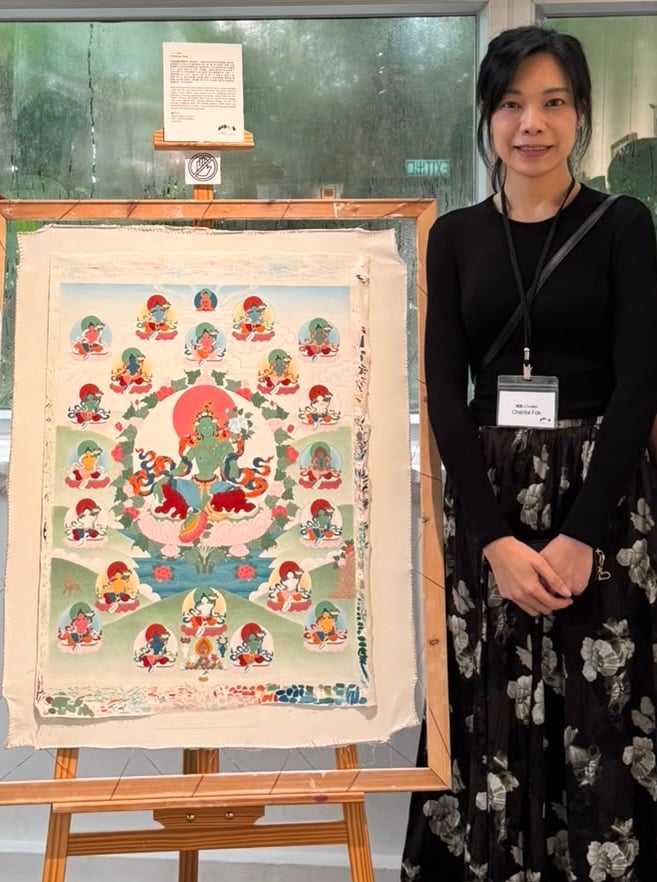
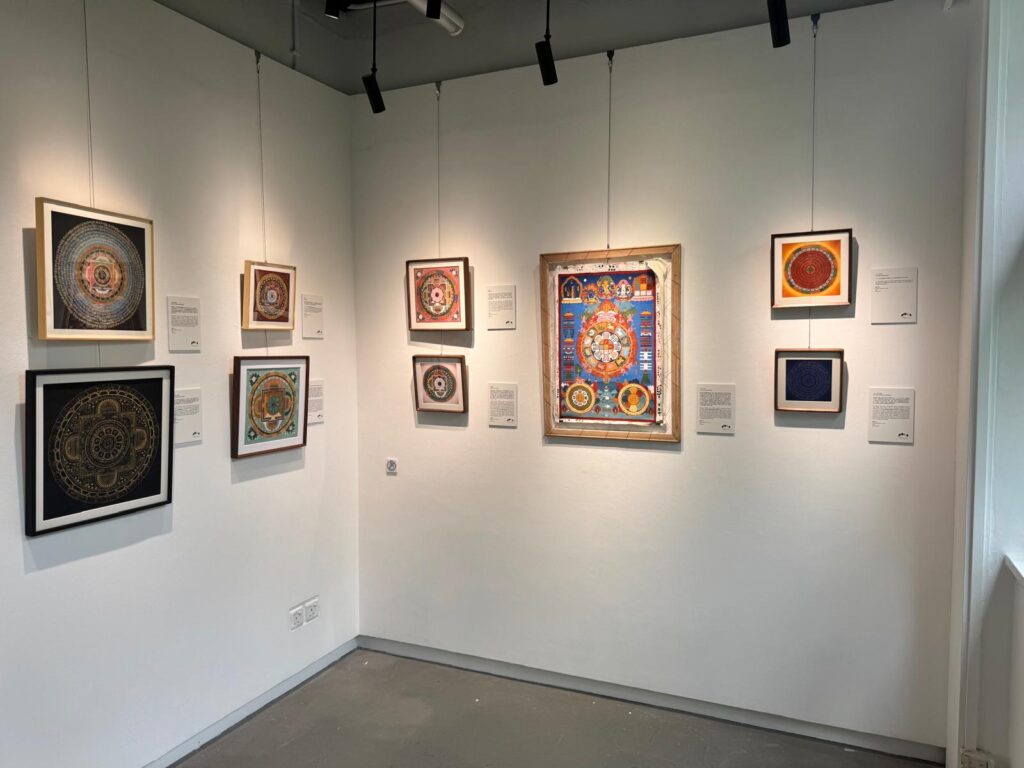
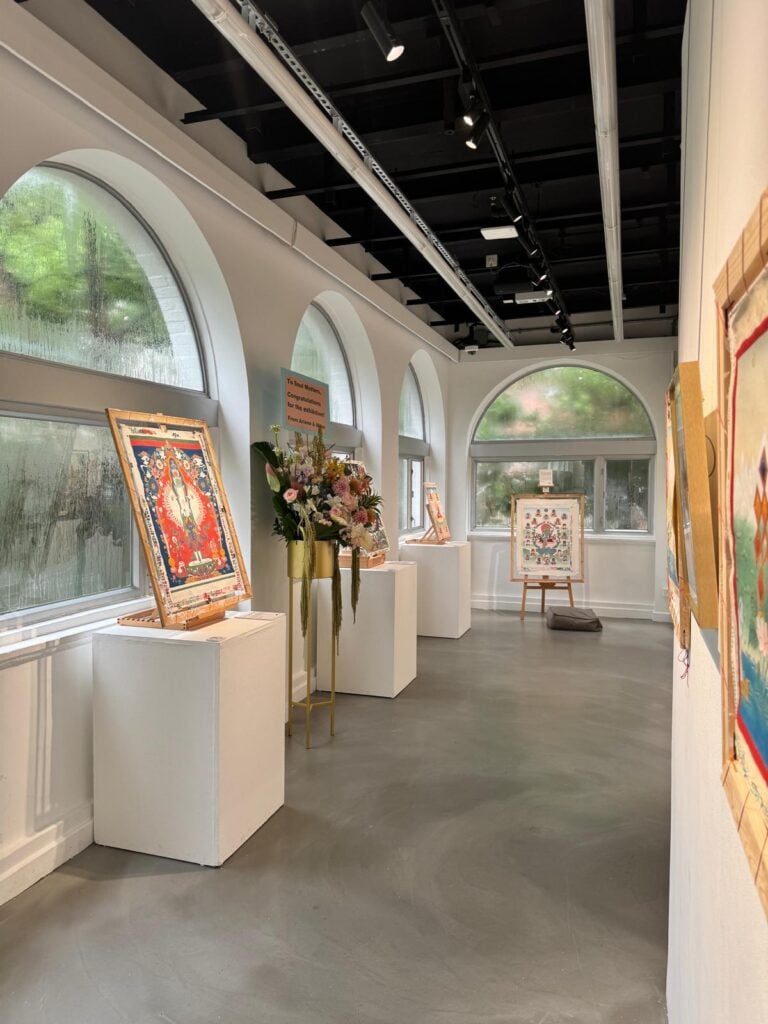
Fok’s recent exhibition at the Hong Kong Visual Arts Centre, “Bodhi Blossoms” (which ran from 16–20 July) showcased this distinctive synthesis of tradition and contemporary sensibility. Presented within one of Hong Kong’s most important public and respected spaces for art, the exhibition introduced visitors to the meditative precision and symbolic richness of thangkas and other Tibetan styles of art. Many of Fok’s works were on display, alongside those of her students. The exhibition highlighted her meticulous brushwork, luminous fields of color, and engagement with Buddhist iconography.
Fok is not only an artist, but she is also an educator She regularly leads workshops, lectures, and community programmes that introduce participants to the history, techniques, and philosophy of thangka painting. In doing so, she is helping to build a local audience for a tradition that has historically remained distant from mainstream Hong Kong artistic life.
Fok’s work reflects a broader cultural moment in Hong Kong, where interest in Buddhist heritage, Asian artistic traditions, and contemplative practices has grown alongside the city’s engagement with global contemporary art. By grounding her practice in authentic lineage training while presenting it in accessible public settings, she is becoming one of the territory’s most visible ambassadors for thangka art.
How can an ancient Himalayan tradition can find meaningful expression in 21st century Hong Kong? Fok, as a cultural mediator between Tibetan Buddhist visual culture and a modern urban audience, might have the answer. In a city defined by speed and reinvention, her paintings invite viewers into a slower world of contemplation, precision, and sacred symbolism. That invitation may be her most enduring contribution: showing that thangkas are living spiritual works capable of enriching Hong Kong’s artscape.