
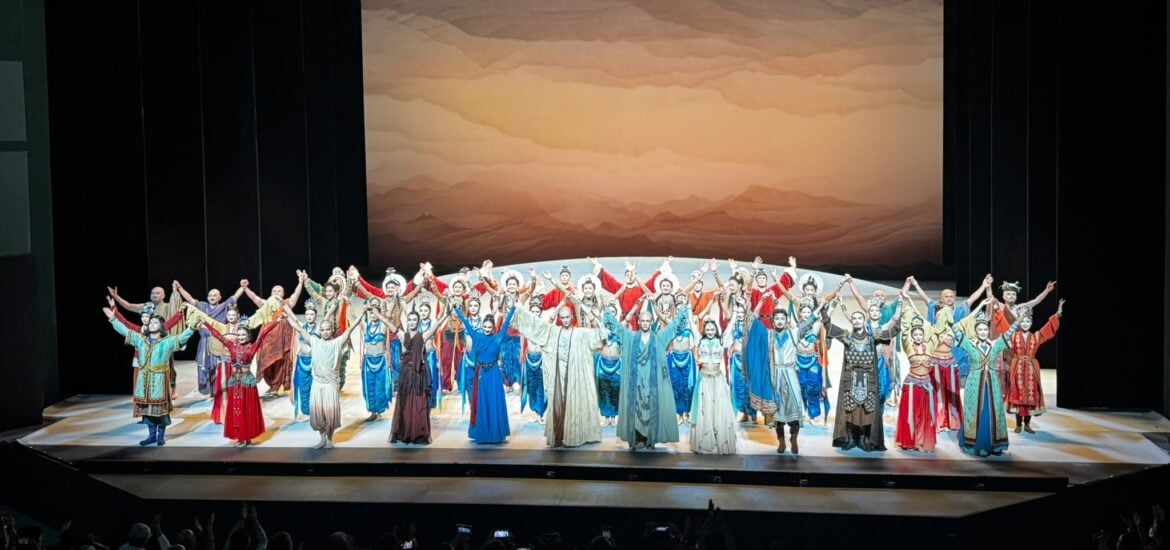
I recently watched a powerful and evocative performance called Qiuci, which retells the story of the Buddhist translator Kumarajiva (344–413) through Xinjiang-style contemporary dance. Qiuci is the Putonghua name for Kucha, his native homeland which is in present-day Xinjiang. It’s fitting that the barnstorming contemporary dance, harmonized with Buddhist aesthetics and themes, was brought to Hong Kong for 9–10 October by the Xinjiang Art Theatre Song and Dance Company and Xinjiang Normal University (as part of the Chinese Performing Arts Hong Kong Season at the Hong Kong Academy of Performing Arts).
The dance company is filled with eye-poppingly talented dancers (playing a diverse range of charismatic characters) who bring blazing passion and electric energy to a story framed by Kumarajiva’s spiritual Chinese successor, Xuanzang (602–64). The story is framed as such: Xuanzang travels to Kucha along his journey westward to India and encounters an ethereal encounter with the memories of Kumarajiva, who lived several centuries ago. His life is dramatized in a prologue, four acts, and an epilogue by the inimitable Tong Ruirui, one of the most acclaimed choreographers in China. He combines his dancers’ estimable talent with a scoring score and vivid props and stage backgrounds.
Tong constructs a drama that combines essential life facts from the monk’s life with motifs from Subashi Monastery and the Kizil Grottoes, Buddhist landmarks in modern-day Kuqa. Kuqa is the contemporary location of Old Kucha. Kizil’s murals depict scenes from the Jataka Tales, including “The Five Divine Beings Discussing the Way,” “Prince Sudāna Offers Himself to Feed a Tiger,” “The Bodhisattva Gives Up His Body to Save a Merchant,” and “The Monk Endures Insults Without Anger.” They describe the virtuous deeds and spirit of self-sacrifice cultivated by our world’s Buddha throughout his previous reincarnations.
In this theater production, Kumarajiva’s core relationships revolve around two women; his mother Jiva and his cousin Princess Ajiyemodi, whom he was forced to marry as an act of humiliating submission to Lü Guang, a warlord who became emperor of the Later Liang. Many beats of Kumarajiva’s life are shown, from his learning under six monastic preceptors (representing the Six Perfections) to being held as an effective prisoner by Lü for seventeen years. He and Ajiyemodi make the most of their relationship, with their initial forced marriage blossoming into a genuine bond that keeps them going amidst their relative helplessness amidst the hurly-burly of war and displacement across Central Asia and China. And his mother, Jiva, is constantly in his heart, even when he finally reaches Chang’an and becomes an elite translator there.
The Xinjiang Art Theatre Song and Dance Company is my new favorite dance company because they have demonstrated that they can bring Kumarajiva’s story (which isn’t exactly the first choice for many scriptwriters) to life in a most compelling presentation. Kumarajiva is celebrated for introducing many expressions in common Chinese lingo today, many of them Buddhist in origin. Qiuci is hopefully only the beginning of many more high-quality, high-budget productions about Buddhist monks in the history of Asian nations.