
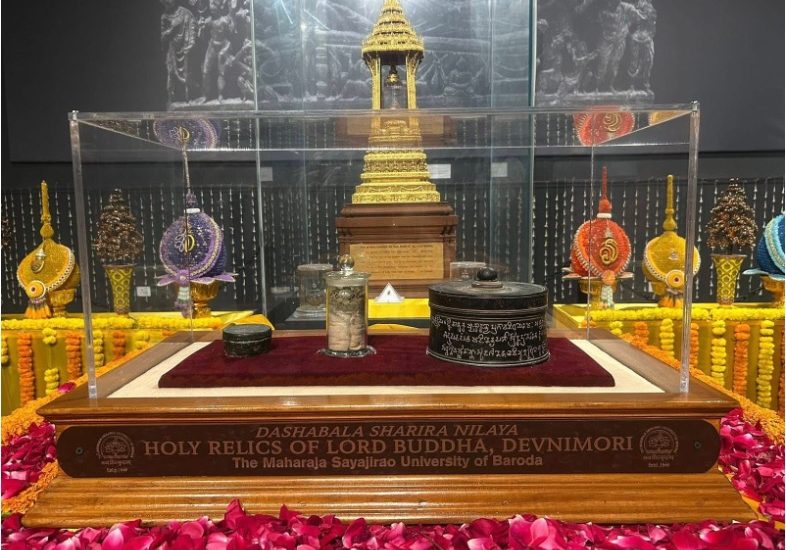
Background of the Exposition of the Buddha Relics
Gangaramaya Temple, Colombo—The Exposition of the Holy Relics of the Buddha has come to be recognized in recent years as an important instrument of cultural diplomacy, spiritual engagement, and people-to-people connectivity in Asia and beyond. Derived from an ancient tradition of Buddhist relic worship, this phenomenon goes beyond the narrow context of religious worship and is actually an act of collective memory, civilization re-endorsement, and international cooperation in the present context.
In this backdrop, the Exposition of Buddha Relics in Sri Lanka between 4–11 February 2026 is of tremendous historical, religious, and international significance inasmuch as, in Buddhist cultural environments, the relics of Buddha and his great disciples are not just revered as sacred objects but as living and dynamic portals of Buddha presence in history and as reflections of his teaching and enlightenment experience in the first place. These relics have historically been pivotal to the propagation of Buddhism as an ideology with sacred geography and identity. These are the same connections which, through transnational mobility in the modern era, have revived ancient connections responding to modern aspirations for intercultural dialogue.
India’s recent attempts at international relic sharing of the Buddha illustrate a renewed commitment to Buddhist diplomacy. The Piprahwa relics, kept at the National Museum in New Delhi, went to Mongolia in 2022. The event was in continuation of the historical and spiritual bonds between India and the Mongolian Buddhist world. Then again, in 2024, a set of the holy relics of the Buddha and his two chief disciples, Śāriputra and Maudgalyāyana, enshrined in Sanchi, one of most sacred sites of Buddhism, were taken to Thailand. This reinforced India’s civilizational links with Southeast Asia. This momentum continued with expositions in Vietnam during May of 2025, Bhutan in November 2025, and Russia in October of 2025.
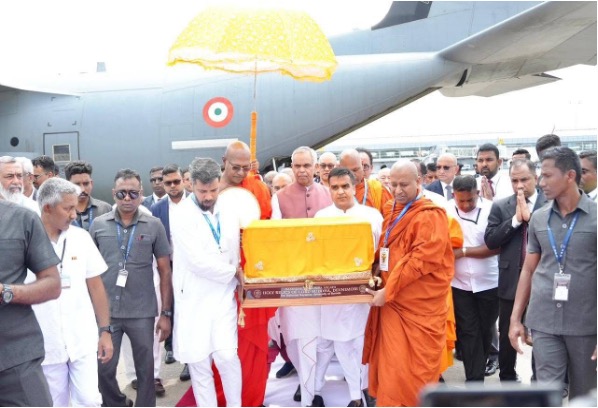
The exposure at each location drew huge public participation, reflecting the message of peace, compassion, and wisdom of the Buddha. These events demonstrated how shared sacred heritage can be used as a bridge between nations, enabling spiritual diplomacy as a supplementary track to formal political engagement.
In 2021, sacred relics of the Buddha from Sri Lanka’s Waskaduwa Sri Subuddhi Rajvihara Temple were brought to Kushinagar in October 2021 for a special exposition of profound religious and diplomatic import. These are a set of bone fragments and ashes associated with the famous Piprahwa relics, discovered in India in the late nineteenth century and later kept in the Waskaduwa Temple in Kalutara, Sri Lanka. Widely regarded as authentic corporeal remains of the Buddha, they were brought to India with full state honors to mark the inauguration of Kushinagar International Airport.
A high-level delegation, consisting of 123 members, led by the Cabinet Minister of Youth and Sports, Mr. Namal Rajapaksa, escorted the sacred relics to Kushinagar on the October 20, 2021. The delegation was comprised of a 12-member Holy Relic delegation, led by the Mahanayaka of the Waskaduwa Temple, along with the Anunayakas from the Asgiriya, Amarapura, Ramanya, and Malwatta Nikayas of Buddhism in Sri Lanka, depicting the collective spiritual significance and unity of the country and the Sri Lankan Buddhist Sangha. Their arrival coincided with the airport’s formal opening by Prime Minister Narendra Modi, underlining the event’s symbolic resonance for Buddhist heritage, pilgrimage, and cultural diplomacy.
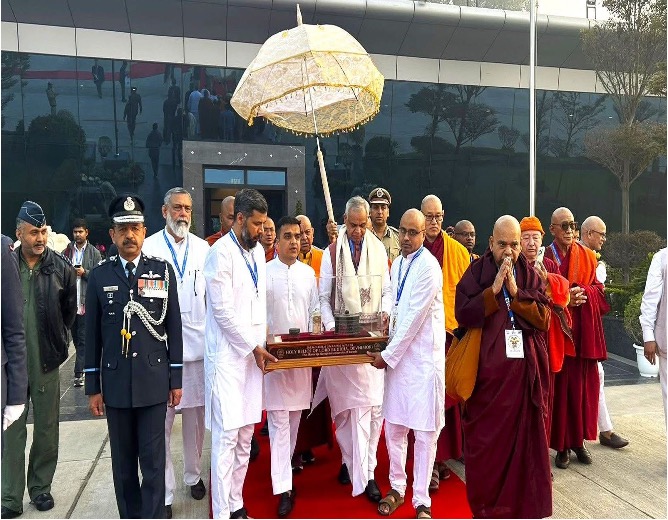
The exposition took place at Kushinagar, the sacred site of the Buddha’s Mahaparinirvana, reinforcing its centrality in the Buddhist sacred geography. H.E. President of Sri Lanka, Shri Anura Kumara Dissanayake stated, on the occasion of the arrival of sacred relics of Lord Buddha: “Deeply appreciate PM Modi for honoring promise.”
In this continuum, Sri Lanka finds a place that is unique, emotional, and historical. Its history, closely intertwined with that of India, could not remain disconnected from the Dhamma. With the advent of Arahant Mahinda and the Bodhi tree sapling from Bodh Gaya, the island simultaneously witnessed the evolution of history related, generally, to the Dhamma. The exposition of the holy relics in Sri Lanka, 4–11 February 2026, in many ways represents a renewal rather than a beginning in terms of a newfound association. The implications of the same go beyond the realm of religiosity.
The expositions of these relics revitalize the heritage that we commonly accept as a unifying force, a component that invigorates cultural diplomacy, nurturing relations based not on formality but on idealism. As a result, in this increasingly global arena, marred by conflict and disintegration, these expositions remind us, in a gentle but beautiful manner, of the universal message delivered by the Buddha, a much-needed voice for peace, harmony, mutual respect, and righteous coexistence at a global level.
The Buddha Relics Exposition in Sri Lanka
In one of the most spiritually significant milestones in contemporary India-Sri Lanka relations, the sacred Devnimori Relics of Lord Buddha are being publicly exhibited at the revered Gangaramaya Temple, Colombo, from 4–11 February 2026, marking the first time these ancient Holy Relics have been exhibited outside India. Brought to Sri Lanka with due solemnity and protocol, the exposition stands as a historic testament to shared Buddhist heritage, civilizational continuity, deep cultural ties, and a renewed commitment to people-centric diplomacy that bridges nations and communities.
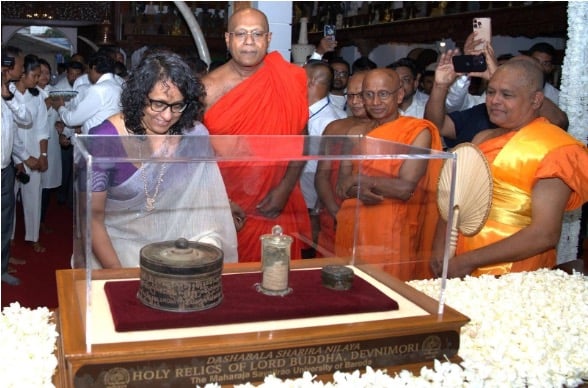
Organized under the aegis of the Ministry of Culture, Government of India in collaboration with the International Buddhist Confederation (IBC), the Devnimori Relics’ journey to Sri Lanka is rooted in a vision articulated by Hon’ble Prime Minister of India Shri Narendra Modi during his April 2025 State Visit to Sri Lanka affirming that spiritual engagement and cultural empathy must be central pillars of bilateral ties. The exposition is justified in the words of Hon’ble Prime Minister of Sri Lanka, H.E. Dr. Harini Amarasuriya who said:
Today, as we pay homage to the Holy Devnimori Relics, we celebrate not just a shared past but a shared future. This exposition enriches our cultural and spiritual landscape and fortifies the bonds of trust between our nations. It inspires Sri Lankans and Indians alike to engage with our shared Buddhist legacy through reverence, learning, and mutual respect.
She further added that “it’s a tremendous opportunity for our people,” and appreciated Prime Minister Narendra Modi’s efforts in bringing the Holy Devnimori Relics for the first ever international exposition to Sri Lanka. This sacred exposition not only underscores India’s role as the birthplace and custodian of Buddhism but also serves to deepen friendship and mutual respect between India and Sri Lanka, strengthening diplomatic relations, supporting Buddhist tourism, and fostering enduring people-to-people connections across generations and borders.
The Devnimori Relics, presently enshrined at The Maharaja Sayajirao University of Baroda, Vadodara (Gujarat, India), were transported to Colombo aboard a special Indian Air Force aircraft with full State honors, reflective of the deep reverence India accords to its sacred heritage. Accompanying the Relics is a distinguished Indian delegation led by Shri Acharya Devvrat, Governor of Gujarat, and Shri Harsh Sanghavi, Deputy Chief Minister of Gujarat, along with senior Buddhist monks, academicians, and government officials. In Colombo, the Indian delegation is participating in ceremonial, religious, and cultural engagements, including the formal inauguration of the exposition, dialogue with Sri Lankan leadership, and public cultural exhibitions that highlight India’s Buddhist legacy and sustained engagement with global Buddhist communities.
In a region where Buddhism has woven itself into the social and cultural fabric, this exposition holds extraordinary significance for devotees, scholars, and citizens alike.