
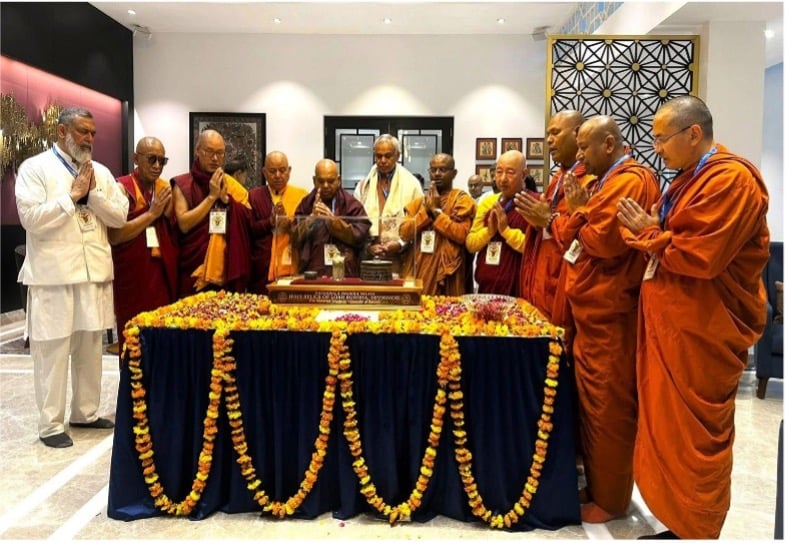
Gangaramaya Temple, a fitting sanctuary for sacred relics
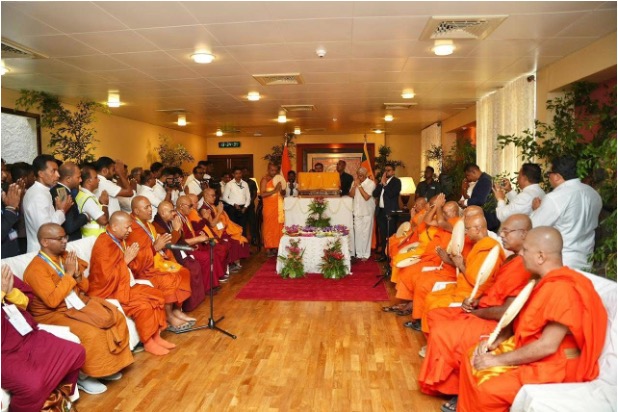
The Holy Devnimori Relics of the Buddhahave been enshrined for public veneration at Gangaramaya Temple, one of Sri Lanka’s most iconic and spiritually revered Buddhist institutions. The Exposition of the Holy Devnimori Relics was inaugurated on 4 February 2026 at the Gangaramaya Temple by H.E. President of Sri Lanka, Shri Anura Kumara Dissanayake, alongside the Indian delegation led by Shri Acharya Devvrat and Shri Harsh Sanghavi, in the presence of senior Buddhist clergy and distinguished guests.
The ceremony was also graced by the Chief Incumbent of Gangaramaya Temple, Ven. Dr. Kirinde Assaji Thero, and eminent representatives from the Government of Sri Lanka including Hon. (Dr.) Hiniduma Sunil Senevi, Minister of Buddhasasana, Religious and Cultural Affairs; Hon. (Dr.) Nalinda Jayatissa, Minister of Health & Mass Media; and Hon. (Prof.) A.H.M.H. Abayarathna, Minister of Public Administration, Provincial Councils and Local Government apart from the Indian delegation. The inauguration also coincided with Sri Lanka’s 78th Independence Day, adding greater symbolic significance to this moment of spiritual unity, shared history, and collaborative vision.
Founded in the late 19th century by Ven. Hikkaduwe Sri Sumangala Nayaka Thera, the Chief Incumbent of Gangaramaya Temple, the temple has grown into a dynamic center of worship, learning, and cultural exchange. Located in the heart of Colombo, Gangaramaya Temple draws worshippers from across Sri Lanka and abroad, offering an ambience of profound spiritual devotion and interfaith harmony.
The temple’s selection as the site for the Devnimori Relics exposition reflects the shared reverence of both nations toward Buddhist values and teachings. The significance of the exposition is reflected in the address of Ven. Dr. Kirinde Assaji Thero, who said that it is a sacred honour for Gangaramaya Temple to host the Holy Devnimori Relics.
These relics embody the essence of the Buddha’s teachings, peace, harmony, and the path to liberation. The devotion and reverence shown by people today reflect the enduring legacy of Buddhism, which transcends time and space to bring solace and spiritual awakening to all.
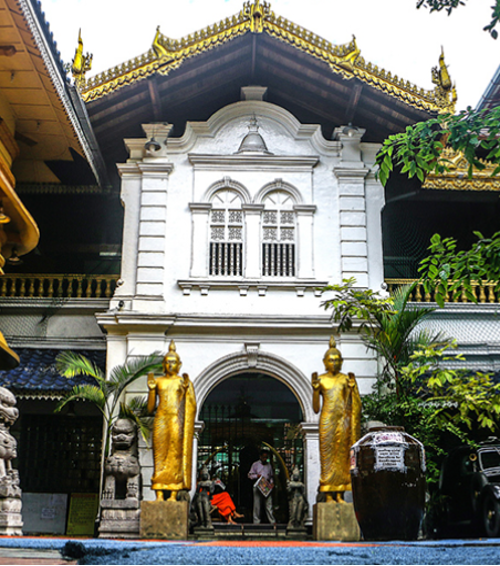
The sacred Devnimori relics, a treasure of Buddhist history
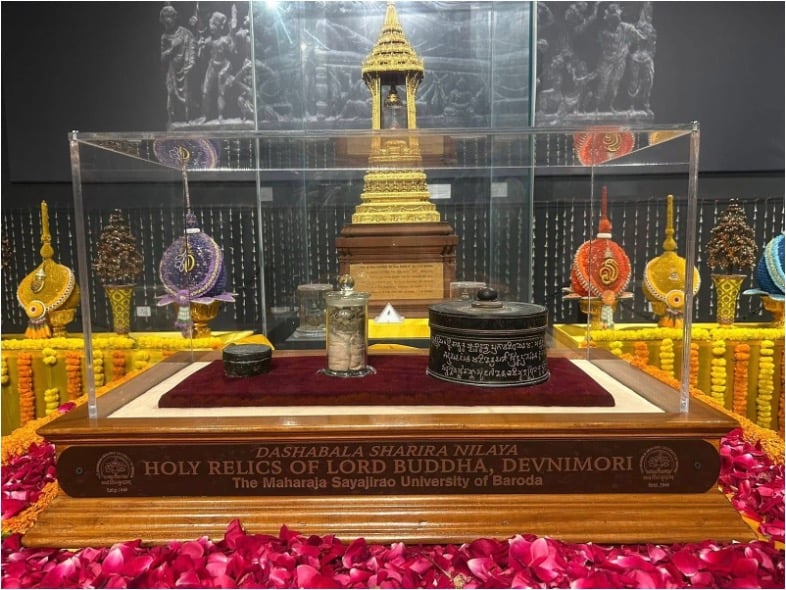
The Devnimori Relics originate from the Devnimori archaeological site near Shamlaji in the Aravalli district of Gujarat, a site of immense historical and spiritual importance. First excavated in 1957 by eminent archaeologist Prof. S. N. Chowdhury, the site revealed important Buddhist structures and artefacts dating back to the early centuries of the Common Era. The relic casket, found within the Devnimori Stupa at a height of 24 feet from the base, is crafted from green schist and bears an inscription in Brahmi script and Sanskrit, which reads: “dashabala sharira nilay” interpreted as “the abode of the Buddha’s bodily relic.”
Inside the casket, a copper box housed organic material with holy ashes, wrapped in silk cloth and accompanied by beads and a gold-coated silver-copper bottle evocative of ancient Buddhist mortuary traditions. Today, the Devnimori Relics rest in an air-tight glass desiccator for preservation, ensuring that pilgrims and devotees can view and venerate them without risking their physical integrity. In the words of Shri Acharya Devvrat, Governor of Gujarat who is leading the delegation has said: “The Devnimori Relics symbolize the ancient Buddhist heritage of Gujarat and India’s enduring spiritual links with Sri Lanka. This exposition strengthens cultural bonds and inspires global awareness of Devnimori as an important Buddhist site.”
In conjunction with the exposition, two major exhibitions have been inaugurated at the Gangaramaya Temple:
“Unearthing the Sacred Piprahwa”: This exhibition showcases the historical and archaeological journey of the Piprahwa Jewel Relics, including their discovery, scholarly interpretation, and eventual repatriation to India, a moment celebrated as the homecoming of a priceless spiritual heritage.
“Sacred Relic and Cultural Engagement of Contemporary India”: This exhibition highlights India’s ongoing cultural initiatives that engage global Buddhist communities through heritage diplomacy, scholarly exchange, and collaborative cultural programming.
These exhibitions offer visitors deeper insights into the historical contexts of Buddhist relics, the shared heritage of India and Sri Lanka, and the contemporary relevance of Buddhism in promoting peace, harmony, and intercultural understanding.
During the inauguration ceremony H.E. President of Sri Lanka, Shri Anura Kumara Dissanayake said:
The arrival of the Holy Devnimori Relics at Gangaramaya Temple is not only a moment of deep spiritual devotion but a reaffirmation of the ancient bonds between Sri Lanka and India. As nations rooted in the teachings of Lord Buddha, we are reminded that peace, compassion, and empathy are timeless values that continue to guide humanity. This exposition strengthens the bridge of faith and friendship that unites our peoples.
Ven. Shartse Khensur Rinpoche Jangchup Choeden, Secretary General of International Buddhist Confederation (IBC), when delivering remarks during the inaugural ceremony, stated that:
The exposition reflects faith becomes a bridge between nations and devotion becomes a language of friendship which remind us that the Buddha’s message belongs to all humanity, and through such shared veneration, India and Sri Lanka deepen cultural engagement and spiritual connections.
The Exposition of Devnimori Relics exemplifies cultural diplomacy at its highest form, not merely as an intergovernmental engagement but as a living, breathing dialogue between peoples, traditions, and spiritual lineages. Shri Harsh Sanghavi, Deputy Chief Minister of Gujarat, put forth his view: “This sacred exchange ties and encourages Buddhist tourism, and cultural understanding between our nations.”
While India and Sri Lanka share Buddhist civilizational ties, this exposition strengthens diplomatic relations in ways that are civilizational rather than transactional. By facilitating an act of spiritual sharing, both nations reaffirm:
- A commitment to peace and harmony as central to governance and cultural exchange;
- A collaborative vision for South Asia and the Indian Ocean region, where shared heritage fosters cohesion and mutual respect;
- People-centric diplomacy that engages hearts as well as governments.
This event also complements and reinforces India’s broader engagement with Buddhist communities globally, a legacy that includes the exposition of relics in countries such as Thailand, Mongolia, Vietnam, the Russian Federation, and Bhutan in recent years.
Encouraging Buddhist tourism in Gujarat’s Devnimori and beyond
The Devnimori site in Gujarat, an ancient Buddhist landmark, has drawn scholars and pilgrims keen to explore early Buddhist history in western India. The international exposition of Devnimori Relics in Sri Lanka is expected to:
- Increase global awareness of Devnimori as a site of historical and spiritual significance;
- Encourage bilateral tourism partnerships between India and Sri Lanka for Buddhist heritage circuits;
- Boost local economies and cultural infrastructure in both Gujarat and Sri Lanka through heritage tourism;
- Create joint promotional platforms highlighting Buddhist heritage trails spanning Kusinagar, Devnimori, Sarnath, Bodh Gaya, Anuradhapura, and Colombo.
By positioning shared Buddhist pilgrimage routes, India and Sri Lanka can enhance not only tourism but also cultural understanding, academic collaboration, and spiritual solidarity.
A celebration of peace, compassion, and shared destiny
The exposition of the Holy Devnimori Relics at Gangaramaya Temple is a moment of joyous reverence, civilizational pride, and diplomatic warmth. It embodies the Buddha’s timeless teachings such as non-violence, compassion, harmony, and respect for all life, in an era that sorely needs these values. Shri Abhijit Halder, Director General of IBC, said:
The exposition of the Holy Devnimori Relics in Sri Lanka is a sacred act of shared devotion and civilizational continuity. Buddhism transcends borders, and these relics serve as living links between communities bound by the Dhamma. Through this collaboration with the Ministry of Culture, the IBC is honoured to contribute to a moment that deepens spiritual bonds, strengthens connections between the devotees of two countries, and reaffirms the Buddha’s timeless message of compassion, peace, and coexistence for globalized world.
As pilgrims and visitors pay homage to the sacred relics in Sri Lanka, they are participating in a shared legacy that binds nations, communities, families, and generations through the values of peace and empathy. The journey of these relics reaffirms that cultural heritage is not a relic of the past, but a living bridge to our collective future. Through this sacred exposition, India and Sri Lanka have reconfirmed that heritage can inspire diplomacy, spirituality can nurture friendship, and shared history can lay the foundation for a more peaceful and interconnected world.