
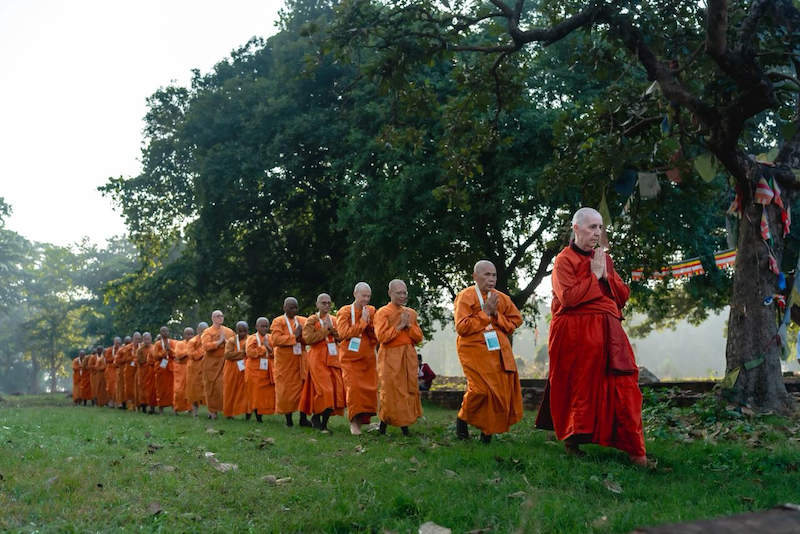
Photo: One hundred bhikkhunis embark on a transnational pilgrimage to follow in the footsteps of Mahapajapati Gotami.
This article is inspired by and based on the English translation of the Chinese original published on 23 December 2025, English editing by Raymond Lam, with contributions from Tathaloka Theri.
From 16 to 22 December, 100 bhikkhunis and samaneris from 13 countries around the world set off from the Buddha’s hometown in Kapilavastu, Nepal, traversed the Indian state of Bihar, and finally arrived in Vaishali. It was officially known as the “Footsteps of Mahapajapati Carika” Dhammayatra pilgrimage.
This pilgrimage was inspired by the first enlightened female arahant Mahapajapati Gotami, popularly known in Classical Han Chinese as, “She to Whom the Path is Dear” or “the Path of Great Love,” (大愛道比丘尼 dà ài dào bi qiu ni). Known in Pali as Mahapajapati and Sanskrit as Mahaprajapati, she was the Buddha’s maternal aunt and foster mother more than 2,500 years ago. The pilgrimage brought together bhikkhunis and laywomen from around the world, not only from the Buddha’s homelands in Nepal and India, but from the Buddhist sanghas across Asia in Sri Lanka, Thailand, Vietnam, Cambodia, and Bangladesh; as well as from the US, Canada, Cuba, the UK, Germany and Australia.
The pilgrimage began at the palace gates of the stone foundations of the Buddha’s birthplace in ancient Kapilavastu, where on 17 December, 30 aspirants underwent tonsure, donned monastic robes, and undertook temporary monastic precepts. 100 bhikkhunis and samaneris then followed the ancient Great Renunciation Trail —the Abhinishkramana Path to it’s completion in Vaishali on 22 December. According to Indian media outlet Patna Press, after entering India, the pilgrimage group passed through Kushinagar, the place where the Buddha attained Nirvana, and finally arrived in Vaishali. Along the way, the bhikkhunis, samaneris, and anagarikas transformed each rest stop into a tranquil place of meditation. Vaishali is a city of epochal significance in Buddhist history, as it is the place where the Buddha approved Ananda’s request for ordaining women, hence establishing the women’s Order.
The pilgrimage group carried the sacred relics of Mahapajapati Gotami from Sri Lanka (on loan from the United States for this pilgrimage) together with a statue of her, from Nepal. This is the first time these sacred relics have returned to their homelands, after their departure abroad centuries ago, where they are still preserved in monastic and royal collections in Sri Lankan and Thailand.
Leading organizers, supporters, and contributors included the Tzu Chi Foundation (whose volunteers came from Taiwan, Malaysia, and Singapore), laywoman Wangmo Dixey and team of the Light of Buddhadharma Foundation International (LBDFI) and International Tipitaka Chanting Council (ITCC), senior monastic advisor and Bhikkhuni Sangha History and Heritage coordinator Ven. Tathaloka Mahatheri, Ven. Bhikkhuni Preceptor Santini Mahatheri and Ven. Bhikkhuni Sakya Dhammadinna of United Theravada Bhikkhuni Sangha International (UTBSI), and researcher Deepak Ananda of the Retracing Bodhisattva Xuanzang project. They had been working in collaboration with Ven. Nyanawati and Prasannawati Guruma, Secretary and Lead Pilgrimage Coordinator of the Nepal International Nuns Association, and leaders and members of the Dhammadharini Support Foundation USA, and the Bodhipakkhiya Dhamma Foundation India.
Ven. Bhikkhuni Vandana, a member of the pilgrimage from Gujarat and Maharashtra, India, believes that this pilgrimage has profound significance in today’s society, which is rife with war and conflict. She said: “When humanity faces violence and hatred, the compassion and the Middle Way taught by the Buddha are no longer just options, but the fundamental remedy for resolving crises.”
Ven. Vandana echoed the words of Ven. Bhikkhuni Master Cheng Yen of the Tzu Chi Foundation, an active and important supporter of the pilgrimage. The launching of the pilgrimage coincided with the inauguration of Tzu Chi’s “Great Love Village,” which was attended by the 100 monastic pilgrims led by Mahapajapati Gotami’s sacred relics. Tzu Chi has named this project Great Love Village or “大愛村” (da ai cun) after Mahapajapati Gotami’s Chinese name, which was translated from ancient Gandhari, “Mahāpriyapathī.”*
Tzu Chi, led by its lay vice-president Pi-Yu Lin, also filmed an educational documentary along the entire route, from beginning to its end in Vaishali, at the ancient site of Mahapajapati Gotami Theri’s Parinibbana Stupa.
The story of Buddha’s aunt, Mahapajapati Gotami
The inspiration for this pilgrimage arose from the legacy of Mahapajapati Gotami.
After attaining enlightenment under the Bodhi tree, the Buddha preached in Magadha and his hometown of Kapilavastu. During his first return to his hometown, upon hearing the Buddha’s Dhamma teaching, both King Suddhodana, the Buddha’s father, and Mahapajapati Gotami, his stepmother, opened their Dhamma eye and attained “stream entry” (sotapanna), the irreversible first levels of awakening. As more and more princes and members of the royal family become followers of the Buddha’s teaching and entered monastic life as bhikkhus with the Buddha, Mahapajapati Gotami also aspired to the idea of becoming a bhikkhuni, a female monastic.
Later, Gotami witnessed many things that reshaped her outlook on life: the husband she and her deceased sister, Maya (the Buddha’s birth mother) shared, Suddhodana, passed away, but not before attaining arahantship. She saw the devastation of a conflict over water rights between the Kapilavastu Shakyans and her home family of Koliya Shakyans, and the going forth of 250 kinsmen as bhikkhus on both side of the conflict. These all prompted her to make the unsurpassed aspiration to go forth as a bhikkhuni. Many of her royal Shakyan kinswomen, on both the Kapilavastu and Koliya sides, set their minds and hearts to the same hope. As the news of Mahapajapati Gotami’s determination to ordain spread, many women followed her, numbering as many as five hundred.
However, at this time there were no bhikkhunis in the sangha. The Buddha had recommended that she engage in renunciate practice at home, and she was already a stream-enterer, irreversibly on the Noble Path, and destined for complete awakening. But Mahapajapati Gotami’s inclination of mind to fully enter the renunciate monastic life, together with the Buddha and his arahant bhikkhu disciples, was too strong. It arose in her mind and heart again and again. So she asked the Buddha’s compassionate permission a full three times. The Pali Canon states that after the Buddha’s third refusal, one of his chief disciples, Ananda, inquired on her behalf. He posed the logical question of whether it was possible to attain arahantship if she were to receive the Upasampadā, as there were at that time not yet any women arahants in the Buddha’s sangha. The Buddha, making undoubtedly clear that this was possible, then finally blessed her with his full acceptance, ordaining her himself, and explaining important principles of monastic practice to her.
Mahapajapati Gotami thus became the first bhikkhuni in the women’s Order, and five hundred women followed suit, ordained by the male sangha (some texts say, with Gotami as their preceptor), as per the Buddha’s guidance. This marked the beginning of the Bhikkhuni Order.
Not long after, within one week’s time, Mahapajapati Gotami, diligent, ardent and resolute, following the Buddha’s instructions to her, attained the full fruits of the holy life, for which it was said both women and men rightly go forth, and enter upon the monastic life. She became the first female arahant, or arahanti, among the Buddha’s disciples.
As more and more of the original five hundred members of the women’s Order attained arahantship, the Buddha confirmed that this fulfilled his own criteria of success. He later made it clear that this was in fact his founding intention, his founding mission when he set forth from Bodh Gaya to turn the wheel of the Dhamma in Sarnath, in Varanasi; that is, to have a fully knowledgable, accomplished and capable four-fold community of disciples, including bhikkhunis.
Mahapajapati Gotami did not expect any special privileges just because she was the most senior bhikkhuni or female arahanti, or even when she was looked to as a leader. She would lead bhikkhuni retreats in the main centers of the Buddha’s strongholds, in Vaishali, in Sravasti, and in Rajagaha (Rajgir). She served the women’s Order with dedication and sincerity for 40 years from the age of 80 until her Parinibbana at age 120, only a few months before the Buddha’s own Mahaparinibbana. The Buddha ultimately had sent her many women to ordain, all of who expressed their great gratitude and devotion to her.
* Mahāpajāpatī Gotamī or Mahā Gotamī, as she was remembered in the Pāli texts, is also known by these Indic and Classical Han Chinese transliterated and translated forms of her name: Mahāprajāpatī, Mahāprajāvatī, Mahāpriyapathī, Gotamī, Gautamī, Mahāgotamī, and Mahāgautamī, as well as 大愛道瞿曇彌比丘尼 Dà ài dào qútán mí bǐqiūní, 摩訶波闍波提苾芻尼 Mó hē bō dū bō tí bì chú ní, and as noted by Xuanzang: 鉢邏闍鉢底 Bō luó dū bō dǐ, and 波闍波提 Bō dū bō tí.
See more
Following Mahaprajapati’s Footsteps, Buddhist Bhikkhunīs Conclude Ancient Pilgrimage for Equality (Patna Press)