
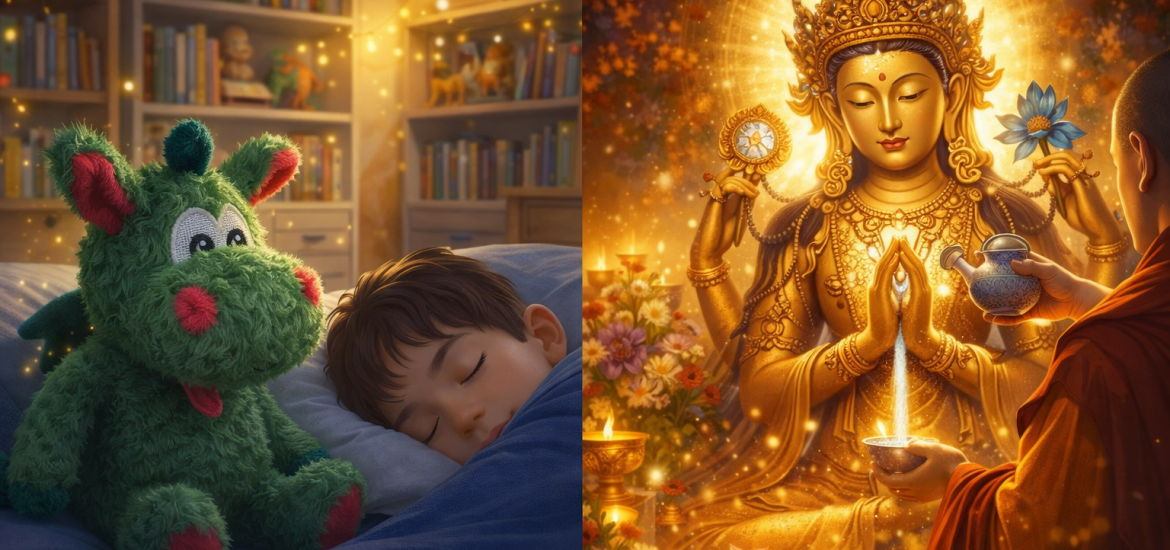
I have no plush toys remaining from my childhood (sadly), but I have several that have accompanied my household for the greater part of a decade. I make no apology for the period I acquired these plush toys (during which I was well into my adult years), of which my favorite is a goofy green dragon from German children’s toy manufacturer Rudolf Schaffer. With my grown-up arc in full swing, with nothing to prove and no one to impress, it simply doesn’t seem sporting or honest to deny the comforting power of plush toys; a power, which many more grown women and men than I suspect would care to admit, regularly draw emotional renewal from.
I do not believe that this sense of comfort and bonding is purely psychological projection. Consider two notions that might prompt one to look at one’s childhood companions a little differently. The first is the Shinto philosophy of yorishiro (依り代)—objects that become vessels capable of attracting or housing spirits. The second is the widespread Vajrayana practice of bringing images of Buddhas and bodhisattvas to senior khenpos, geshes, and Rinpoches to consecrate (rabné).
In Shinto, there is a concept known as Shinto also teaches that kotodama (言霊), or the “spirit of words,” holds power, and that sincere feelings and rituals can purify and imbue the world around us with spiritual significance. Plush toys start out as simply sewn and stuffed inorganic matter. It is simply mono—a thing with no tama (soul) of its own.
Then, someone chooses it, perhaps at a toy shop off the shelf. The moment a child (or an adult with a child’s heart) holds it close for the first time, the process of “soulification” begins. This first hug is the first ritual. The owner begins to fill the plush with kotodama. When a child whispers, “You are my best friend,” the words sink into the fiber and cloth of the plush. When an adult holds it tight after a difficult day, that feeling of relief and love becomes a kind of prayer, cleansing the plush of its mono “thing-ness” and preparing it to become something more.
While the process of rabné is much more formal and demands a qualified master to perform the ritual, the process of consecration transforms a Buddha or bodhisattva image from a mere object into a living embodiment of divine presence. Without consecration, statues are considered spiritually inert; with consecration, they become vessels of blessings, merit, and protection for monasteries and homes alike.
Consecrations are believed to “invite” the enlightened mind into the statue. This makes the image not just symbolic, but a living presence of the Buddha or a bodhisattva. For example, a consecrated image of Mahakala truly embodies and exudes the wrathful deity, providing his power and blessings to the individual or community that reveres it.
Meanwhile, over time, through countless hugs, shared tears, and whispered secrets, the plush toy becomes a yorishiro: a vessel for a spirit. Granted, the spirit won’t be a grand, ancient kami or a majestic Buddha or bodhisattva. But it will be a new, gentle and loving spirit born from the owner’s heart and feelings. In Shinto philosophy, the boundary between the mundane and the spiritual is thin; sincere emotion is a creative force. The love the owner pours into the toy is so pure and focused that it awakens a kami of comfort and companionship within it. Buddhism also breaks down simplistic, dualistic boundaries. A consecrated statue becomes a skillful means (upaya)—a physical form infused with the ultimate truth of emptiness and compassion, serving as a bridge between practitioner and enlightenment.
Consecrated statues serve as focal points for collective rituals, meditation, and pujas. They radiate spiritual energy, believed to purify the environment and benefit all beings nearby. And they point to the unbroken lineage of teachers, ensuring continuity of Vajrayana practice. They are furthermore filled with mantra texts, relics, and scriptures. These act as a spiritual “DNA” so that the statue literally embodies wisdom and compassion.
The spirit inhabiting our beloved plush might not be so revered, but is perhaps just as beloved. It is quiet and small, abstaining from interfering with the forces of nature or the grand kami of forests, mountains, and oceans. Its entire world, rather, is the owner. As the owner sleeps, the plush toy keeps a gentle vigil. Its eyes, once empty, now see the owner, not in the visual sense, but to perceive the feeling of the room, to sense if its beloved person is safe and at peace. It absorbs the sadness of a crying child and holds onto it, transforming it into fluff so that the child feels lighter and happier.
Without consecration, statues are like empty vessels—beautiful but spiritually dormant. With consecration, they become living supports for practice, capable of transmitting blessings, purifying karma, and inspiring devotion.
When a plush receives love and relational bonding, the plush toy ceases to be a mere object and becomes a yorishiro for love, a vessel made present by the sincere heart of its owner, quietly watching over them through the years they are together. And when an adult, no longer a child, holds their old (or new) companion, they are reconnecting with an innocent, loving spirit they have created. The toy watches over them not by warding off physical danger, but by guarding that small, sacred space of childhood sincerity within their owner’s being.
I am not necessarily advising consecrating your old childhood toys. But perhaps—just perhaps—their power to bring you joy is not a figment of your imagination but in fact a hint of something spiritual.