
By Tshering Tashi
This article was originally published in Kuensel
Local lore in Sarpang tell stories of how Guru Padmasambhava first entered Bhutan through their soil. Validated by Bhutanese scholars and deeply rooted in the region’s history, this claim is honoured with a name for the 8th century Indian Buddhist master: Sarvanga Rishi.
The title is Sanskrit in origin, where Sarva means “all” and anga means “body.” Combined with Rishi (an enlightened being), it translates to “The Enlightened One who is Everything in Himself.” This name captures the devotion of the Bhutanese people toward the Guru who brought Vajrayana Buddhism to the country. Though known by this regional title in Sarpang, he is revered throughout Bhutan as Guru Rinpoche and celebrated worldwide as the Lotus-Born Master.
As documented in the Kathang Sheldrak, Guru Rinpoche visited Bhutan three times during the 8th and 9th centuries. While his journeys through the northern valleys are widely known, his path through the southern region of Sarpang left an equally lasting mark, woven into both the landscape and the oral traditions of its people.
According to local history, when the Guru first arrived, the people gave him a warm and devout reception. They carpeted the ground with fresh green leaves (shom) and served him traditional food on a meadow (pang). From this act of devotion, the place was named Shompangkha. Over time, the name evolved into the modern Sarpang, though it is still popularly pronounced “Shorpang,” preserving a phonetic echo of its origin story.
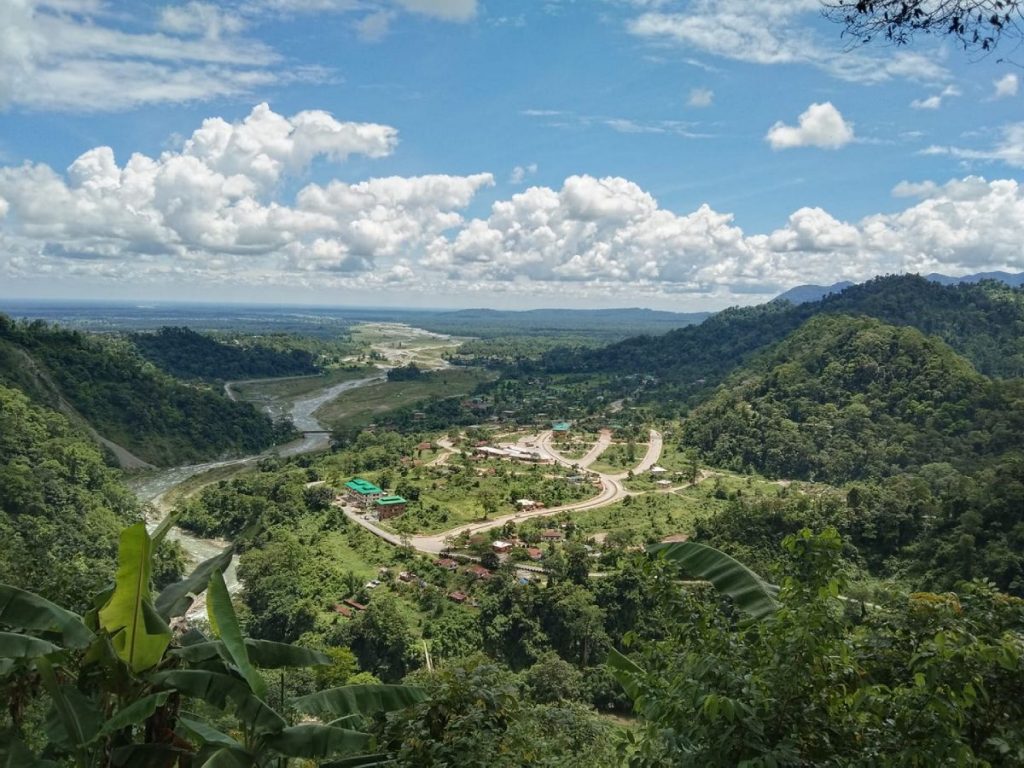
Oral traditions map the Guru’s trial with remarkable detail. He is said to have travelled along the Sarpang Khola to Sarpang Seer before following its tributary, the Belkhola, to the sacred site of Deonidab. From there, his path continued through the villages of Phangkhey and Gongring, tracing the Kharhola river toward his destination in central Bhutan. Two key locations along this fabled route stand out for their legends: Deonidab and Nabji-Korphu.
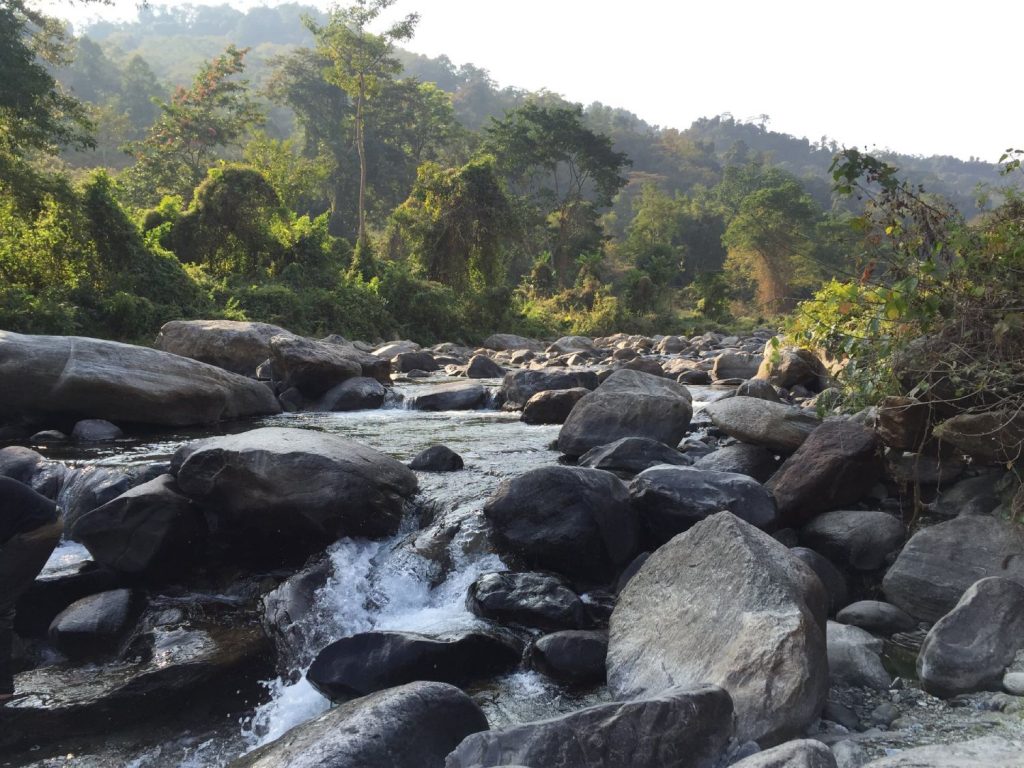
Deonidab is a site of deep spiritual significance, believed to be where Guru Rinpoche meditated for three years. This claim is supported by numerous sacred sites, spread across the local Gewogs, which include the Guru’s footprints, his throne, and the cave where he is said to have meditated. Situated at 653 meters, Deonidab is a six-hour walk from the old Sarpang market. Its pristine landscape serves as the principal watershed for the region, an area also known as Sarpang Seer, or “catchment area” in Nepali. The name Deonidab itself holds another story, derived from the small, straight bamboos (dab) that grow there, which are used to make the country’s finest arrows (deo). In earlier times, these prized bamboos were reserved exclusively for kings and remain a protected species today.
Nabji-Korphu: The Pillar of Peace
Further along his journey, in the village of Nabji-Korphu, Guru Rinpoche is credited with one of his most famous acts of diplomacy. Legend holds that he brokered peace between two warring kings: King Nauche from the south and King Sindhu Raja of Bumthang who invited Guru to Bhutan to cure him of his illness. Because both rulers trusted the Guru’s integrity, he was able to bring them to the negotiating table. To commemorate this historic pact, a stone monolith known as the “Peace Pillar” was erected. The pillar still stands today, bearing the handprints of the Guru and the two kings as a lasting symbol of their agreement.
While legends of the Guru define Sarpang’s spiritual land- scape, the land itself holds other stories, etched in stone and soil. For years, a mysterious ruin in Sangkha village, situated direct- ly along the traditional footpath from Sarpang to Damphu, was shrouded in local lore.
Some claimed it was the fortress of the 8th-century Tibetan King Trisong Detsen who invited Guru Rinpoche to Tibet, while others, including the Pesling Trulku from Bhutan believed it to be that of the exiled Tibetan Prince Khikha Ratho.
In 2011, the Royal Government of Bhutan, in collaboration with the Swiss-Liechtenstein Foundation for Archaeological Research, began a formal excavation to unearth its secrets.
The investigation initially centred on the 8th-century theories, but the material culture it revealed told a different story. The team uncovered a two-story rammed-earth house destroyed by fire, from which they salvaged a sword, a spearhead, and, crucially, the metal barrel of a rifle. Artifacts such as glass bottles, copper coins, and Chinese tableware helped date the building’s destruction to the late 19th century. The rifle barrel, a definitive chronological marker, directly debunked the 8th-century claims.
The presence of an ink bottle suggested a high-status household with literate resident likely a clergyman or government official. This theory is reinforced by the site’s strategic location on a spur, offering a panoramic view of the Sarpang-Damphu footpath. This path was the primary transit route to Tsirang until the national highway opened in the 1970s, and monitoring such trade corridors was a key duty of local officials in the 19th century.
The Gakidling excavation replaced folklore with the tangible reality of a regional administrative outpost, adding a rich, new layer to the Dzongkhag’s history. Today, a Lhakhang stands on the site, where the recovered artifacts are pre- served as sacred relics bridging scientific discovery with local tradition.
Bose’s 1815 Journey
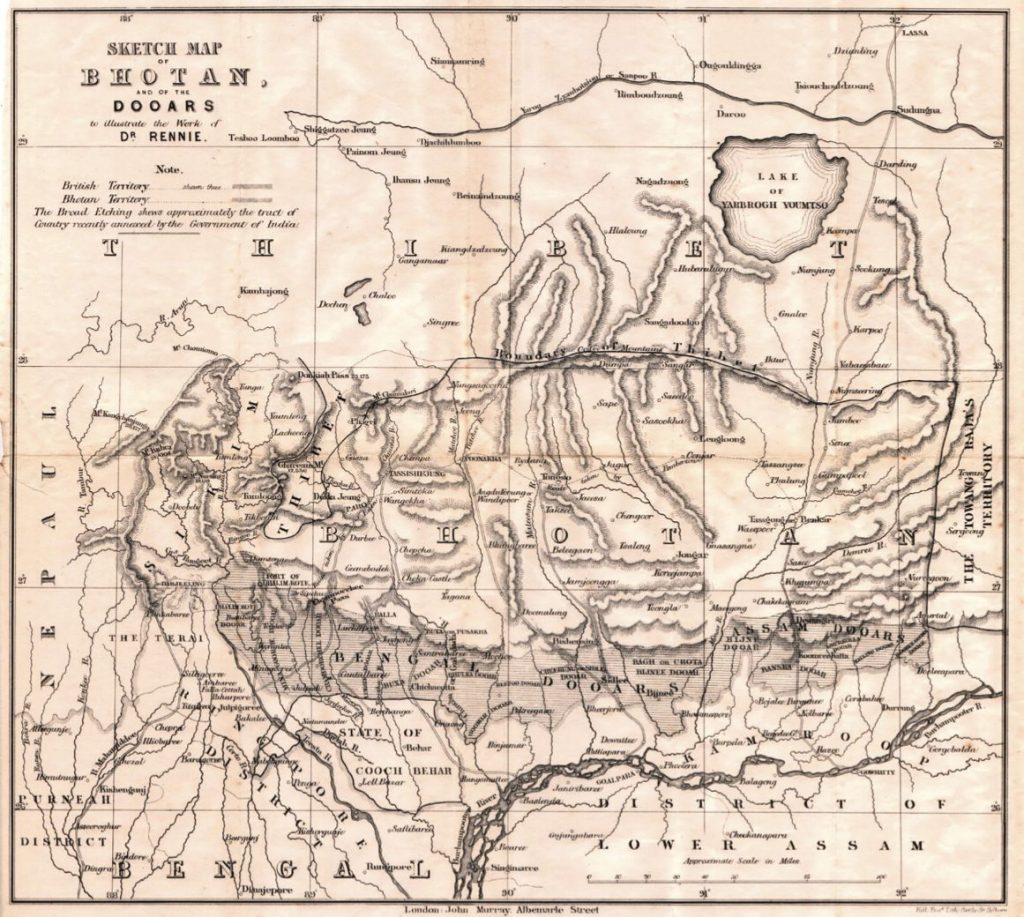
The Gakidling discovery underscores Sarpang’s long-standing role as a strategic corridor for more than just pilgrimage. One of the earliest documented accounts of this route comes from Krishna Kanta Bose, an Indian official dispatched by the British to Bhutan in 1815. His report chronicles a gruelling ascent from the hazardous Bijni lowlands to the interior.
Bose described the initial trek through a sweltering “sea of reeds” near Sidli, a jungle so dense and leech-infested that “a person cannot move a hundred yards, without having his body. . . covered with these animals.” As his expedition moved northwest, the tall grass gave way to Sal forests and rapid torrents like the Sarabhanga river. The brutal conditions of the lowlands were relentless; the heat was intolerable by day, while at night, travellers were tormented by “innumerable mosquitoes.”
Bose’s journey demonstrates the route’s historical importance. For generations, traders from Punakha, Wangdue Phodrang, Dagana, and Tsirang braved this same rugged corridor, descending to Sarpang to procure salt and other essentials from the plains. The elders’ stories echo Bose’s account, recalling dense tropical forests teeming with wildlife. Eventually, a dedicated mule track was cleared to facilitate this critical trade. The corridor’s role as a lifeline has endured, a testament to the region’s essential, hard-won connections to the world beyond its hills.
The Rishi’s Path Reborn
Today, this ancient corridor of faith and trade is being reborn. Sarpang Dzongkhag is now the Gelephu Mindfulness City, a Special Administrative Region envisioned by His Majesty the King. Conceived as a global Vajrayana hub and rooted in mindfulness, the city is spiritually anchored by the newly inaugurated Lotus Born Trail, a 150-200 kilometer pilgrimage route that retraces Guru Rinpoche’s legendary journey.
Connecting the future city to the hallowed Kurje Lhakhang in Bumthang, the trail winds through some of the country’s most sacred landscapes. The trail is a living story that unfolds from sites of ancient oral lore like Deonidab to the revered Peace Pillar in Nabji, where the history of peace in this region was first forged. The Lotus Born Trial traces Bhutan’s cultural past and centuries-old Buddhist traditions and bridges it with a bold, sustainable future. In doing so, GMC embodies the very essence of Sarvanga Rishi, “The Enlightened One who is Everything in Himself.”
Related news from BDG
Her Majesty the Gyaltsuen Leads Inaugural Ceremony for Kurukulle Centre at Gelephu Mindfulness City
His Majesty the King of Bhutan Offers Gelephu Mindfulness City Full Support with Official Visit
Bhutan Integrates National Identity Platform with Ethereum Blockchain
Related features from BDG