
By Tsering Tashi
Around 1938, Bhutan’s Second King, Jigme Wangchuck (r. 1926–52), commissioned a master Newari craftsman from the Kathmandu Valley to caste a bronze statue of Maitreya, the successor to Buddha Shakyamuni. Known as the Future Buddha, Maitreya is believed to reside in the Tusita heaven, waiting the right moment to descend to earth.
Often depicted in the bhadrasana, or “throne posture”—with knees spread wide and heels close; he assumes this pose to signify his imminent descent. His mission to teach universal love and compassion has earned him the name the “Buddha of Friendship.”
A messianic figure revered across Asia, this “Buddha of Friendship” is known by different names: Miroku Butsu in Japan, Mi Lo Fo in China, and Jow Jampa in Bhutan.
Photograph by John Tsantes. Image courtesy of the author
According to traditional Buddhist sources, Jow Jampa’s advent is not immediate; rather, it is tied to a future dark age when the world will be afflicted with war, disease, and famine. At that time, he will emerge as the World Teacher.
The man tasked with bringing this divine figure to life was one of Nepal’s most celebrated craftsman of his time: Kuber Singh Shakya (1881–1957). He was a master of repoussé, the intricate art of shaping metal, a craft in which the Newari artisans of Nepal excel.
According to two American scholars James A. Giambrone and Mary Shepherd Slusser, Kuber Singh learned the art from his father, Bhima Narasimha Shakya, who eventually set aside his own career to support his son’s prodigious talent. The family’s artistic lineage was legendary, tracing back to the 16th-century priest who founded the famous Mahaboudha temple in Patan. This heritage granted them the honour of serving as designated repoussé craftsmen for the Malla Kings.
It wasn’t long before Kuber Singh’s own fame surpassed his father’s. His masterpieces graced monasteries and temples not only in Nepal but also in Ladakh, Tibet, and Bhutan, commissioned by both Buddhist and Hindu patrons.
As Giambrone and Slusser noted in their 2001 joint article, “Kuber Singh Shakya: A Master Craftsman of Nepal,” the artist often worked for distant patrons: “Kuber Singh made at least one image for a gonpa in Ladakh and another for the king of Bhutan, but in both instances he fabricated them in his Patan workshop and shipped them to the respective countries.”
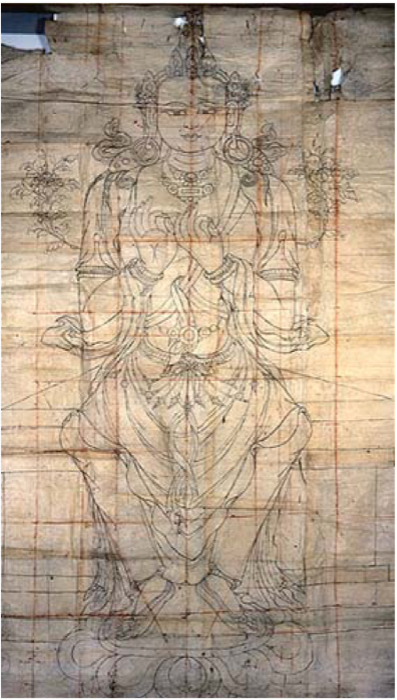
While details of the image in Ladakh have since emerged, the one in Bhutan remains shrouded in mystery. However, the drawing for the statue in Bhutan is remarkably well preserved. It depicts Lord Maitreya, seated with pendant legs.
The article states that the resulting gilt copper repoussé image was enormous. At more than three meters tall, the multi-part statue was so large it had to be assembled in the street outside Kuber’s Patan workshop. Completed around 1938–39, the disassembled image likely made its way to Bhutan in pack baskets on the backs of Nepalese porters.
The decision to construct such a monumental piece in Patan, rather than on-site, raises a compelling question. Kuber Singh was known to be accommodating, often traveling to difficult locations in Nepal and Tibet for his commissions. Why did he not travel to Bhutan to oversee the creation and final assembly himself?
According to the article, Kuber’s son, Rudra Raj, affirms that the Bhutan King’s emissary—the “Dukpa lama”—warned Kuber not to set foot in Bhutan. The emissary feared the King would be so impressed with his skill that he would never be allowed to leave, effectively making him a prisoner of the court.
Thus, despite the logistical challenges, Kuber thought it wise to remain in the safety of his homeland. This story is reminiscent of Nepalese folklore in which kings would allegedly maim gifted sculptors, preventing them from creating comparable works for rival courts.
A Commission in a Time of Change
Why did the Second King commission such a significant piece at this specific time? Historical records paint a picture of a nation in transition. In 1936, the King had commanded the construction of new temples and the renovation of sacred sites like Sangchokhor, Taktshang, and Kyichu. While Bhutan enjoyed peace, the world beyond was on the brink of chaos; the Second World War erupted in 1939. By 1940, Bhutan had contributed to the Viceroy’s War Fund. Closer to home, a smallpox epidemic broke out in Thimphu and Punakha.
A more personal reason may lie with the King’s devout wife, Her Majesty Ashi Phuntsho Choden (1911–2003). In 1938, the 27-year-old Queen was already a prominent patron of Buddhism, playing a vital role in strengthening the nation’s spiritual heritage. Perhaps she inspired the commission of the Future Buddha, a symbol of hope in a darkening world.
A Trail of Clues
Today, Bhutan is home to over 2,000 monasteries, yet few statues are dedicated to Jow Jampa. The search for Kuber Singh’s masterpiece leads down a trail of compelling clues. The famous statues of Maitreya at Jampay Lhakhang in Bumthang and in the Trongsa Dzong, while monumental and in the throne posture, are moulded from clay, not bronze. Another at Dumtseg Lhakhang in Paro is neither large nor cast in metal.
The trail grows strongest in the Punakha Valley, where four large Maitreya statues reside. Three are made of clay and housed at the Kyabji Chorten Nyingpo Lhakhang, Sewla Goenpa, and Nidrup Chu Goenpa. The fourth, a striking bronze figure, is housed in the Punakha Dzong. According to senior monks, this statue once served as the centrepiece of the main assembly hall. It is a large, bronze repoussé figure seated in the throne posture, a near-perfect match.
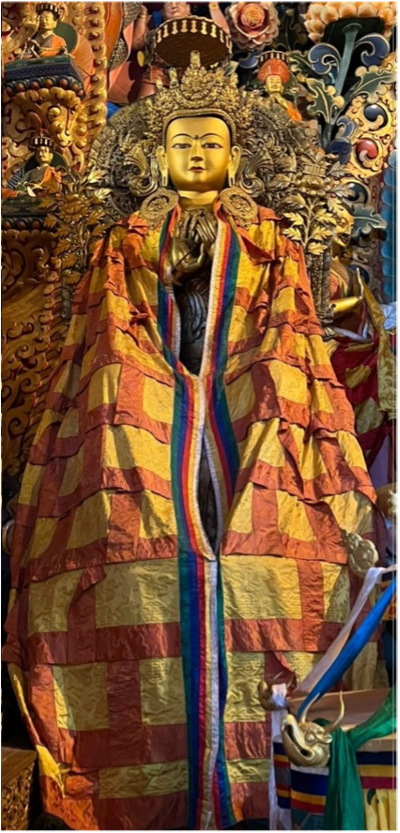
Yet, one curious detail sets it apart from Kuber Singh’s original drawing: the feet are set flat upon the ground, whereas in the drawing, the heels click. This alteration may be the key that unlocks the mystery. Kuber Singh’s absence from Bhutan meant he could not oversee the final assembly. Is it possible that a local Bhutanese sculptor, tasked with completing the work, adapted the master’s design? This theory is strengthened by the presence of two smaller bronze Buddhas in the Dzong, representing the past and present, a gift from Queen Ashi Phuntsho Choden herself, further tying her patronage to this sacred space.
The Newari craftsmanship of the Punakha statue seems undeniable. For comparison, a 17th-century copper Maitreya at Phajoding Monastery in Thimphu, also in the bhadrasana posture, is attributed to a Newari artist based on its fire gilding and crown style. The artistic lineage is clear.
While the exact reason for the King’s commission remains a matter of speculation, the evidence increasingly points toward the influence of Queen Phuntsho Choden. The question remains: Is the magnificent bronze Jow Jampa in the Punakha Dzong the lost masterpiece of Kuber Singh Shakya? Though the full story is yet to be confirmed, the statue stands today as a powerful testament to a king’s vision, a queen’s devotion, and a master craftsman’s enduring legacy.