
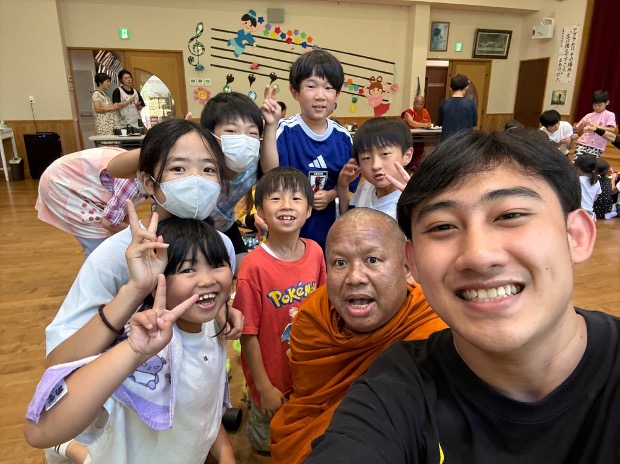
By Ven. Ryokyu Endo, Chief Priest of Wada Temple
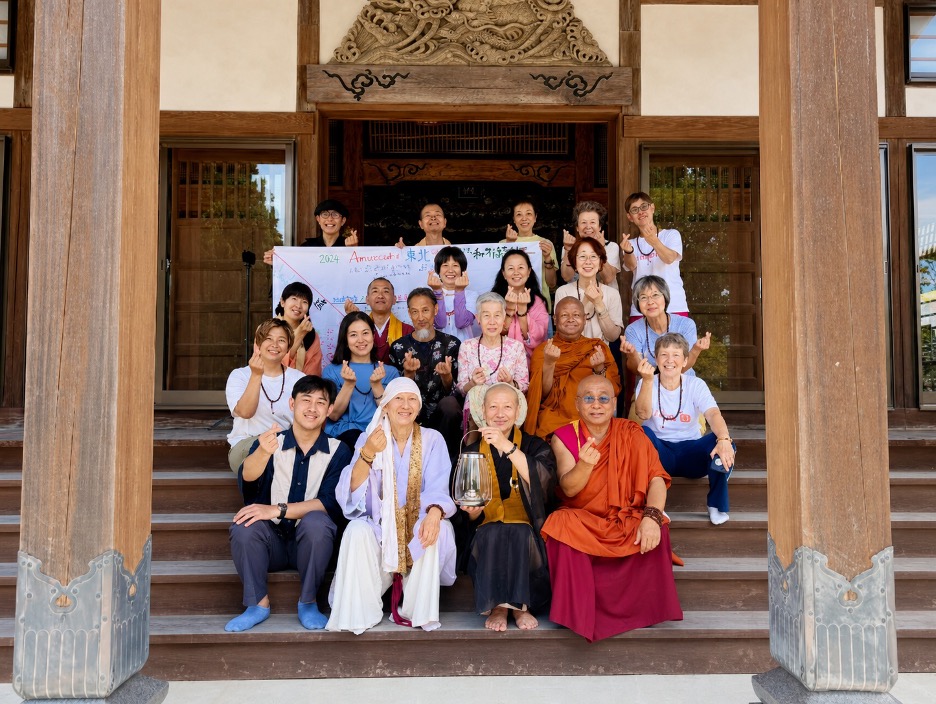
What discoveries might await Buddhist monks from Bhutan and India as they travel through Japan — visiting local temples, encountering beautiful natural landscapes, experiencing a different culture, and meeting the people who live there?
From 5 to 15 July 2026, Ven. Sonam Dorji, a Bhutanese monk living in Bodh Gaya, Ven. Ratneswar Chakma, an Indian monk, and Phurich Inthep, a Thai university student involved in human rights work, joined us on a journey through Tohoku in Northern Japan.
Much of what they encountered in Japan was new to them. There were surprises, moments of unexpected joy, and encounters with a world they had not known before.
But this was not a sightseeing trip. Marking 15 years since the Great East Japan Earthquake, it was a pilgrimage of remembrance and prayer for those who lost their lives in the earthquake and tsunami.
Ven. Sonam Dorji has travelled to around 20 countries and serves as the abbot of the Bhutanese temple in Bodh Gaya. About ten years ago, he also spent a year living in Japan. Ven. Ratneswar Chakma is also a monk based in Bodh Gaya, as well as a lawyer. For both of them, this journey was not only an encounter with places they had never visited before, but also an opportunity to look again, from a different perspective, at the Buddhism they already knew.
We all shared Buddhism as a common foundation. Yet our Buddhist and cultural backgrounds were different.
That was precisely why this journey became more than a pilgrimage through Tohoku.
It became an encounter between different Buddhist traditions and, through that encounter, a journey of rediscovering Japanese Buddhism itself with fresh eyes.
Carrying the Flame of Hope
The pilgrimage brought together 15 members of the Flame of Hope community centred around Wada Temple, who travelled together with our three guests from overseas.
The Flame of Hope began in 2015, after I met a nine-year-old boy in Gaza who had lost both legs in an air strike. That encounter changed me deeply and led me to make a vow: no child should ever have to suffer in this way again.
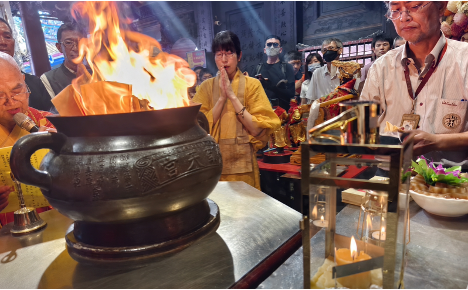
It is an initiative that brings together 17 sacred flames preserved around the world—including the Chángmíng Dēng (Eternal Lamp) at Beigang Chaotian Temple in Taiwan, which has burned continuously since 1694—and unites them in a single Flame of Hope, carrying people’s prayers for peace.
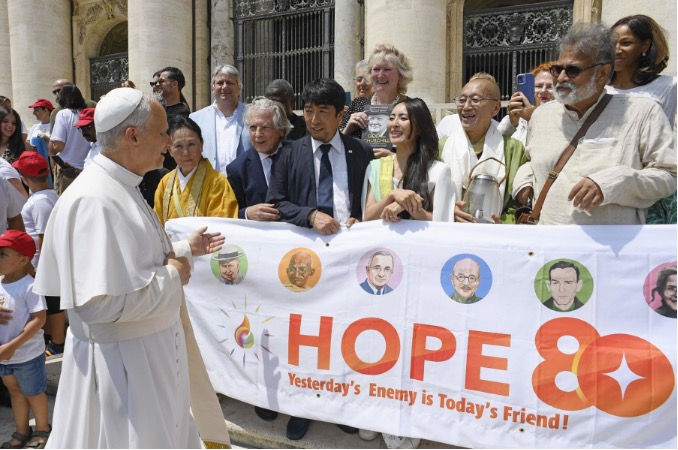
Across religions, ethnicities and national borders, people’s prayers are brought together in one flame. So far, around 700,000 people—including the Pope and His Holiness the Dalai Lama—have offered their prayers into the Flame of Hope.
Today, the flame burns continuously, twenty-four hours a day, 365 days a year, at Rajakiya Boudha Vihar in Lumbini, the birthplace of the Buddha.
On this pilgrimage, we carried the Flame of Hope with us as we visited temples, shrines, primary schools and other places. At each stop, we lit the flame, prayed for those who lost their lives in the Great East Japan Earthquake and tsunami, and, on this fifteenth anniversary, shared our hopes for world peace.
The following day, we headed north by car. As the journey continued, one thing that left a particularly strong impression on our visitors was another face of Japanese Buddhism.
Another Face of Japanese Buddhism
As Buddhism spread across Asia, it encountered the religions and cultures of different lands, taking on different forms according to place and history.
Outside Japan, Japanese Buddhism is often associated first with Zen. One reason for this is the international influence of D. T. Suzuki (1870–1966). Yet one of the great currents that brought Buddhism deeply into the everyday lives of ordinary people in Japan was Pure Land Buddhism. At its heart is an extremely simple practice: chanting the name of Amitabha Buddha.
“Namo Amitabha.”
Nembutsu — A Path Open to Everyone
The person who opened this path widely to ordinary people was Venerable Hōnen (1133–1212). Hōnen taught Nembutsu — chanting the name of Amitabha Buddha — as a path to birth in the Pure Land open to everyone. A major turning point in his spiritual understanding came through the writings of the Chinese Pure Land master Shandao (613–681), particularly his Commentary on the Contemplation Sutra (Guan Wuliangshou Jing Shu).
In this work, Shandao presents the continuous, wholehearted recitation of Amitabha Buddha’s name in everyday life as the central practice leading to birth in the Pure Land. Deeply inspired by this teaching, Hōnen opened the path of Nembutsu to people throughout society. Whether learned or uneducated, monk or layperson, aristocrat or commoner, man or woman, all could equally receive salvation by chanting “Namo Amitabha.”
This marked a major turning point in the history of Japanese Buddhism.
When Nembutsu Became Dance
Then, in the thirteenth century, Venerable Ippen (1239–1289) appeared.
What Ippen spread was even more striking. People chanted “Namo Amitabha” while dancing together. This became known as Odori Nembutsu—Dancing Nembutsu. Monks and laypeople sang and danced side by side.
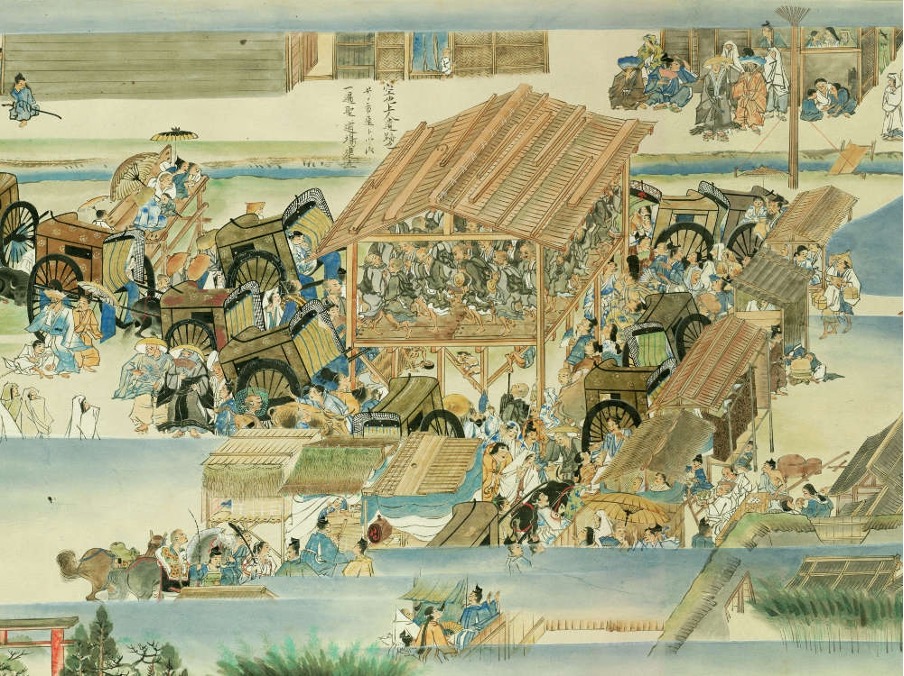
It was more than a religious ritual. Through voice and movement, people expressed the joy of being saved in the Pure Land. Even today, Bon Odori dances are held throughout Japan every summer.
As part of the Bon season, people gather to welcome and remember the spirits of their ancestors through communal dance. Behind this tradition lies a long history in which chanting Nembutsu while dancing became closely connected with the Buddhism of ordinary people.
For our visitors from overseas, this was a side of Japanese Buddhism they had never known.
Odori Nembutsu Reborn in the Modern Age
There is a reason I have spent some time explaining Pure Land Buddhism and Odori Nembutsu.
This memorial pilgrimage through Tohoku, carrying the Flame of Hope, was also a journey with Aminadabu, a Dharma music band that I lead seeking to bring Odori Nembutsu to life again in a contemporary form. Its members do not perform simply as musicians. As Buddhist practitioners, they express the Pure Land through music and carry the Nembutsu into sound, rhythm and movement.
The monks from Bhutan and India had expected to visit Japanese temples and offer prayers for those who lost their lives in the earthquake and tsunami. But for them, it was a new discovery that deep within Japanese Buddhist culture there was also a tradition in which monks make music and people chant and dance together. It was an encounter with another face of Japanese Buddhism.
Three Buddhist Traditions, One Stage
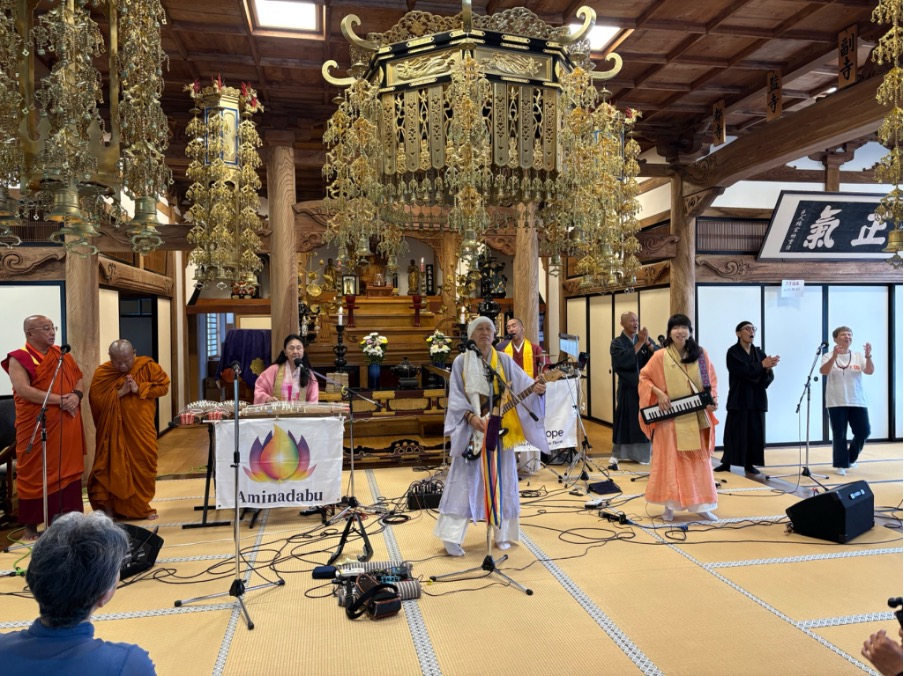
During this journey, Aminadabu performed at six different locations, including temples and shrines.
Following the customs of their own Buddhist traditions, Ven. Sonam and Ven. Ratneswar did not sing and dance. Instead, they stood on stage together with Aminadabu and chanted mantras from their own traditions. Monks from different Buddhist traditions were sharing the same stage. At every venue, the audience gradually began to sing “Namo Amitabha” and dance.
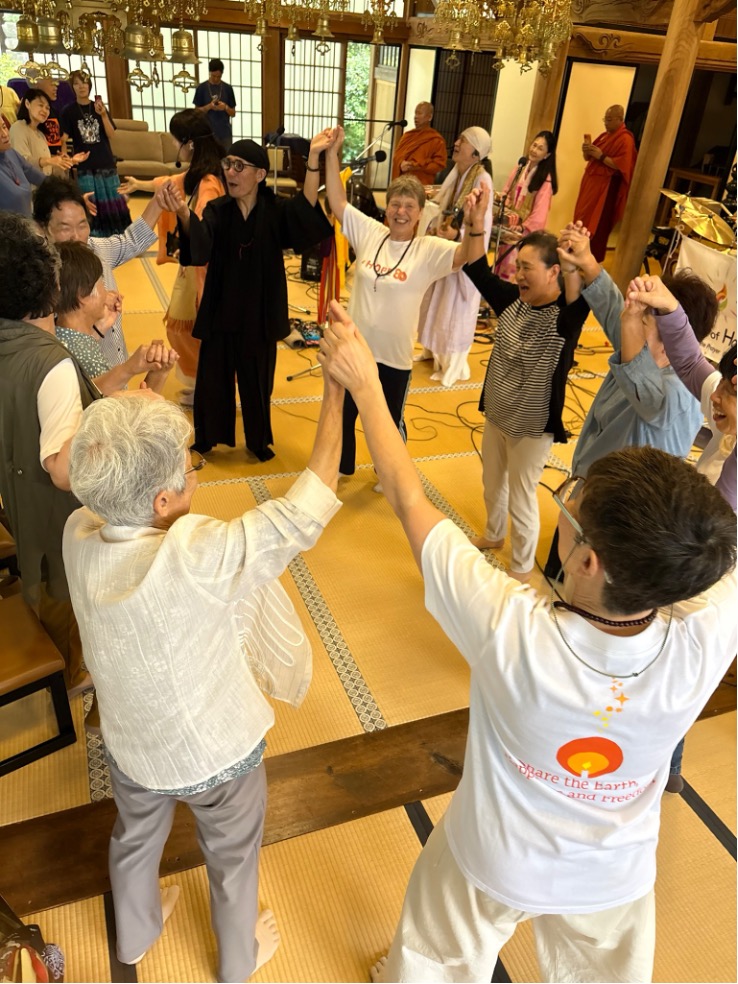
Monks, children, adults and elderly people all joined in. The boundary between performers and audience gradually began to fade. The people gathered there chanted the Nembutsu and moved their bodies together.
A shared space emerged, transcending the divisions between one person and another. It was as though the Pure Land itself had appeared in this world.
At the End of the Journey
After returning home, Ven. Sonam Dorji and Ven. Ratneswar Chakma each sent us their reflections on the journey.
Ven. Sonam Dorji wrote: “’Where there is determination, success will follow.’ The wisdom of this Japanese proverb reminds me that when our hearts are united by a noble purpose, every step becomes a prayer, every challenge becomes a teacher, and every act of compassion becomes a seed of peace. . . May the Flame of Hope continue to illuminate hearts across nations, transforming grief into compassion, remembrance into wisdom, and hope into lasting peace.”
And Ven. Ratneswar Chakma wrote: “Through the powerful sound of Aminadabu, we felt a message that went beyond words — a message of unity, courage, and connection among people. . . This experience has given us not only wonderful memories but also a deeper feeling of connection, gratitude, and peace.”
When the Boundary of “Me” Begins to Dissolve
Finally, I would like to share the words written after the journey by Phurich Inthep, the Thai university student who travelled with us: “By the time we arrived at the final live venue, my mind was full of work, deadlines, and all the worries I had left behind in Bangkok. But after the music had been playing for a while, I suddenly noticed something. The noise in my head had disappeared. People around me began to stand up and move their bodies, and eventually everyone joined hands. Without thinking, I found myself joining the circle too.
“I am Thai, and most of the people around me were Japanese. Our ages were different, our work was different, and our lives were different. But in that moment, those differences disappeared. It felt as though everyone there was moving on the same frequency. The boundary of ‘me’ began to loosen, and I felt as though I were dissolving into everyone around me. And afterwards, I felt strangely, deeply fulfilled.
“I want more people to experience this feeling. It was only then that I felt I began to understand why Ven. Ryokyu and the others continue travelling from place to place, carrying the Flame of Hope and their music. If moments like this can be created in even a few more places, then this journey is worth continuing.”
Different, Yet Resonating Together
Through this journey in Tohoku, we discovered something important. Buddhist traditions have different histories, forms and ways of expression. Yet when people pray together, raise their voices together and move together, difference no longer becomes distance.
Each tradition can remain distinct, while hearts resonate with one another and create a shared space.
Different Buddhist worlds gathered around one flame.
And there, a new Buddhist space emerged — one in which people could connect across the boundaries of different traditions.
Biography
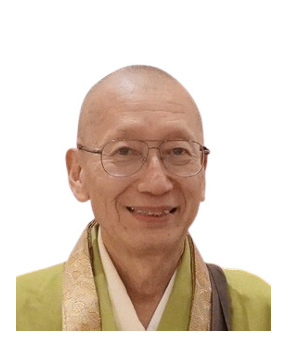
Ryokyu Endo was born in Tokyo, Japan, and spent part of his childhood in New York City. He is Chief Priest of Wada Temple in Japan, founder of Tao Shiatsu, a musician, and a peace activist.
He is the author of eight books, translated into seven languages, and has released six CDs through a major record label. He has taught in fourteen countries and has students around the world.
Ven. Endo is also the founder of the Flame of Hope, an international peace initiative that brings together sacred flames and prayers for peace across religious, cultural, and national boundaries. Flame of Hope International has been granted Special Consultative Status with the United Nations Economi.
Website: https://www.flameofhope.net/