

Goshir Gyaltsab Rinpoche, who is seen as an emanation of Vajrapani, stewards a lineage that dates back to Paljor Dondrub (1427–89), who received the title of “State Preceptor” from the Ming Chinese emperor (goshir being a Tibetan loan word from guoshi). He is one of the most senior teachers in the Karma Kagyu school of Vajrayana Buddhism.
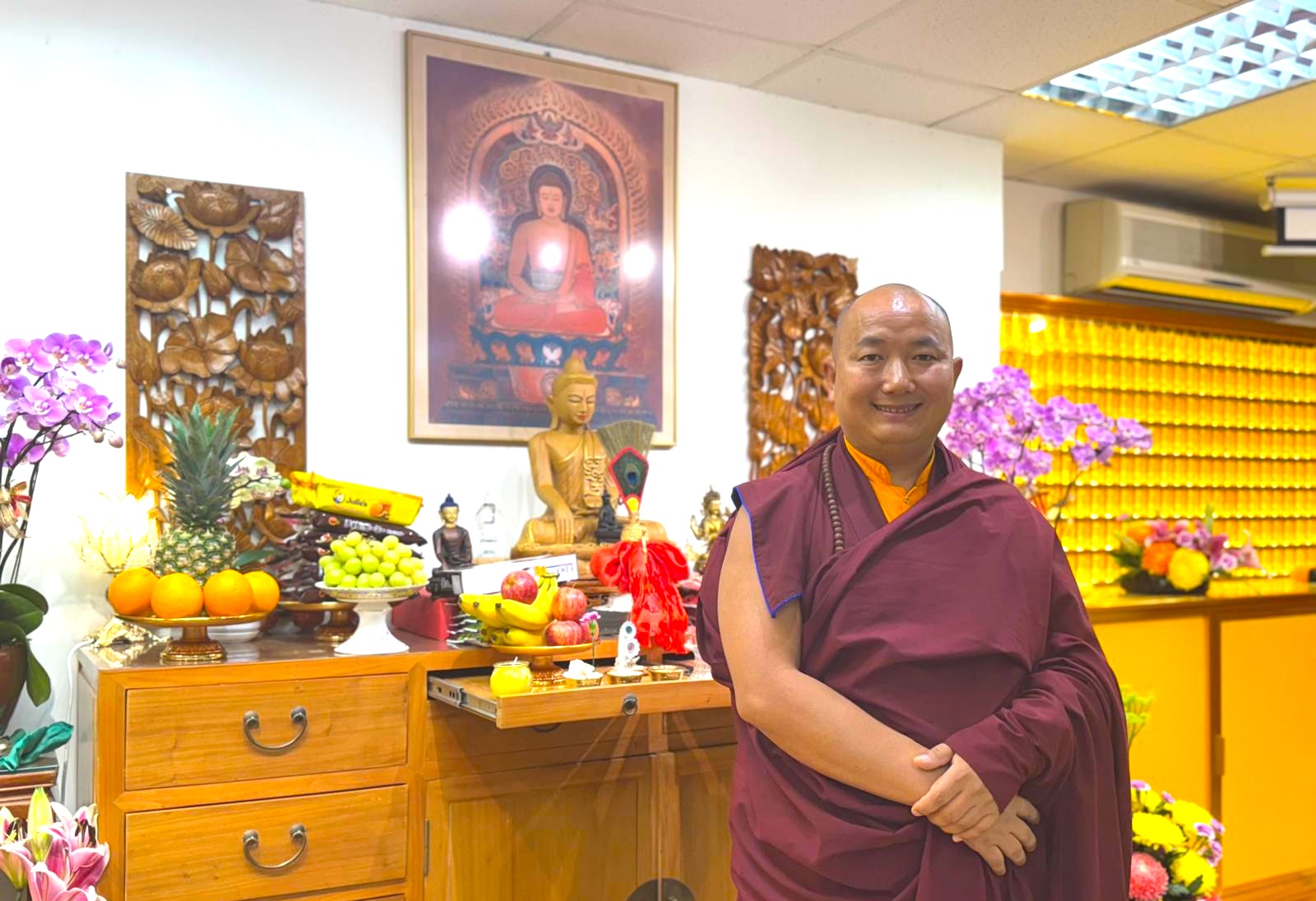
In recent years he has delegated his teaching to Tulku Rinjung Rinpoche, whose lineage was recognized by HH the 17th Karmapa as one that has produced teachers for the Gyaltsab Rinpoches throughout history. In April 2025, Ringjung Rinpoche was in Hong Kong to oversee the opening of a new center, and BDG caught up with him to explore some foundational ideas in the teachings he was giving that month.
Buddhistdoor Global (BDG): In deity yoga, the Vajrayana tradition has many deities to give devotion to. Why have you chosen Chenrezig as the central deity for your visit to Hong Kong in 2025?
Rinjung Rinpoche (RR): All sentient beings need to generate love and compassion, which is the root of practicing Dharma. Chenrezig is the embodiment of the love and compassion of all the Buddhas. This time, we are doing the four-armed Red Chenrezig empowerment, because all sentient beings possess Buddha Nature or the potential to be enlightened, but it is covered by obscurations. In order to clear these obscurations, Red Chenrezig is the most powerful deity.
BDG: You were explaining that the 12th Gyaltsab Rinpoche has a very powerful connection to four-armed Red Chenrezig.
RR: Yes, although all practitioners should build a bond with four-armed Red Chenrezig.
BDG: On this tour, you also are teaching the lojong. Can you explain why students need to learn lojong?
RR: In the age of degenerate Dharma, many people are suffering and busy, rushing here and there. Because of busy-ness, our conceptual thoughts are very frenetic and concrete, which only lead to more suffering. We don’t know how to handle these strong conceptual constructions, and therefore are unable to control our minds. So we will have all kinds of problems, like high blood pressure, insomnia, and many illnesses. The main purpose of lojong is to help students take care of our minds.
BDG: This is a world of increasing volatility. What do you tell your students who feel a sense of insecurity?
RR: The most important thing we can do here is to practice lovingkindness and compassion. Without practicing these qualities, you will become very easily angered against your enemies, or fall into negative emotions. There are so many wars and conflicts today, all of which arise from our attachment. Attachment and anger, in turn, have ignorance as their root. Ignorance is the source of why we have so much attachment and anger. We cannot recognize that all beings share Buddha nature and have the same potential for enlightenment. Therefore, discriminative mentality arises and we generate favoritism to those we like, animosity against those we do not. So, the main purpose of my teaching is to explore how we can handle our mind and eradicate our anger and attachment, and therefore dismantle (as best as we can) ignorance and dualistic thinking.

BDG: How can we practice when we understand the theory of non-attachment, but we still experience dualistic thinking in everyday life?
RR: There are many excellent methods. According to the scriptures, we must see all sentient beings as our parents. There are specific meditative practices for this. The practical effect of this is that we generate a respectful kind of love towards all beings. Another idea is the fact that all sentient beings possess Buddha-nature, and if we really took this to heart, really absorbed it, we would no longer be able to harm them, because they are all Buddha. So we have many methods for changing our mindset of discrimination. Another is the Akshobhya Buddha mantra. If you practice that, your anger will fall away. The Chenrezig mantra is also an incredible antidote to reducing our anger.
BDG: Your tour in Hong Kong also focuses on pujas, in particular chöd and liberation. What is unique about these two configurations?
RR: Chöd means “to cut,” in this case, the four demons or Maras. The first demon is the tangible demon (external objects, people, or phenomena we create constructs of in our minds). The second is the intangible demon (internal afflictive emotions and thoughts that grasps at appearances). The third is the demon of exaltation (attachment to spiritual or material joys, in particular how we feel happy or sad when receiving praise or criticism). These three demons come from self-grasping or ego-clinging, which is fourth demon in the form of arrogance (the fundamental self-cherishing thought). Defeating this fourth demon will also lead to the fall of the other three. Hence we practice chöd to cut through self-cherishing.
If you read the Jataka Tales, you’ll see the Buddha’s past lives as a king or prince, and he’s always cutting his body and offering it to benefit others. As ordinary beings, we cannot practice such selflessness, but we can emulate the Buddha’s example through visualization and, in doing so, give rise to our love and compassion.
BDG: What of the liberation puja?
RR: So many sentient beings suffer in the intermediate state of the bardo after passing away. The main purpose of the liberation puja is to show these beings how to move through the intermediary states. There are prerequisites, the first being the power of samadhi. The second is the power of mantra. The third is the power of ritual. If the lama or Rinpoche fulfils these prerequisites, they can bring the consciousnesses of the lost or wandering deceased beings to this puja, and through the ritual, release them from their suffering.
BDG: What is the right balance of meditation, morality, and ritual practice?
RR: The first thing we have to do is make offerings to the Three Treasures. Then our devotion to anyone, our guru, the deities, and so on, will arise easily. We can also read the biographies of the great masters, the mahasiddhis, and learn what practices they did. Devotion also arises from that. We do not blindly offer devotion, however. We must check whether a potential teacher comes from a pure lineage. We also need to make sure he is following proper samaya. They must be free from the Eight Worldly Concerns. And those teachers that feel happy when you praise them, or angry when you critique them, are very questionable and should be avoided. In contrast, if you see that the teacher shows compassion to students and is delighted by your service to the Dharma, then he would appear to be a good lama. Correct identification of a good teacher means a clearer spiritual path.
BDG: Do you have a final message for devotees engaged in Dharma work?
RR: Please maintain the mind of practicing Dharma. When we are happy or in a good situation with our jobs, families, and so on, we naturally feel very “Buddhist.” But can we maintain the teachings of self-lessness and non-attachment when we are down on our luck? Do we return to grasping and worldly modes of thinking? We should always keep in mind that the present moment is the most precious thing of all, even when we are suffering. Please remember: when you’re happy, this is the blessing of the Buddha. When you’re suffering, this is a test of the degree of your learning in the Dharma. Practice the Dharma without breaking, and maintain your practice. If water from the mountain does not flow continuously, it can never reach the sea.
Tashi delek!