
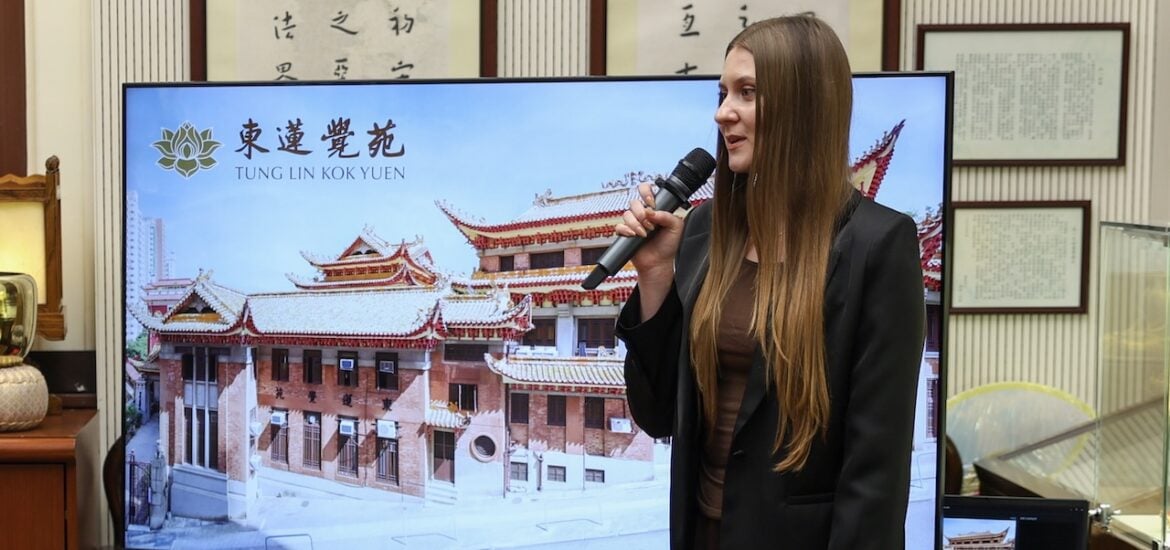
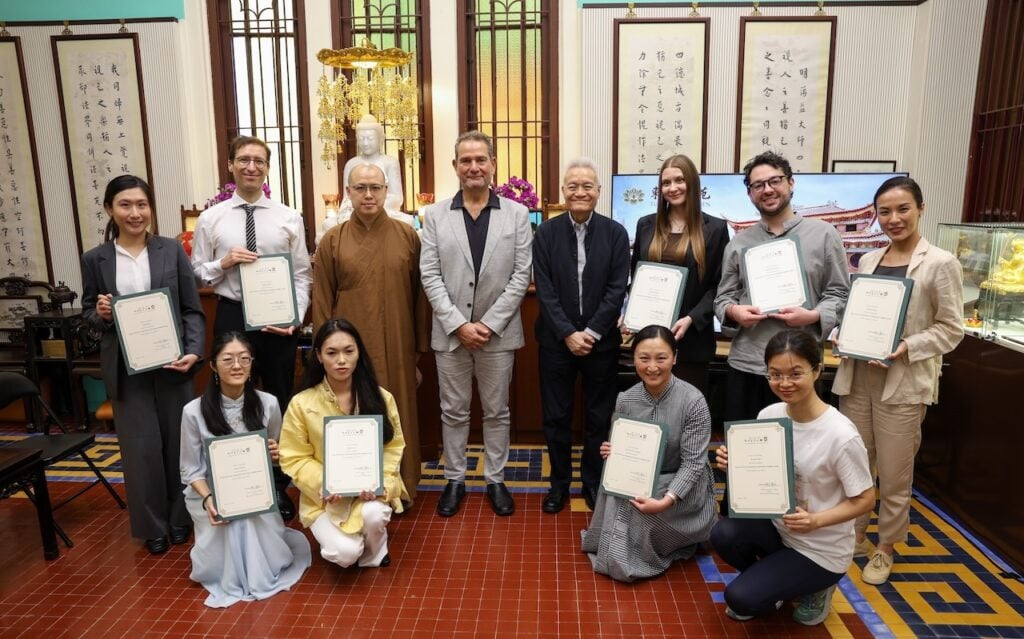
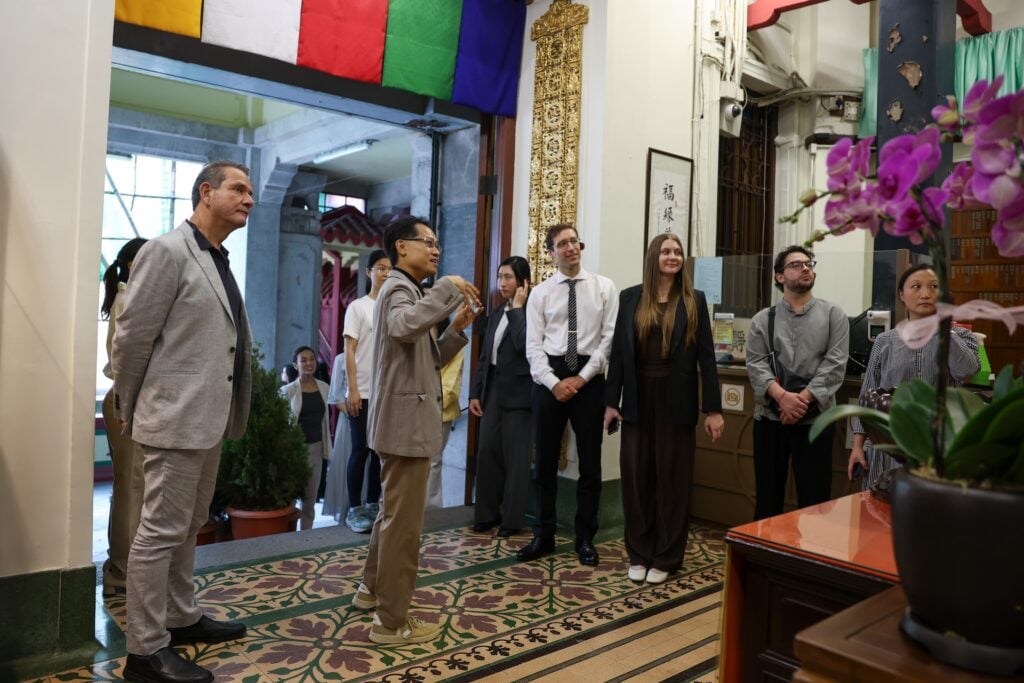
The Tung Lin Kok Yuen Postgraduate Scholarship in Buddhist Studies is a prestigious award bestowed on students of exceptional promise and potential. These students are enrolled in the Master of Buddhist Studies (MBuddhStud) degree program at the Centre of Buddhist Studies at The University of Hong Kong (HKU). As with each year, recipients of this prize are invited to tour the temple after which the scholarship is named, Tung Lik Kok Yuen. Ekaterina Norton and Giacomo Terelli were two such students among the cohort of 2026, and they discussed with Buddhistdoor Global how their individual backgrounds and aspirations have led them to a common goal and a shared visit to one of Hong Kong’s most distinctive temples and important Buddhist groups.
In this discussion, Norton shares how her reading of comparative philosophy and extensive travels have drawn her to learning more about Buddhism in an academic environment, so that she can enrich her understanding of Asian thought and religious traditions.
Buddhistdoor Global (BDG): How did you get interested in cultural studies and comparative philosophy?
Ekaterina Norton (EK): My interest in Buddhism started with meditation, which I have been practicing for several years. Over time, it made me curious about deeper questions regarding the mind, suffering, and how we understand ourselves and the world around us. My travels in South Korea and India also played an important role in developing this interest.
Visiting Buddhist temples in both countries, I noticed differences in their atmosphere, practices, and cultural expressions, which made me curious about how Buddhism adapts to different societies while maintaining its core teachings. Later, I became particularly interested in the development of Buddhism in China and its interactions with Daoism and Confucianism. I find it fascinating how different traditions influence one another, and this curiosity drew me to comparative philosophy and cultural studies.
BDG: Do you have an idea of the broad interests you intend to focus on during your MBS? If so, any pointers (Theravada, Mahayana, Vajrayana, textual criticism, philosophical schools, history, and so on)?
EK: I am particularly interested in Mahayana Buddhism and the development of Chinese Buddhist thought. I would like to understand how Buddhist teachings were interpreted in China and how they interacted with existing philosophical traditions. I am also interested in Buddhist art and architecture, especially how religious ideas were expressed through images, temples, and sacred spaces. For example, I find the relationship between Buddhist scriptures and their visual representations fascinating. At the same time, I want to build a stronger foundation in Early Buddhism and Sanskrit so that I can engage more deeply with Buddhist texts and develop my research skills.
BDG: How might the study of Buddhism contribute to a greater understanding of contexts with diverse philosophical conversations (such as the USA, Russia, or the world as a whole)?
EK: I think Buddhist Studies can help people approach different philosophical and cultural traditions with more openness and understanding. What interests me most is how traditions can encounter one another, exchange ideas, and develop in new ways, as happened when Buddhism spread to China. Studying these encounters can help us recognize that different cultures may ask similar questions about suffering, ethics, and what it means to live a meaningful life, while answering them in different ways. I believe this kind of study can create opportunities for dialogue without overlooking the differences that make each tradition unique.
BDG: As an American, how do you see the presence of Buddhism in the US today shift and change in terms of philosophical emphases, teaching priorities, and so on?
EK: One thing I find interesting about Buddhism in the United States is how differently people approach it. There are longstanding Asian American Buddhist communities, as well as people who discover Buddhism through meditation, mindfulness, or an interest in its philosophy. In some contemporary settings, there is a strong focus on mental well-being and the practical benefits of meditation.
While this can make Buddhist practices more accessible, I am also interested in what happens when they are separated from their wider ethical, philosophical, and religious contexts. I would like to explore more about how Buddhism adapts to American society and how this process can both open new possibilities and raise important questions about what is preserved or left behind.