
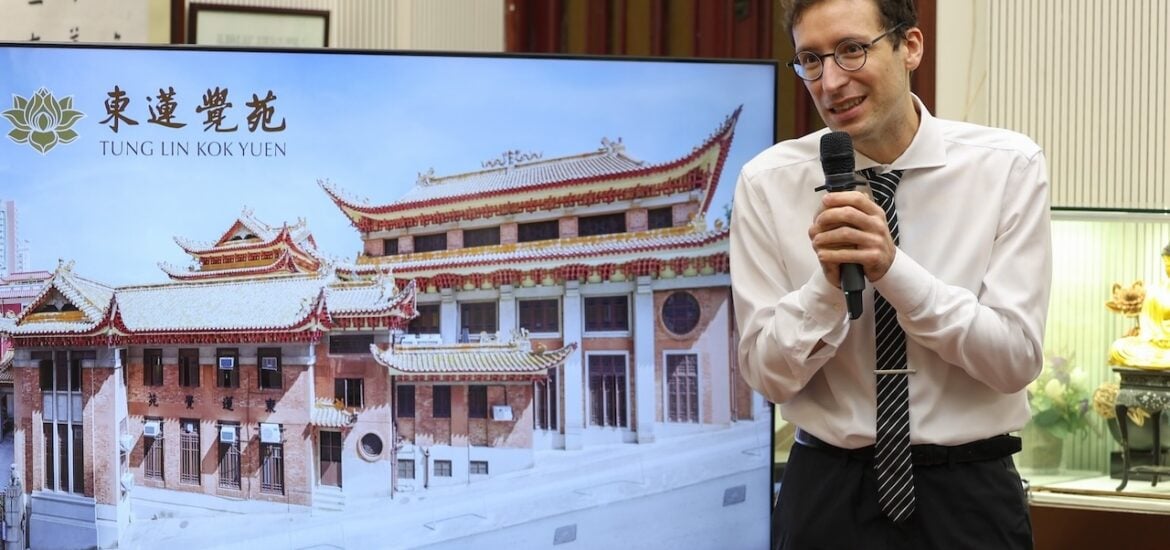
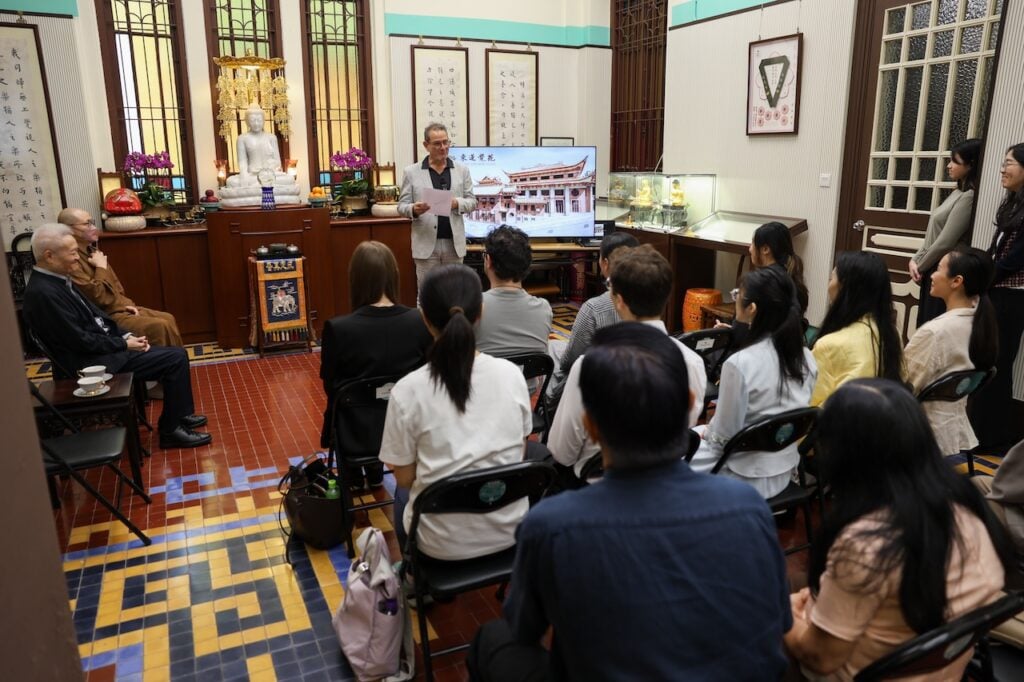
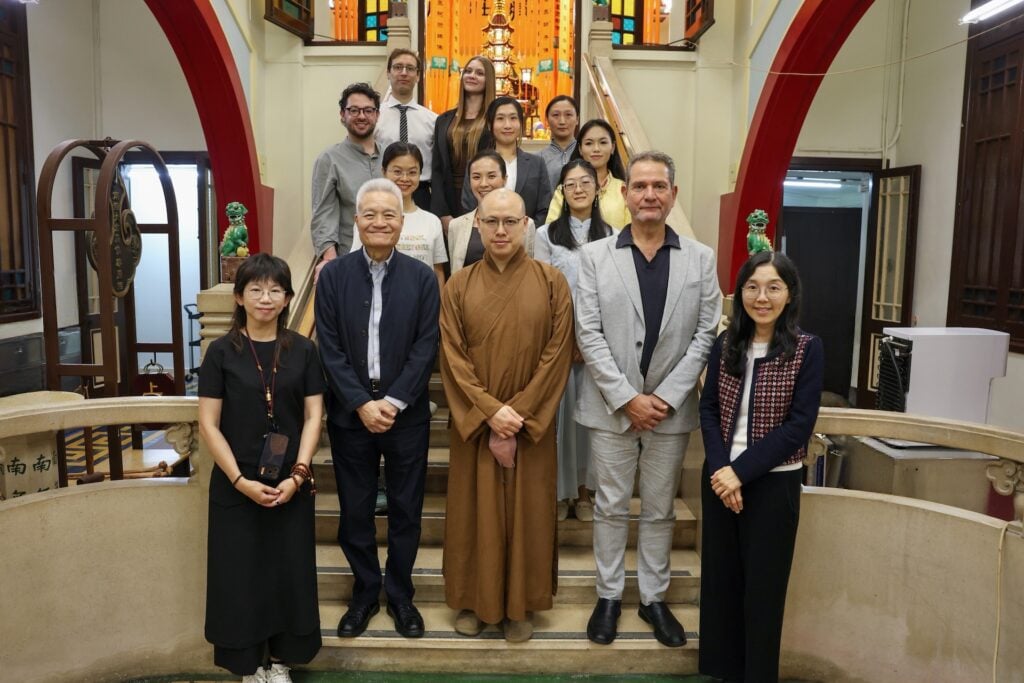
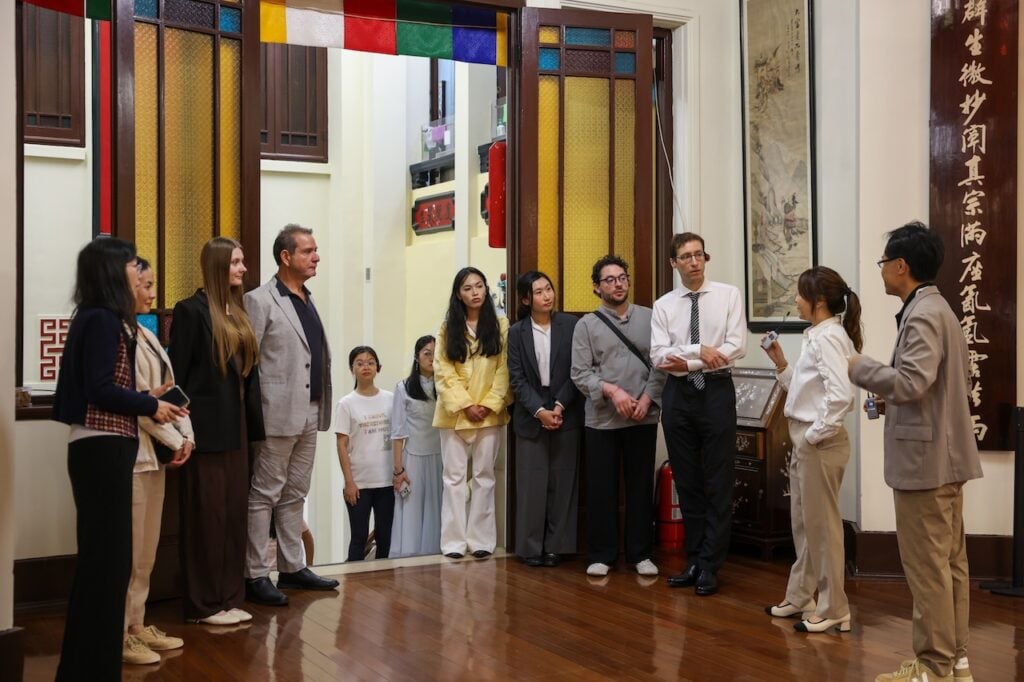
The Tung Lin Kok Yuen Postgraduate Scholarship in Buddhist Studies is a prestigious award bestowed on students of exceptional promise and potential. These students are enrolled in the Master of Buddhist Studies (MBuddhStud) degree program at the Centre of Buddhist Studies at The University of Hong Kong (HKU). As with each year, recipients of this prize are invited to tour the temple after which the scholarship is named, Tung Lik Kok Yuen. Ekaterina Norton and Giacomo Tirelli were two such students among the cohort of 2026, and they discussed with Buddhistdoor Global how their individual backgrounds and aspirations have led them to a common goal and a shared visit to one of Hong Kong’s most distinctive temples and important Buddhist groups.
Giacomo Tirelli reveals how the Dharma might be able to contribute to the resolution of structural injustices that he witnessed in South America, and discusses his interest in international development and Buddhist thought’s potential contributions.
Buddhistdoor Global (BDG): During your recent volunteer experience in South America, you got involved with providing primary education to young people from very disadvantaged, poor neighbourhoods. What did you learn from the experience? How do you see your studies in Buddhism benefiting your contribution to society, and why did you choose to pursue them?
Giacomo Tirelli (GT): South America is a beautiful continent, and every country I visited offered something extraordinary. During my travels, I felt the need to give back to local communities and learn from their knowledge, resilience and kindness. I decided to volunteer in Trujillo, Peru, helping provide basic education to children and young people aged three to eighteen years old. Some had left primary or secondary school to work and support their families, while others faced learning difficulties.
My main role was to teach various school subjects, but I soon discovered that the work also included food distribution, cultural activities, support for older people and individuals with disabilities, and the organisation of extracurricular activities and events.
The children and their families faced serious and complex challenges, including lack of sanitation, poor health and inadequate nutrition. In such circumstances, meeting basic needs is a priority. Education can help children imagine and build a better future. The NGO held many success stories of young people who continued their studies through university and were later able to improve their living conditions and support their parents.
However, many also remained in the same disadvantaged situation. Hearing repeatedly phrases such as “we are stuck here; it will all be the same” broke my heart. When someone sees no possibility of a better future, finding the daily motivation to study becomes very difficult. This made me reflect on how education can support both practical opportunities and a sense of hope.
It is difficult to talk about introducing the Dhamma and meditation into a curriculum when children do not have enough to eat and live in homes without running water. A story in the Dhammapada commentary describes the Buddha arranging for a hungry man to be fed before teaching him the Dhamma (Dhp-a III 261–264). Addressing poverty and structural exclusion is therefore essential. Alongside this, Buddhist teachings and meditation may offer tools for emotional support and empowerment. Research on mindfulness in educational settings has explored potential benefits, but any approach would need to respond first to the children’s needs and the local context.
I am still at the beginning of my studies, and I would like to understand these possibilities more deeply. The Master of Buddhist Studies at the University of Hong Kong offers opportunities to explore applied areas such as what we are learning in the course on Buddhist psychology and mental cultivation. I have chosen to study Buddhism because I believe its precious teachings are valuable for each of us, as well as for educational and peace projects in general.
BDG: You characterize peace and development as needing a stronger foundational basis, which might be found in Buddhism. What might Buddhist principles provide that today’s system of UN-driven peacemaking and international law lacks?
GT: More projects and sustained funding in public projects, conflict prevention, dialogue and peacebuilding are essential. The work of my colleagues and of people across these fields is extremely valuable, often under very difficult circumstances. At the same time, persistent conflicts and overlapping crises and challenges raise serious questions about how far that progress reaches.
Multilateralism is often associated with dialogue, but bringing people or states together does not automatically mean that they can engage on equal terms to maintain or bring peace. We need to ask what views and concerns shape the discussions and whose interests determine the outcomes. Debates about UN reforms recognize the need for more representative and accountable decision-making.
In this respect the inclusion of women, young people, gender minorities, indigenous peoples and other historically excluded groups in dialogue and conflict prevention, as well as in policy making in general, is essential. However, participation alone is not enough. We should ask: participation in what, and with what degree of influence? For example, having an indigenous representative at the table does not unfortunately necessarily mean that their knowledge and priorities will necessarily inform the decisions being made.
Buddhist teachings can help move away from a “business as usual” approach. Buddhist principles can strengthen the ethical foundations of this work. Our perceptions and priorities are not simply originating from nothing. Buddhism can contribute to make us understand how our intentions, habits and even priorities are conditioned, both on a personal level and at a decision-making table. It can help us identify what key factors are shaping our views and how to work towards reducing such biases.
Applied to peacebuilding, I think this encourages us to look beyond immediate symptoms and recognize the many conditions sustaining a conflict or issue. These problems often involve complex, interrelated conditions. No single actor can address them alone, nor claim to have a solution that serves everyone. Hence Buddhist teachings to understand how things really are, and to develop ethical conduct, concentration and wisdom, could help proposing new practical approaches to work together in multilateral setting to advance durable solutions.
Many roots of conflicts often rest on the wrong assumption of a given “us” versus “them.” Buddhist teachings of impermanence and no-self can help us to move beyond self-centered, subjective views. Once we move beyond a “mine” notion, all other assumptions such as “my country” will also become unnecessary. The breakup of such binary distinctions, which are often at the root of many conflicts, will prompt us to seek union rather than division, peace rather than conflict, harmony rather than misery.
Other important teachings may include active listening and the cultivation of loving-kindness for other human beings around the world and for our beautiful planet. The applications of Buddhist teachings to development, conflict prevention and dialogue and peacebuilding are numerous and diverse. These can also prompt the protection of our environment, planet and wildlife, which goes hand in hand with harmony and peace. The teachings are various and precious. The teachings I mentioned here are a just a small sample.
BDG: How can Buddhist ideas contribute to conflict prevention before conflict resolution is needed?
GT: For conflict prevention, I think the practical question is how we recognize and respond to hostility before it becomes deeply entrenched within us. Buddhist teachings can show us how we often respond to things and phenomena in an automatic way, in a pattern, or in similar ways. We become accustomed to reacting to a stimulus in particular manners, and this gets repeated and repeated, every time reinforcing the likelihood that we will react in a similar way the next time that a similar stimulus will appear. Usually when provoked, offended or attacked, we react based on greed, hatred and delusion. We often later regret. However, it is hard for us to prevent reacting blindingly and in negative ways. This happens at interpersonal levels, as well as in international settings. Buddhist teachings enable us to examine these habits, and invites us, rather than immediately reacting to something, to reflect and consider our actions first and foremost, and try to act positively and nicely.
Buddhist teachings can help us understand how conflict often originates by our clinging to a particular view or ideology. Once we adopt an opinion on something, soon after because of subjectivity, we start to cling to it. We tend to overemphasize the rightness and correctness of a particular set of views. We perfume it with our subjectivity, making the view ‘mine’ or ‘ours’. This also happens when a person wrongly regards another human being, or an entire group, as inferior or undeserving of equal rights and respect. This is highly problematic and often linked to radicalization. This trend unfortunately is common, fostering hate, discrimination and extremism.
Buddhist teachings about how the mind works allow us to uproot such attachment to views. For example, the Abhidhamma analyses of mind, consciousness and mental factors, encourages us to examine the intentions and states of mind from which our actions emerge. Once we understand how our mind works, we can comprehend how conflicts are a product of impermanent conditions. With the removal of such conditions, they can thus be prevented. Understanding how things really are, allows us to see how all conflicts are unnecessary and counterproductive and how they make us more miserable.
Buddhist teachings are key for inner cultivation and social responsibility. The cultivation of good ways of thinking, speaking and acting, simultaneously reduce the likelihood of conflict and harm in our lives and in the lives of others. Right speech offers guidance on avoiding falsehood, divisive speech and harmful ways of communicating.
Finally, Buddhist meditation and mindfulness can help us prevent blind reactions and with time build a new routine making us rooted like a tree, not shaken by provocations. Buddhism also teaches us how to cultivate compassion and loving-kindness for all people and the planet indiscriminately. All these teachings are essential to prevent conflicts.
BDG: What are you most looking forward to about your time in Hong Kong?
GT: I am very grateful to have been awarded the Tung Lin Kok Yuen Postgraduate Scholarships in Buddhist Studies 2026-27. Thanks to the scholarship I can pursue the studies here.
I have not yet had much time to explore the city. My studies are my priority for now. Some days I spend around twelve hours studying, which is demanding, but I am grateful to be able to dedicate this time to something so meaningful.
The Master program started in September. I already feel that I have learned an enormous amount. The professors are wonderful experts in their field. They have written books and are always available to respond to any questions. The variety of courses offered is equally impressive. The Master is giving me an in-depth and comprehensive understanding of Buddhist teachings and the opportunity to examine them from various disciplines such as art, philosophy and history. I am also learning Pali language. I am looking forward to exploring the connections between Buddhist psychology and ethics and to learning through exchanges with professors and fellow students.
I would like to thank once again Tung Lin Kok Yuen for the scholarship and to the Centre of Buddhist Studies for accepting me in the Master program. I look forward to working diligently and applying what I learn in my future career.