
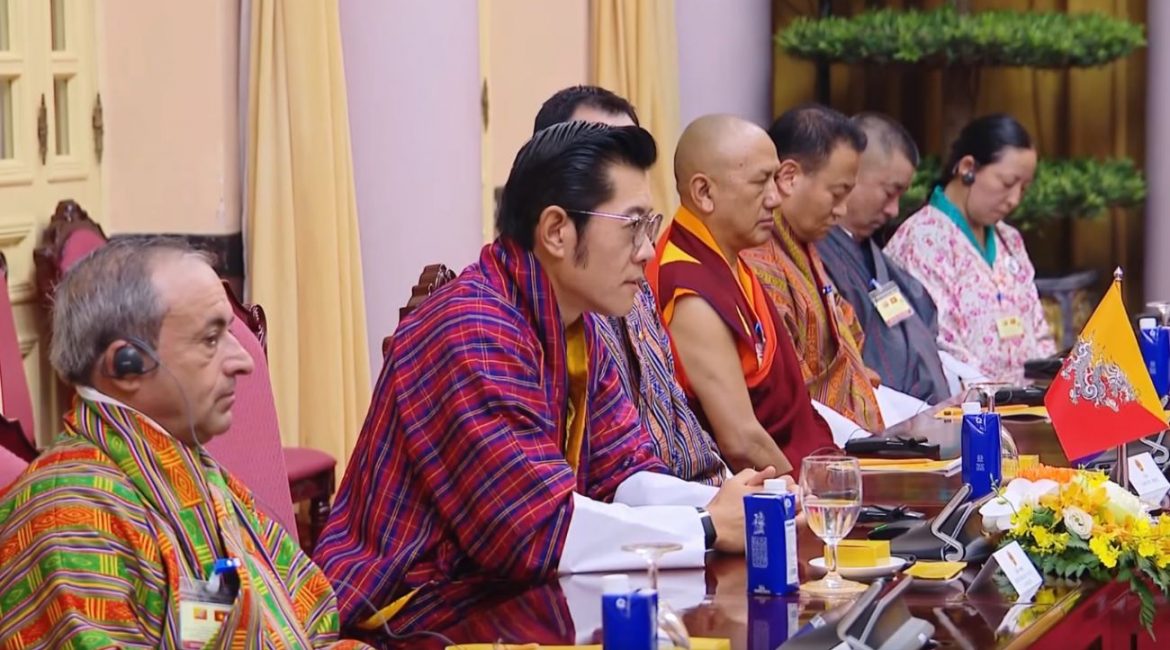
Since first establishing diplomatic ties in 2012, His Eminence Sangay Dorji, one of the most senior monks, has been a frequent visitor to the Southeast Asian nation, ministering to large crowds of Bhutanese expatriates as well as Vietnamese converts. On 19 August, he accompanied his monarch to Hanoi to meet the Vietnamese leader and government figures. This was His Majesty Jigme Khesar Namgyel Wangchuck’s first official visit to the socialist Southeast Asian country as head of state.
Footage, shot by Vietnam News Agency of the meeting between the king of Bhutan and Vietnamese state president, Luong Cuong, shows Sangay Dorji sitting to the king’s left, a silent sentinel watching Bhutan’s friendship with Vietnam unfold. This meeting, no doubt, was partly or mostly thanks to his quiet and steady hand behind the scenes.
Both countries’ governments seem to admire the other. According to the website Vietnam+, Mr. Luong said that his talks with the Bhutanese king were of a “sincere, profound and positive atmosphere,” and their bilateral cooperation spanned the “economy, trade, investment, culture, tourism, people-to-people exchange, connectivity and issues of mutual concern.” (Vietnam+) For his part, the king expressed his admiration for the endurance and vitality of the Vietnamese nation, and also shared how much he respected the “father” of the country, president Ho Chi Minh (it is the 80th anniversary of Ho Chi Minh’s founding of modern Vietnam).
As his student, I have observed how Sangay Dorji diligently cultivates friendships and attends to Buddhist communities in the Asia Pacific region and Southeast Asia; namely Vietnam, Australia, and Thailand. With the exception of Australia (which still hosts a large Bhutanese immigrant community), Thailand and Vietnam are countries notable for not only their Buddhist heritage and nationally supported sanghas, but also their fierce geopolitical independence and careful balancing act of larger powers.
Since Sangay Dorji is also welcome in both India and China, it is possible that Bhutanese officials are positioning the country in the center of a nexus that forms a “great vajra” of Buddhist diplomacy. Four points in the directions of China, India, Vietnam, and Thailand would serve as the perfect balance for Bhutan: to be a “pivot” through which the Buddhist diplomacy of four major Asian countries, some of them with ongoing disputes, flows through the Land of the Thunder Dragon.
Vietnam, an officially communist country, would initially seem an odd choice for a constitutional monarchy in the Himalayas that also needs to listen to the foreign policy priorities of New Delhi. Yet, as King Jigme Khesar Namgyel Wangchuck noted, historical heritage can serve as a compass guiding both peoples toward a better future. This is an important nod to the work that Sangay Dorji has done in connecting people and practitioners, allowing Vietnam and Thailand a window into the Drukpa Kagyu institution of the Central Monastic Body.
The king has proclaimed that Bhutan, a small and landlocked kingdom with a small population but considerable natural resources and outsize soft power, has much to offer to, and simultaneously learn from Vietnam. He said that as dual lands of “dragons,” their relationship can be strong, confident, and eternal. Not every diplomatic step needs to be a Buddhist one, of course, but there is no doubt that Buddhism will continue to facilitate diplomacy between Bhutan and friendly countries.
See more
Vietnamese State President hosts banquet in honour of visiting Bhutanese King (Vietnam+)
State President holds talks with King of Bhutan (Facebook)
Related blog posts from BDG
Sangay Dorji’s Dhammadhuta award is evidence of his increasingly non-sectarian reach
Related features from BDG
H.E. Sangay Dorji’s Vision for Global Buddhadharma: Bhutan Steers Buddhism Toward the Future