
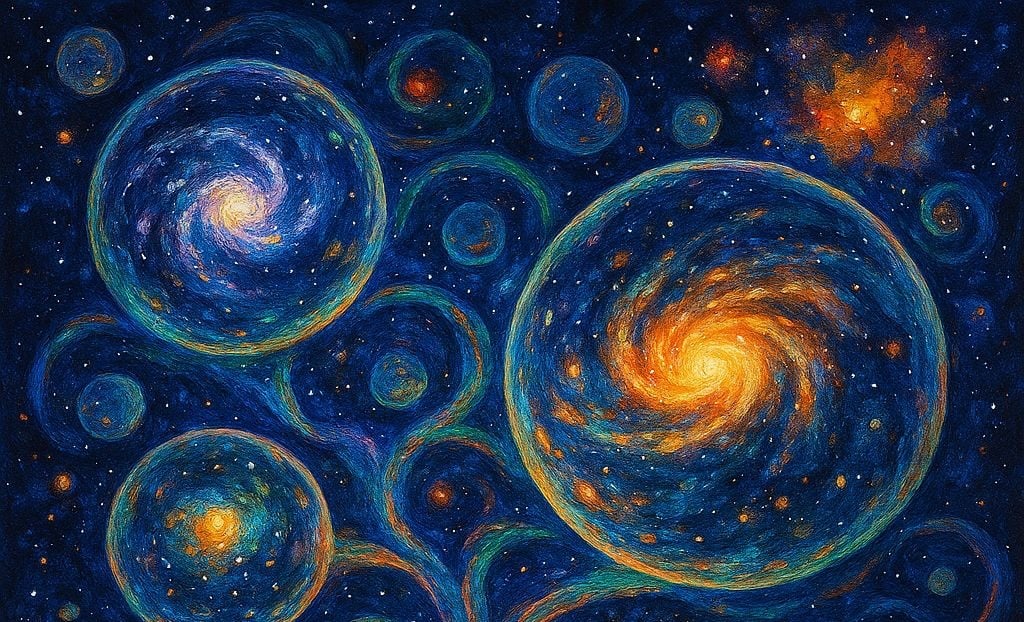
The most fascinating potentiality of our universe is that it is only one of many. Whether it is physically non-distinct from other “pockets” of existence that might be out there, or dimensionally the only plane of reality that we can perceive, is the subject of much heated debate among the greatest minds of our time (and probably other not-so-qualified, chronically online minds). As former editor Thomas Polin pointed out while hosting director Laurence Brahm for a dialogue after Brahm’s film screening (of Searching for the Lotus Born Master: Eight Manifestations of Quantum Energy) with Buddhistdoor Global at Asia Society in Hong Kong in July, science is still catching up to insights that Buddhist siddhis and sages had realized centuries ago:
Take for example quantum physics, quantum energy, the whole idea that in its ultimate form, everything can be boiled down to energy. That all is one is a very well-known Buddhist teaching from the Avatamsaka Sutra. And another is the idea of multiple universes and multiverses. In the Buddhist sutras, for example, you have Buddhas and bodhisattvas zipping throughout the cosmos all the time, calling on, making offerings to other Buddhas, and very advanced beings; and without regard to time or space which really doesn’t exist. That’s the picture that you can get from just reading any number of Buddhist sutras. It’s stated as a matter of fact.
But it’s only within recent decades, I suppose, that science has become to talk seriously about the absence, when you take it to the bottom line, the absence of time and space, and therefore the possible of existence of multiverses, parallel universes, all at the same time.
In Science Focus on the BBC, an article from July stated that from listening to the baryon acoustic oscillations left by the Big Bang, it is possible that we are living in a “void,” defined as a billion-light-year-wide emptiness that has a remarkably low density of galaxies (20 per cent lower than the universe’s average). The scale is difficult to comprehend, and of course, the immediate significance is only that our tiny galaxy might be much lonelier than once thought. And from a linguistic perspective, “universe,” or indeed “observable universe,” encompasses all of reality, so anti-multiverse proponents would decry the term as a meaningless one. But just because we have not found the right way to test the multiverse theory, does not mean that one does not exist.
“An infinite number of alternate little pocket universes, or bubbles universes, some of which have different physics or different fundamental constants, is an attractive idea,” writes Nadia Drake for National Geographic, quoting physicist James Kakalios. (National Geographic) Primordial gravitational waves are now the target for detectors of the Ali Cosmic Microwave Background Polarisation Telescope (AliCPT), which hunts for the beginning of the universe’s echoes in Tibet’s remote Ali prefecture. It is not only a statement of Sino-US cooperation amidst a geopolitical relationship that is otherwise fraught with mistrust and adversarial, hostile feelings. It is China and the US throwing their hat into the ring, betting on the secrets of the universe’s origins being found high up on the Tibet-Qinghai Plateau.
And here, we might just find multiversal potentialities. Buddhism has never needed to depend on the validation of science, but as technology advances, we might just get our first glimpses of the multiversal bodhisattvas.
See more
Earth may be trapped inside a giant void in space, say scientists (BBC Science Focus)
What is the multiverse—and is there any evidence it really exists? (National Geographic)
Related blog posts from BDG
Quantum Buddha: A Dialogue with Laurence Brahm
Starry Buddha: Searching for Primordial Gravitational Waves on the Tibetan Plateau