
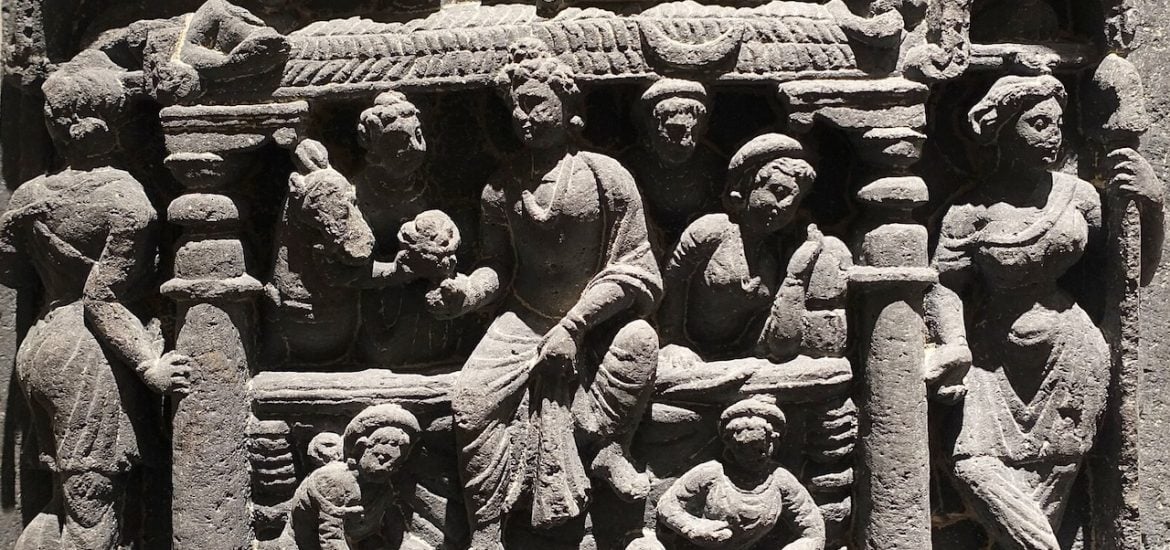
Her eyes were red, not with anger,
But blazing with the fire of separation;
Pain was lodged in her throat,
Her breath breaking into trembling sobs.
Tears shattered the embankments of patience,
And the heart drowned in an unfathomable current of grief.
“Channa! Where has the radiance of my heart gone,
The one who left me while I slept at night?
Three departed, only two returned,
Kanthaka and you; why did he not come back?
This sight makes my very soul tremble.”
“What kind of friendship is this, so ruthless, so inhuman?
Why then these tears, when the deed is so cruel?
Restrain your tears, show cheer!
Your tears do not befit your action.”
“A prudent enemy is better
Than a foolish friend skilled in the improper;
Calling yourself a friend, O ignorant one,
You have driven this lineage toward ruin.”
When the minister returned to the city that day,
The queen roared like a lioness:
“Channa! Where is my lord of life?
Go, bring him before me at once!
I shall not rest until I see him.”
“Those tender feet, like lotus fiber,
Webbed toes, softness like petals,
Hidden heels, wheels upon the soles –
How will they endure the forest’s harsh ground?”
“He who was accustomed to rest and repose in palaces,
Adorned with aloe, sandalwood, and priceless garments,
How will that majestic body survive in the forest,
Struck by cold, heat, and rain?”
“In the forest’s shadow there is
No seat for you, no refuge.
An unceasing fire burns within my heart;
I beat my breast, hand upon my heart, and weep.”
“Beloved! Do you now sleep upon forest flowers?
Have those tender feet filled with pain?
Are the hosts of gods guarding you?
My lord, my elephant king,
O master of my life – where are you?”
This poem is is attributed to Arvind Kumar Singh, a modern Hindi poet and translator. It comes from his retelling of episodes from the Buddha Charita and related Pali sources, where he renders Queen Yaśodharā’s grief after Siddhartha Gautama (the Buddha) leaves the palace. Singh’s work blends classical Buddhist narrative with contemporary poetic expression, giving voice to Yaśodharā’s anguish in a lyrical style.
The poem is born out of an instance when the palace of Kapilavastu is emptied. It is not an emptiness caused by putting out lights or locking doors but an emptiness felt for the first time in the heart of Yashodharā. As soon as Channa comes back, this emptiness, resonating with the beating hoofs of Kanthaka, settles deep into her. Siddhārtha, whose touch made her feel secure, is now beyond the walls of this palace, in search of the truth. News of this reaches Yashodharā not just as a separation but like a thunderbolt.
In this moment, numerous emotions rush into her, and among them are astonishment, anger, humiliation, fear, and limitless compassion. Her grief is not just the loss of her husband, but her cry is also that of a deserted woman who has been left with no words or explanation. Her question is not just a question of “why.” It is also whether love and family were smaller compared to the pursuit of truth. In her anger, she communicates coldly with Channa, but within her anger, her powerlessness and broken trust reside.
At the same time, in Yashodharā’s heart, a fountain of pity flows for Siddhārtha. The lord who was brought up amidst royal pleasures, who was used to silken beds, whose feet were so tender how shall he now walk on the harsh forest floor, how bear cold and heat and rain? All this anxiety heightens her lament. So the poem becomes an expression of Yashodharā’s inner turmoil, on one hand, a wife wounded by renunciation; on the other, a sensitive soul trying to understand a great resolve. This very tide of feelings creates the poem, which pours out as a thick voice of pain, interrogation, and mute pity.