

Tung Lin Kok Yuen 90th Anniversary International Conference: The Keynote Speaker Interviews
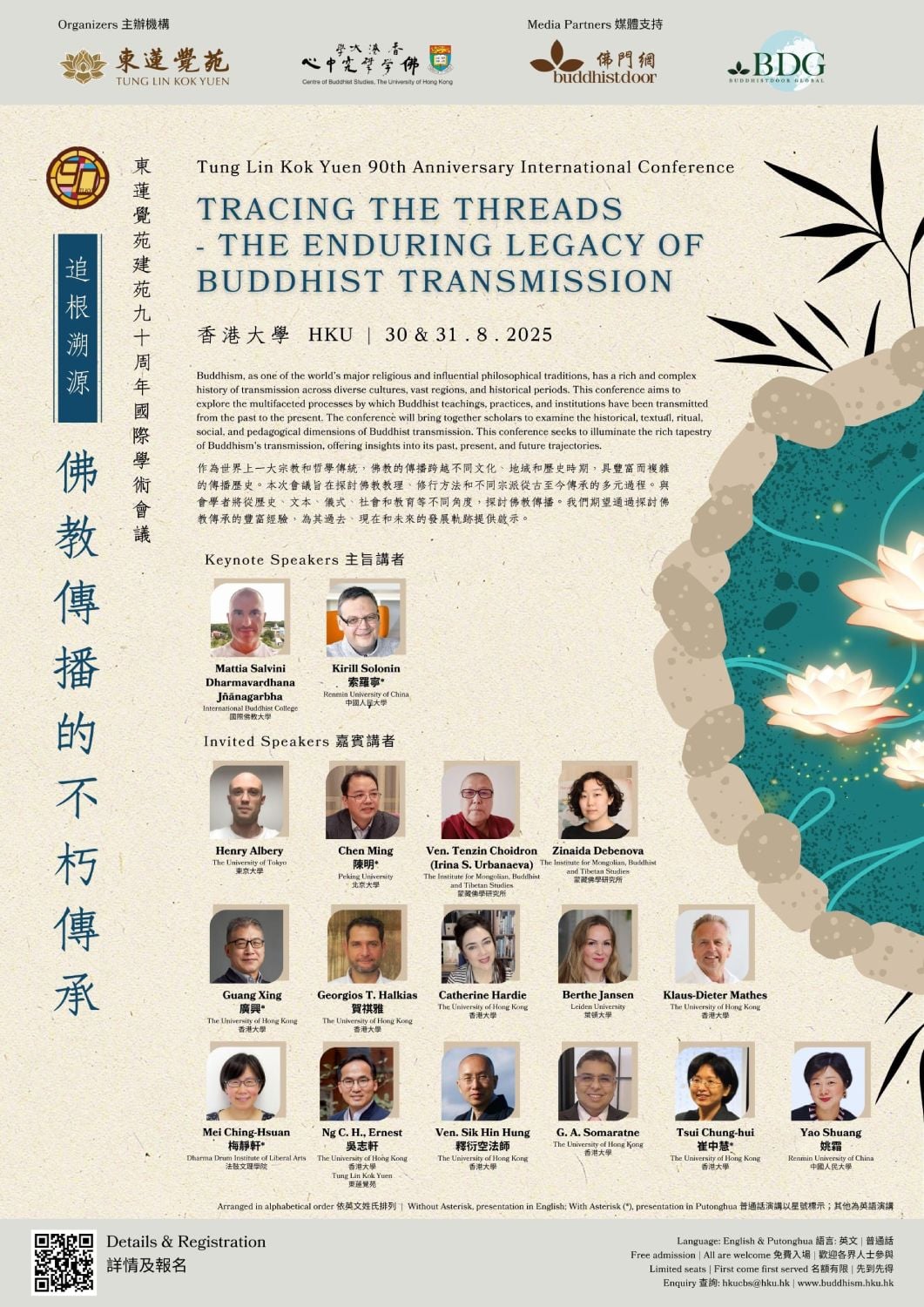
Held from 30–31 August 2025, the conference “Tracing the Threads – The Enduring Legacy of Buddhist Transmission” seeks to illuminate the rich tapestry of Buddhism’s transmission, offering insights into its past, present, and future trajectories. The conference was held to commemorate the 90th anniversary of Tung Lin Kok Yuen. In this series we interview the keynote speakers of the conference.
As the rector and dean of Liberal Arts at Thailand’s International Buddhist College (IBC), as well as a doctoral alumnus of the School of Oriental and African Studies (SOAS), Mattia Salvini Dharmavardhana Jñānagarbha would seem to be the face of the academic “establishment.” He acknowledges that he must force himself into a box of specific expectations in order to remain in this profession. The subject of Dharmavardhana Jñānagarbha’s upcoming lecture certainly would fit in a heady academic conference: “Two Sanskrit verses on Sukhāvatī: prosody, chanting, and the transmission of Buddhism from language to language and from place to place.”
But it is delving into the subject matter where he feels most comfortable: the full-throated study of Sanskrit, which he calls a “beautiful” language, one which deserves complete immersion: “I think a student should be exposed to non-Buddhist Sanskrit texts, like poetry (kāvya), so that they can enjoy the full range of Sanskrit’s subtlety and elegance,” he says. “And I believe in a balance between ‘classical,’ for lack of a better word, and postcolonial-inspired education.”
As a traditionalist, he is an astute if somewhat somber observer of the manifold problems dogging not only academia and Buddhist Studies, but the Buddhist world as a whole. One example is his observation that many young monastics that enter Buddhist Studies as the only route to any hope of position, prestige, and even income. “Monastic education is not flourishing in many traditionally Asian countries. Fewer young people have any interest in entering the monastic life, and therefore the kind of intensive training that would have immersed promising future monastic leaders and teachers in Pali or Sanskrit is fading.”
The overall picture is one in which the perspective of the “outsider” (the non-Buddhist scholar) is often lauded at the expense of the “insider,” or the Buddhist or committed believer. It is an inversion of the wisdom (often found in the discipline of theology) that an insider’s “academic objectivity” is not always compromised and can even be enriched by their commitment.
More problematically, much of Buddhist Studies’ prestige and even legitimacy is predicated on a foreign imposition of linear, secularized time upon the very epistemic foundations of Buddhism. Dharmavardhana Jñānagarbha says, “You might be familiar with current opinions from Buddhist writers who are concerned with how much epistemic ground Buddhist leaders have conceded to the scientific worldview. Although this arose out of good intentions and a genuine belief that Buddhist ideas were congruent with science, it has led to Buddhists measuring their teachings by the yardstick of science, with Buddhism conceding ever more and science offering nothing in return except a vague and ultimately superfluous sense of ‘validation.’”
On top of this epistemic concession that has unfolded over decades, an insidious “common sense” has crept into Buddhist academia, which in spirit is for non-Buddhists and Buddhists alike, in turn percolating into the Buddhist tradition itself. Teachings like karma, rebirth, and the supremacy of ethical volition—which would otherwise be taken for granted if scholars talk about Buddhism with a Buddhist understanding of reality and time, regardless of their “observability” or “empiricism”—are constantly having to be justified according to precisely these unexamined yardsticks.
“We give nowhere near enough thought to how we have almost forgotten or abandoned Buddhist conceptions of time: not entirely linear, probably not that real, and not so uniform in its perception. We have inherited and simplified scientific frameworks that do not work so well for Buddhist history, and perhaps for history in general,” observes Dharmavardhana Jñānagarbha.
Reporting on religious affairs requires a paradigm of constructive journalism, and a solutions-oriented approach is necessary. So, what can be done?
“I believe in a type of education that is well-rounded, and at a basic level that simply means more opportunities to study one or more among Sanskrit, Pāli, Tibetan, Chinese, Gāndhārī, and other Buddhist languages. A good future for Buddhism starts with some concerted effort, in as many places in the world as possible, to bring students back to the primary sources. That’s really what I try to do in my classes: to take a text and read it with students. Reading, especially with empathy, is where it all begins,” replies Dharmavardhana Jñānagarbha.
He also insists that educators need to dispel the widespread misconception that the Buddhist liturgical and canonical languages are difficult. Reading simply takes patience and a sense of comfort with “not getting it” right away, which he admits goes against the current cultural zeitgeist of fast and easy results with zero effort. But the idea of accumulated training, patience, and the joy of getting it wrong, and then less wrong, before earning that sense of gratification through refined skill, is actually the original spirit of education. Modern academia can return to it.
“An immersion in the primary sources is absolutely crucial because we have this idea of academics as critical thinkers, but think about it: if you can’t engage with the primary material, how are you supposed to judge the accuracy or truthfulness of any academic’s second-hand account of the Buddhist teachings, whatever their qualifications? And this has implications for the transmission of Buddhism, which is what TLKY’s theme for this conference is all about.”
Dharmavardhana Jñānagarbha urges that at the end of the day, Buddhists need to think like Buddhists, because no one else will. They need to try as much as they can, regardless of the outward trappings of academia, be it the culturally dominant view of linear time or the Western institution of secular degree holders. If even Buddhists do not think in terms of, and defend, the Buddhist texts, and embrace their worldview, cosmology, and so on, who will?
“I would love to see some progress towards this in the next three or four decades. That, however, seems very optimistic – it will more likely take many lifetimes. It doesn’t matter. To quote my late Guru, Ayang Rinpoche: ‘This is samsāra, we have to try.’”
Related blog posts from BDG