
By Wangmo Dixey
For the past 21 years, we have had the extraordinary privilege of working in Bodh Gaya to help strengthen the living traditions of Buddhism and bring the international Buddhist Sangha together beneath the sacred Bodhi Tree.
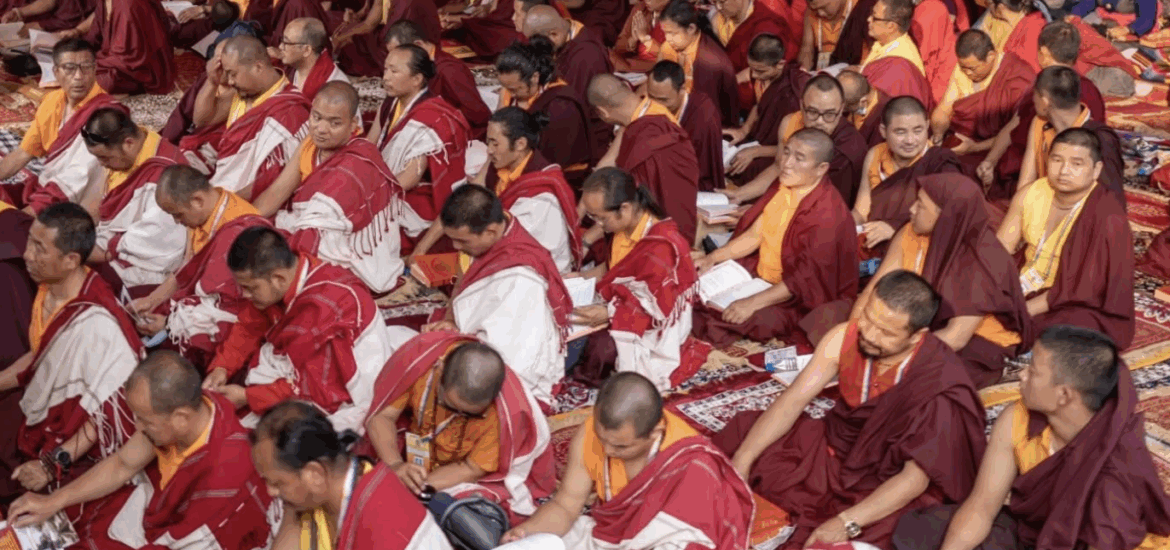
When we began the International Tipitaka Chanting Ceremony, approximately 250 Venerable Bhikkhus gathered to recite the words of the Buddha. Year by year, country by country, the gathering grew. Today, under the guidance of the Light of Buddhadharma Foundation International and the International Tipitaka Chanting Council, we are preparing to welcome approximately 25,000 participants from more than 22 countries this December.
What began as a relatively small gathering has become one of the great annual international Buddhist assemblies in Bodh Gaya.
This experience has taught us something important: Sacred places can come alive again.
They come alive through pilgrimage. Through prayer and chanting. Through scholarship and education. Through the presence of the Sangha. And, most importantly, through people returning year after year with devotion.
Bringing New Life to Odisha’s Diamond Triangle
It is with this same spirit that we are deeply honored to work together with the Government of Odisha, particularly the Department of Tourism and Culture, to bring renewed international attention to the extraordinary Buddhist heritage of the Diamond Triangle—Udayagiri, Ratnagiri and Lalitgiri.
These ancient sites preserve remarkable evidence of the flourishing of Buddhism in eastern India and of the development of some of the great monastic, Mahayana and Vajrayana traditions of the Indian Buddhist world.
Our vision is therefore not simply to create another Buddhist event.
It is to help reactivate a sacred landscape and transform an extraordinary archaeological heritage into a living heritage.
We hope to create an environment in which archaeology, history and academic research can exist alongside living Buddhist practice: where scholars can deepen our understanding of the past while monks, nuns, lamas, practitioners and pilgrims once again offer prayers in these ancient places.
Central to this vision is the life and legacy of Guru Padmasambhava, together with the many Buddhist masters, scholars and monastics who contributed to the extraordinary transmission of the Buddhadharma across the centuries.
Rediscovering Odisha’s Buddhist Story
The Buddhist story of Odisha reaches across a vast historical period. It invites us to explore the early foundations of Buddhism associated with the era of Emperor Ashoka, the great monastic and scholastic traditions that followed, and the later flowering of Mahayana and Vajrayana Buddhism, when some of India’s great tantric masters emerged and the teachings traveled across the Himalayan and Asian worlds.
Odisha was also an important gateway to the sea. From its ancient ports, merchants, pilgrims and travelers carried Indian culture, religious traditions, artistic influences and ideas across the Bay of Bengal to Sri Lanka and Southeast Asia.
This wider maritime history gives Odisha a special place in understanding not only the development of Buddhism within India, but also the extraordinary movement of Indian civilization across Asia.
We hope that Udayagiri and the wider Diamond Triangle can increasingly become places where these many layers of history are carefully researched, internationally discussed and brought into dialogue with living Buddhist practice.
In particular, we hope that the historical connections surrounding Guru Padmasambhava, the development of Vajrayana Buddhism, and the earlier traditions of the Buddhadharma in this region can be studied with academic rigor and brought more fully into the world’s understanding of Buddhist history. But research alone is not enough.
A sacred place becomes living heritage when people return to practice there.
The chanting of Guru Padmasambhava prayers and Tara prayers allows prayer and devotion to return to an ancient Buddhist landscape.
The Third Guru Padmasambhava Ceremony
This year marks an important milestone: the Third Guru Padmasambhava Ceremony in Odisha, from December 28, 2026 through January 5, 2027. For seven days, practitioners will gather in the Diamond Triangle for prayer, chanting, teachings, pilgrimage, and offerings.
The infrastructure for this gathering, including tented facilities and accommodation arrangements, will be supported locally by the Government of Odisha, while our foundation will sponsor food and a number of special Dharma offerings.
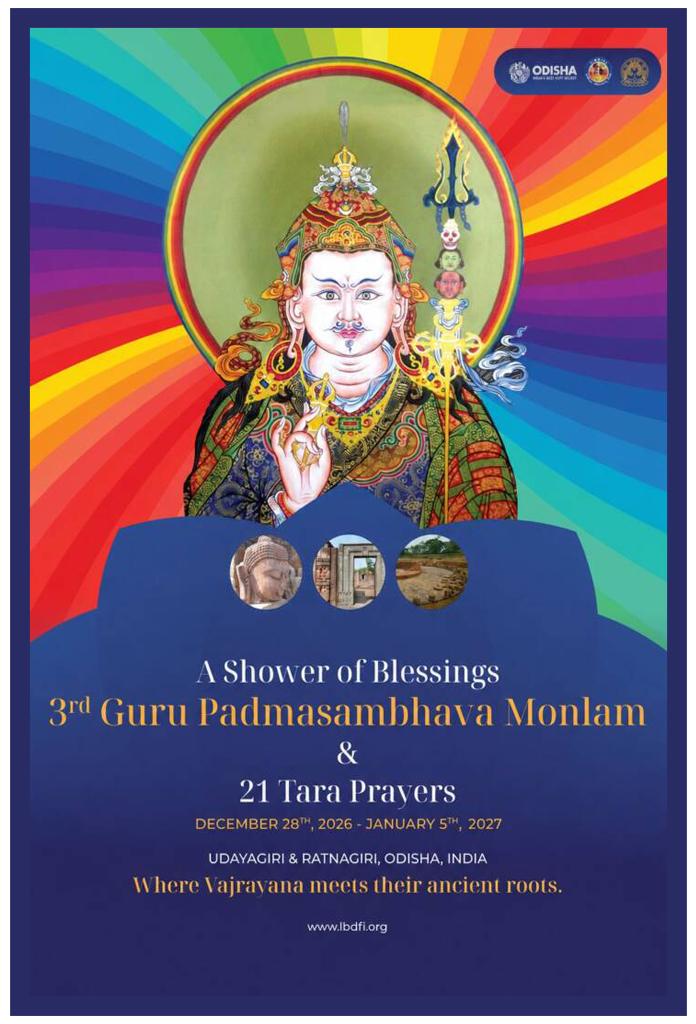
Among these will be texts containing Guru Padmasambhava prayers, enabling thousands of participants to practice together and then carry these prayers back to their monasteries, temples, Dharma centers and communities.
An equally important part of our work is to build stronger connections with the Buddhist communities already living in Odisha. We want to listen to their histories, understand their traditions and memories, and ensure that local communities become participants and partners in the rediscovery of Odisha’s Buddhist past.
A magnificent approximately 25-foot thangka of Guru Padmasambhava, coming from the United States, will also be displayed during the gathering, creating a powerful focal point for prayer and devotion.
A 40-Foot Image of Guru Padmasambhava
Perhaps the most significant moment of this year’s gathering will be the groundbreaking for a monumental 40-foot stone image of Guru Padmasambhava at Udayagiri. The project will begin this year and is expected to take approximately two and a half years to complete.
We hope this statue will become much more than a monument. We hope it will become alive with the living legacy of Guru Padmasambhava.
We envision it becoming a destination for pilgrimage—a place where future generations can encounter the legacy of Guru Padmasambhava, learn about the history of Vajrayana Buddhism in India, offer prayers and make a direct connection with the Buddhist heritage of Odisha.
Designed to last at least one hundred years, Long after any single ceremony has ended, the statue will remain. It will stand as an offering of gratitude, a symbol of continuity and an invitation to future generations.
Connecting the Himalayan Buddhist World with Odisha
For this vision to flourish, the gathering must reach far beyond Odisha.
We are therefore working to invite Buddhist communities throughout the Himalayan region— including Ladakh, Bhutan, Sikkim, Nepal, Siliguri, and the Tibetan and Himalayan communities of India—as well as the international Buddhist community already gathering annually in Bodh Gaya.
We particularly hope that monasteries, lamas, monks, nuns, young people and lay practitioners will begin to regard the Diamond Triangle as an essential part of their pilgrimage journey through India.
We are also deeply grateful for the participation of Tibetan lamas and nearby Tibetan communities, as well as the local villages and communities surrounding these sacred sites.
Its success will depend upon partnership—between Sangha and communities, scholars and practitioners, international pilgrims and local people.
What Bodh Gaya Has Taught Us
We know from experience that such a vision does not happen overnight.
Twenty-one years ago, we could not have imagined that a ceremony beginning with approximately 250 monks would one day bring tens of thousands of people together beneath the Bodhi Tree. It grew gradually. One ceremony led to another. One monastery told another monastery. One country invited another country. Pilgrims returned home and told others what they had experienced. Eventually, something much larger emerged.
Today, during the pilgrimage season from approximately September through March, Bodh Gaya comes alive with Buddhist activities and practitioners representing traditions from across the world.
This gives us great hope for Odisha. Our aspiration is that the Guru Padmasambhava ceremony will grow organically in the same way—not merely into a large annual ceremony, but into a catalyst for Buddhist pilgrimage throughout the Diamond Triangle and beyond.
A New Great Buddhist Pilgrimage Destination
Our long-term dream is ambitious: that the Diamond Triangle might one day become one of the great international Buddhist pilgrimage destinations of India, complementing Bodh Gaya and the other sacred places associated with the Buddha and the history of Buddhism.
For this to happen, spiritual revival must be accompanied by thoughtful practical development.
Better train connections, improved roads, easier air access, quality accommodations, multilingual information, pilgrimage infrastructure, trained guides, academic engagement and sustained international promotion will all make an enormous difference.
As access improves, pilgrims will come. As pilgrims come, local communities should benefit. Hotels, restaurants, transportation providers, guides, craftspeople, farmers, small businesses and young people seeking employment can all participate in a pilgrimage economy centered upon the preservation and celebration of Odisha’s Buddhist heritage. This is important because the revival of a sacred landscape should not exist separately from the people who live around it.
In the end, pilgrimage should also contribute to the economic and social uplift of the surrounding communities. Heritage preservation, spiritual practice, tourism and local economic development can strengthen one another when they are approached thoughtfully and sustainably.
A Vision for the Next 25 Years
We should therefore think not only about this year’s ceremony, but about the next 25 years.
Imagine thousands of pilgrims traveling each winter from Bodh Gaya to Odisha. Imagine monks and nuns from Bhutan, Nepal, Ladakh, Sikkim and across the Himalayan world gathering with practitioners from India, Southeast Asia, Europe, America and beyond.
Imagine universities conducting archaeological, historical and textual research alongside international Buddhist conferences. Imagine young people from Odisha learning about the extraordinary Buddhist civilization that once flourished on their own soil and becoming scholars, guides, preservationists and ambassadors for this heritage. Imagine pilgrims staying longer—visiting Udayagiri, Ratnagiri and Lalitgiri and then discovering the many other Buddhist and cultural treasures of Odisha.
And imagine Guru Padmasambhava prayers and Tara prayers once again resounding among the ancient Buddhist remains of the Diamond Triangle. Over time, perhaps a long-term Buddhist Pilgrimage Master Plan could emerge, looking 20 or 25 years into the future. Such a vision could connect sacred sites, archaeological preservation, pilgrimage routes, transportation, accommodation, research, museums and interpretation centers, local communities, international Buddhist institutions and annual ceremonies into one coherent whole.
The question is not simply: How many pilgrims can we bring next year? The greater question is: What could the Buddhist sacred landscape of Odisha become for the world over the next generation?
Planting the Seeds of a Pilgrimage Tradition
That is the deeper significance of this Third Guru Padmasambhava Ceremony. We are not simply organizing seven days of prayer. We are planting the seeds of a pilgrimage tradition.
Bodh Gaya has taught us that when the Sangha gathers, when pilgrims return, when sacred texts are recited, and when communities work together with patience and dedication, a sacred place can awaken again.
Our hope is that Udayagiri, Ratnagiri and Lalitgiri will increasingly become known throughout the Buddhist world—not only as extraordinary archaeological treasures, but as living places of Dharma.
We are profoundly grateful to the Government of Odisha, the Department of Tourism and Culture, the district administration, the local communities, the Sangha, the Tibetan and Himalayan Buddhist communities, scholars, supporters and volunteers who are helping make this vision possible.
This is only the third year.
We are at the beginning.
But if we nurture these seeds carefully, perhaps 25 years from now we will look back—as we do today at Bodh Gaya—and realize that something extraordinary began here.
May the Diamond Triangle once again become a great meeting place of pilgrimage, scholarship, practice and prayer, and may its blessings reach people throughout Odisha, throughout India, across the Himalayan region, throughout Southeast Asia and around the world.
Wangmo Dixey, Executive Director Light of Buddhadharma Foundation International
Related features from BDG
Related news from BDG
UNESCO Adds Odisha’s “Diamond Triangle” of Buddhist Sites to India’s Tentative World Heritage List
New Treasures Unearthed at Ongoing Ratnagiri Archaeological Excavation in Odisha, India