

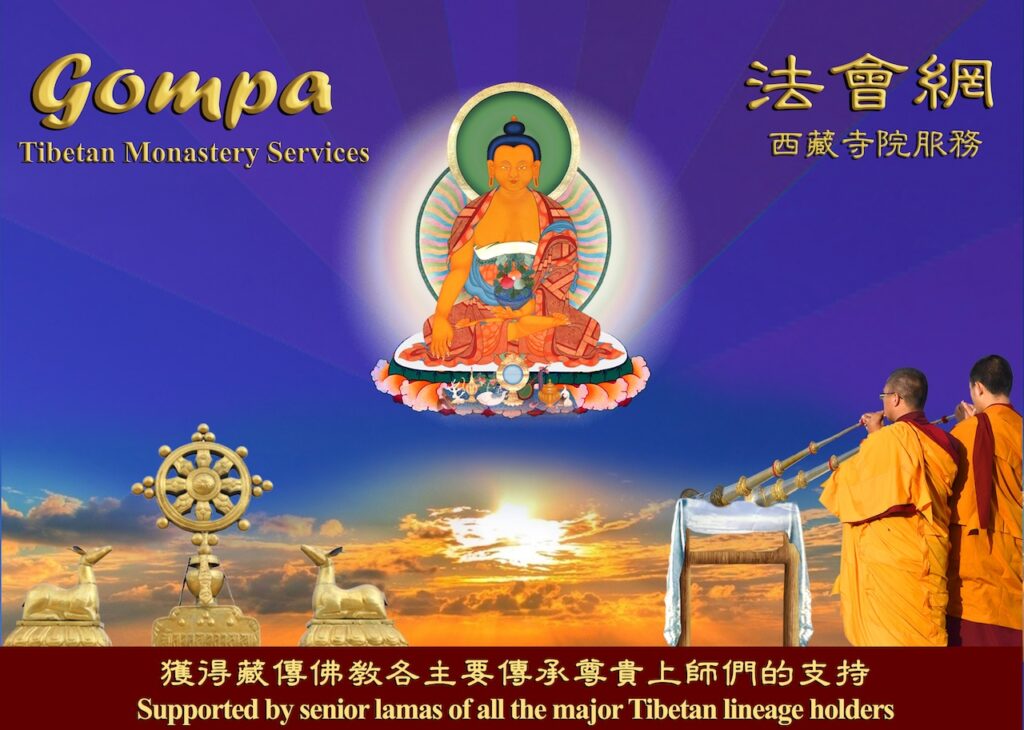
In 2012, Graham Coleman drove the start-up period of “Gompa – Tibetan Monastery Services.” Long before the pandemic years, Gompa’s services were established to connect people who lived around the world and could not easily visit the many Vajrayana monasteries in India and Nepal, and thus not easily connect with the right people to offer support for the annual cycle of prayers and pujas performed at the monasteries and nunneries, or request life stage rituals to be performed, or participate in the teachings given at the monasteries and nunneries. Now, with a successful membership program and a council of senior lamas and rinpoches, Graham gave an updated interview to Buddhistdoor Global about the innovative ways with which Gompa is engaging with international supporters and followers of the Vajrayana tradition. These services are available in both English and Chinese.
Buddhistdoor Global (BDG): How does Gompa balance accessibility for global audiences with fidelity to traditional Tibetan Buddhist practices?
Graham Coleman (GC): Ever since we began the creation of Gompa – Tibetan Monastery Services in 2012, the aim has been to offer ways of connecting with the monasteries and nunneries of India and Nepal. That is, to offer a way to arrange for prayers and rituals to be performed, whenever needed, with the option to view videos or photos of the prayers and rituals; to offer ways of participating in the annual cycle of rituals and other special events performed at the monasteries and nunneries throughout the year, including at auspicious times such as Saka Dawa and Chokhor Duchen, and so on, and to offer webcasts of the teachings given by senior lamas at the monasteries and nunneries.
In short, the overall aim was, and is, to provide as similar a connection as possible to the services and activities of the monasteries and nunneries to all those around the world to the connection which the local communities have had for hundreds of years to the services and activities of their local monastery or nunnery.
BDG: How has Gompa fostered connections between Tibetan monasteries and international supporters?
GC: Building this kind of connection was a wish expressed to us by senior lamas of the monasteries and nunneries when we first began discussing the possible formation of Gompa – Tibetan Monastery Services with the senior lamas. Since the early nineties, the Orient Foundation for Arts and Culture, in cooperation with the senior lamas of all the major lineage traditions, had been working to record the oral teachings and commentaries being given at the monasteries and nunneries throughout India and Nepal, especially the oral commentarial teachings to the major classical texts by senior lamas who had completed their education in Tibet prior to 1959 and, in tandem with this recording program, the Foundation was also working to create multimedia libraries in the monasteries and nunneries, so that the recordings were available for study in each monastery and nunnery.
From around 2010 onwards, the senior lamas began to mention to us that since we had expertise in the emerging new media technologies, could we use these technologies to build a connection to their followers internationally? Of course, we wanted to serve the monasteries and nunneries as best we could and thus we began to build Gompa – Tibetan Monastery Services inspired by the wishes of the senior lamas.
Overall, since the beginning, the content and services of Gompa are led by the partner monasteries and nunneries and only senior lamas sit on the advisory council of Gompa. Every activity is carried out in coordination with each individual partner monastery and nunnery and nothing is presented on Gompa without their approval.
BDG: What challenges have arisen throughout the overall project?
GC: A main technical challenge has been building the Gompa website, which is complex and purpose built. The Gompa site is exclusively created by us. We regard it as essential that the Gompa site does not include any third-party components which might use the personal data of monks, nuns, and Gompa account holders for commercial purposes or could be used to link personal data to any form of commercial advertising. This will always be our view.
A second challenge was ensuring that we maintain a high quality of video webcast and still image photography. This quality issue has involved a high degree of training.
Of course, too, there are the financial challenges. Here we have been very fortunate that just a small number of sponsors kindly funded the development of Gompa and we are now hoping that with the launch of the Chinese language Gompa site, Chinese speaking followers of the monasteries and nunneries will appreciate the benefits of Gompa’s services and this will help Gompa to be maintained and developed.
BDG: Do the Chinese-language and English versions of Gompa differ?
GC: There are no major differences between the Chinese and English language Gompa sites. The only difference is that teachings by senior lamas which are not available with Chinese translation are not always highlighted on the Chinese site and vice-versa. Otherwise, everything else is the same.
BDG: In what ways does Gompa contribute to the preservation of Tibetan rituals, teachings, and cultural heritage, particularly for communities that cannot physically visit monasteries?
GC: Gompa makes several significant contributions, especially to the monasteries and nunneries in India and Nepal. The offerings received by the monasteries and nunneries help to maintain the very important annual cycle of prayers and rituals which each monastery and nunnery performs. This annual cycle of practices is continuously helping to create better conditions for the world community – removing obstacles to our practice and obstacles to our daily lives and helping to prevent conflict and deprivation. The monasteries and nunneries have been performing the annual cycle of prayers and rituals for hundreds of years and it is very important that this continues.
Also, the sponsorship for the annual cycle of prayers and rituals, the sponsorship by individuals for personal prayers and rituals, and the general offerings made through Gompa help to support the livelihood of the monks and nuns and also help the monasteries and nunneries to maintain their social welfare activities, such as medical clinics and care for the elderly, and this support also helps the monasteries and nunneries to develop and maintain environmental projects such as, for example, switching to solar energy etc. This is one main aspect.
Also, another main contribution is that Gompa records, archives and gives to each monastery and nunnery the video recordings of the oral teachings and the video recordings of the rituals and other special events recorded by Gompa.
This is important because, as you know, traditionally knowledge is passed from master to student not just on the basis of the text but also through the oral commentary of the master. Also, in the case of the ritual arts practices, for instance, mandala making, torma making, chanting styles, musical instrumentation, and so on, these skills are passed from generation to generation by physical demonstration and some of these practices are in danger of being lost. For each monastery and nunnery to hold a video record of their senior lama’s teachings and of their ritual arts traditions is therefore important in terms of continuity of knowledge and education.
BDG: Looking ahead, how do you envision Gompa evolving—both technologically and culturally—to continue serving Tibetan monasteries and their worldwide audiences?
GC: We are constantly looking at ways of developing Gompa and its services. The next main development, now in process, again requested by senior lamas, is to offer a “pre-arranged” service for the time of death.
This service will offer the option to choose the monastery or nunnery at which you would like prayers and rituals to be performed at the time of death and which prayers and rituals you would like to be performed at the chosen monastery or nunnery. This is important because, as you know, it is regarded as much the best if the prayers and rituals are performed as close as possible to the time of death. This service will help to ensure that the prayers and rituals are performed as quickly as possible and, particularly for those whose partners or families may not be Buddhist, you can specify your wishes through Gompa and know that these wishes will be carried out without relatives needing to make decisions which they may not have certainty of.
Also, a second “pre-arranged” service, in development, is to offer the option to choose on Gompa which monasteries and nunneries you would like to make offerings to following death. This is a service which has been requested by several Gompa account holders. This service will provide the option to choose which monastery and nunnery you would like to make offerings to and the amount of the offering and Gompa will take care of making the offerings.
Overall, we will always strive to make developments to Gompa, which will improve the connection to the services and activities of the monasteries and nunneries, to follow suggestions made by the senior lamas of the monasteries and nunneries and the suggestions of all those who use Gompa’s services – we will always aim to provide a connection to the monasteries and nunneries which is as close as possible to the monastery or nunnery being physically nearby.
Related news from BDG
Chökyi Nyima Rinpoche Leads Recitation of the Buddha’s Words in Lumbini to Mark Inauguration Anniversary of Thousand Buddha Temple
His Eminence the 104th Ganden Tripa Has Died at Sera Jey Monastery, Aged 90
Spiritual Wisdom and Global Relevance: International Buddhist Confederation Honors the Dalai Lama’s Dharmic Legacy
Related features from BDG
The Unfinished Enlightenment: How India Is Reclaiming Its Buddhist Soul—An Interview with Dr. Richard Dixey
Bodhicitta and the Buddhadharma: An Interview with His Holiness the 41st Sakya Trizin
Community, Calling, and Connection: A Conversation with Dagmo Kalden Dunkyi Sakya
Gompa: An Interview with Graham Coleman on an Online Vajrayana Monastery Service
Related blog posts from Tea House
Expressing My Gratitude to the Dalai Lama
The Dalai Lama and the Jonang Gyaltsab Rinpoche Reunite at Thekchen Choeling