
An engraved stone discovered on the northern shore of Gyaring Lake in Maduo county, northwest China’s Qinghai province in July 2023. From xinhua.com
The first emperor of China is unlike any founding national figure in the world. A recent book by Cambridge professor David Woodman about Aethelstan, the first king of England, valiantly seeks to restore the place of the first man to call himself “Rex Anglorum.” But neither Aethelstan nor the most significant figure to reshape the English throne and the place of the British Isles in world history, William the Conqueror, have quite the contemporary status of Qin Shihuang, who is still referenced and revered by Chinese leaders today.
The Duke of Normandy and his powerful Plantagenet successors might have been rapacious, greedy sovereigns, but none were as obsessed with attaining eternal life as Yingzheng. He grew up in such a cutthroat environment with a sworn enemy in his mother and a pitiless puppeteer in his premier, millionarie merchant-turned-minister Lü Buwei. He built on centuries of Legalist reform and patient, ruthless strategizing that ripened into a complete conquest of China’s remaining six states by the Qin war machine.
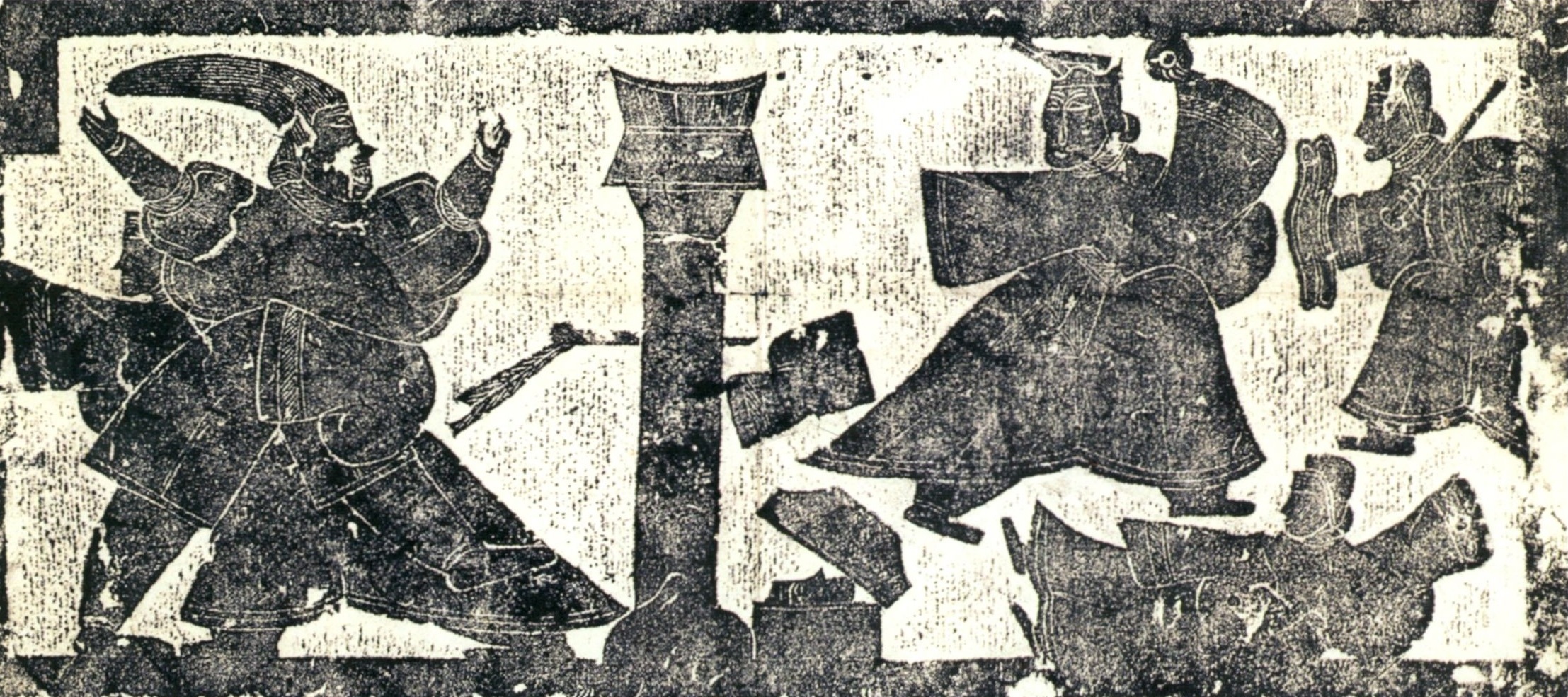
Such a monumental achievement, which was recognized by his contemporary ministers, motivated not only his grand mausoleum and the unmatched Terracotta Army in Shaanxi, but also his search for immortality. One of the earliest artistic, stone rubbing depictions of Qin Shihuang from the Eastern Han (3rd century) shows him barely surviving Jing Ke’s assassination attempt, an event that spurred him on with ever increasing urgency as his life reached its twilight.
We know that the First Emperor dispatched imperial armies, sorcerers, and agents to the Kunlun Mountains, epicenter of Chinese mysticism, to find the elixir of life. Now we know just how far he went. As China Daily reports, “China’s National Cultural Heritage Administration announced on Monday that an engraved stone, discovered on the Qinghai-Tibet Plateau, is the only known Qin Dynasty (221 BC-207 BC) engraved stone still preserved at its original site and the one located at the highest altitude during the historic period.” (China Daily)
The carving, written in the small seal script codified by the Qin Dynasty, read: “’The emperor commanded level five grand master Yi to lead a group of alchemists here to collect yao.’ . . . The inscription also said the group had travelled by carriage to the mountain and had reached Zhaling Lake in Qinghai in the third month of the ancient Chinese calendar in the 37th year of Qin Shi Huang’s reign.” (The South China Morning Post) In this context, yao probably does not refer to medicine, herbs, animals or even minerals with healing power, but rather the coveted elixir of life.
The South China Morning Post reports that the carving had triggered a heated debate about its authenticity after its discovery was announced in June. Sceptics suggested it may be a modern forgery. And was it even possible to travel to the plateau given the freezing cold, harsh conditions? Whatever the emissaries of Qin had tried, they had evidently succeeded in reaching what would have been the pre-Tibetan, Shangshung kingdom, which existed from about 500 BC to 625 AD. New archaeological finds (epigraphy like this engraved stone is always the most useful) will tell if the Qin Dynasty or its successors had extended contact with Shangshung before the rise of Tibet’s first emperor, Songtsen Gampo, during the Tang period.
While it is important not to project the politics of the newly unified imperium into more contemporary periods of China, there is no doubt that the reach, even desperation, of the First Emperor was such that he would stop at no geographic distance to attain his celestial elixir.
Like Alexander the Great before him, but who was more attached to immortality through glory rather than physical eternity, Qin Shihuang was only stopped because he shared the fate of all mortals. In that sense, his devoted servants failed, but who could blame them? It was written that they would not succeed, and that hubristic delusion was as much part of the First Emperor’s character as his monumental, world-shaping achievement.
See more
China discovers highest-altitude Qin Dynasty engraved stone on Qinghai-Tibet Plateau (China Daily)
China’s first emperor really did send quest to Tibet in search of immortality: scientists (The South China Morning Post)