
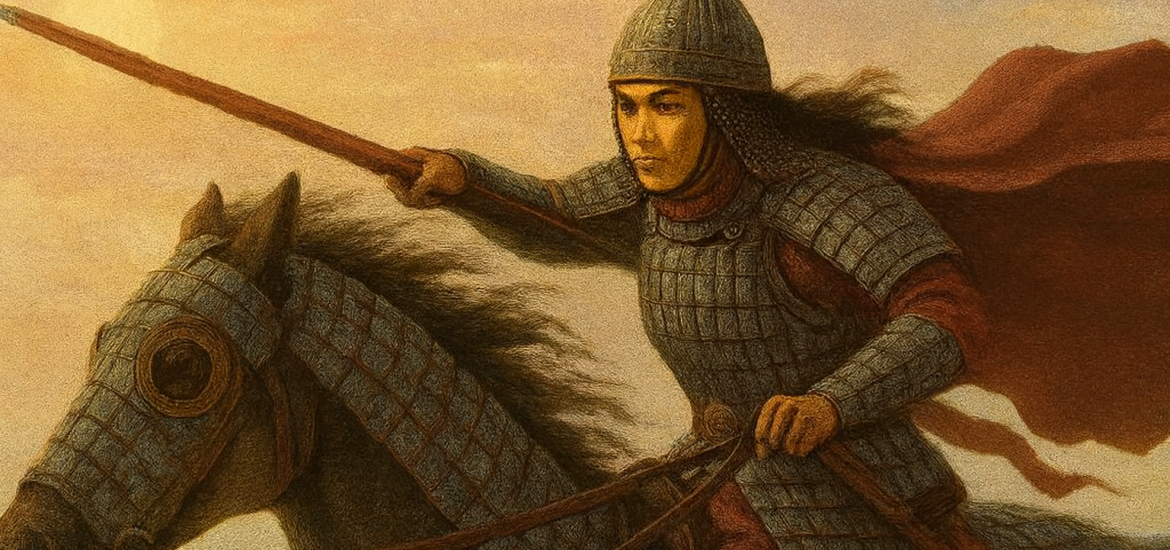
Thunderous are the hooves that hammer the plains of my homeland.
Atop my beloved, I raise my kontos and aim it at the heart of my great foe, my eternal challenge.
My greatest adversary is myself.
One Vehicle. One Dharma. One strike.
I recently compensated for my lack of talent in making art and being creative (I can’t draw to save my life) by creating some art with Copilot (one of my go-to chatbots along with DeepSeek). I asked Copilot to create an image of a Jin Dynasty (1115–1234) princess who had escaped her traditional fate and entered the ranks of the Iron Pagodas. Her lance is raised high amidst a fresh and bright dawn on the Eurasian Steppe Belt. But her martial calling is a dangerous one; as fate would have it, she faces a brash and bold challenge from a Tangut counterpart of the neighboring Western Xia (1038–1223). Both women vie for the favor of the Buddhist deities, and both wish annihilation or at least tributary subjugation of the other’s state. It is only a matter of time before they charge at each other on the plains of Inner Asia.
The Iron Pagoda was a mounted warrior, covered from head to toe in extremely heavy armor, and their steed was similarly encased. Iron Pagodas served as shock horsemen of the Buddhist-guided Jin Dynasty. Contemporary observers compared them to “iron statues” charging across the battlefield. They would be met in battle by the Iron Hawks, similarly valiant and elite horsemen from the Tangut Empire. Both were pious empires whose leaders worshipped the three treasures and contributed immensely to the spread of the Dharma among the Inner Asian elite.
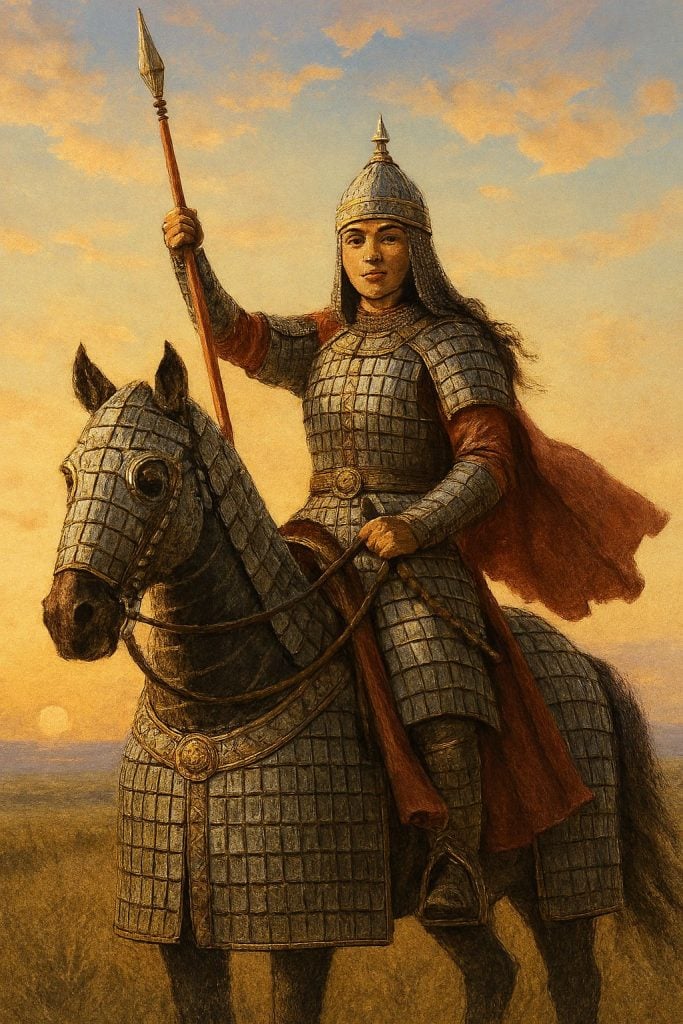
The Iron Pagodas’ and Iron Hawks’ tactics of devastating charges, backed by horse-mounted archers, were inspired by earlier horse-riding warriors that served their state or imperium (in contrast to Western European knights, who were mostly bound to feudal obligations to lords or kings). These warriors were formally known as cataphracts, originating in Iran among the mighty armies of the Sasanian Persians before finding their way into the forces of the Eastern Roman Empire (Byzantium).
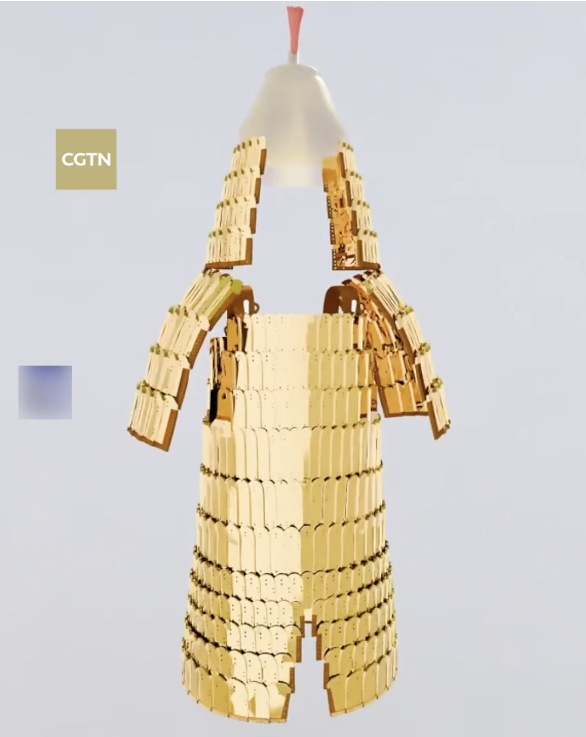
Cataphracts were a ubiquitous military asset throughout Eurasian history, and there were equivalent warriors among the so-called “nomadic” empires and confederations, including the Xiongnu, the Xianbei, the Hephalites, and the groups that comprised Attila the Hun’s westward armies. Many of the cataphracts were recruited from the aristocracy or nobility, and the recent restoration of an archeological wonder unearthed in 2018 from the Xuewei No. 1 Tomb in Dulan, Qinghai Province, raises exciting questions of the priorities and lifestyles of these aristocratic horsemen. The Chinese Academy of Social Sciences announced this restoration, along with several other major achievements in scientific archaeology and cultural heritage protection, in Beijing on 14 January. (CGTN)
The restored item, according to CGTN, is a gilded suit of bronze armor reconstructed to reflect the ceremonial style of the Tuyuhun royal family. Tang poetry mentions a suit of “golden armor” that might have been poetic exaggeration, but the reconstituted set is not far off, which features the finest Tang-era gold-and-silver inlay craftsmanship.
The Tuyuhun Empire (284–670), which grew from the carcass of the Xianbei state (itself a faction of note among the fabled Han-Xiongnu conflict) was actually established earlier than the Tang (618–907). But by the Tang imperium, the Tuyuhun were sandwiched between China and the rapidly growing Tibetan Empire. Eventually, they were completely swallowed up by the Tibetans during the rapid expansion of the new empire under the third emperor, Mangsong Mangtsen (636–76).
It is uncertain whether the restored suit of armor belonged to a Tuyuhun royal who was pro-Tang or pro-Tibetan. But as the website Ancient Origins notes, the remains of bronze plates and associated equestrian gear were badly disturbed and corroded when they were first unearthed in 2018, making physical handling perilous.
What is intriguing is that this set of armor, made of bronze, resembles those of the heavy metal scales that historically composed cataphract armor. While the Iron Pagodas of the Jin would have worn more advanced armor made of lamellar, could the wearer of the Tuyuhun armor have been a distant ancestor of our heroic princess who chose the path of a Iron Pagoda? Or perhaps they were the ancestor of her Iron Hawk rival, whose forebears were the Xianbei people who established the Western Xia.
Whatever the likelier possibility, the galloping of the Buddhist cataphracts’ steeds, and the clash of their lances and swords, echo on.
See more
China restores its only Tang Dynasty gold armor, announces major advances in scientific archaeology (CGTN)
Tang Dynasty “Golden Armor” Reconstructed After 1,200 Years (Ancient Origins)