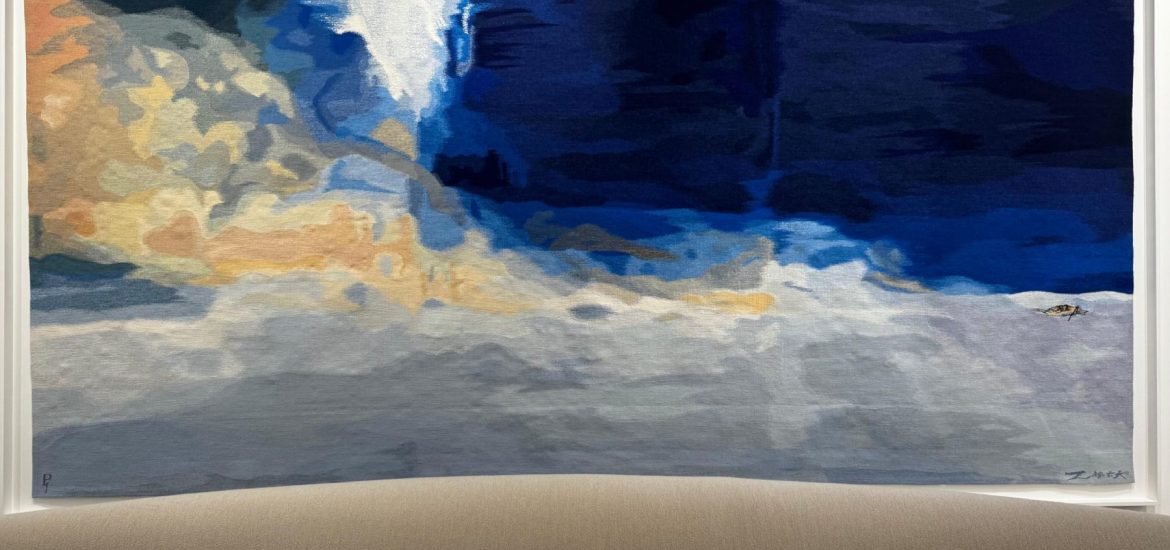
After Zao Wou-ki Le vent pousse la mer (Wind Waves in the Sea, triptych), 2024–25, Aubusson tapestry, wool and mix, Edition of 8, 196 x 385 cm. Image by the author
In the heart of Hong Kong’s reviving art scene of Hollywood Road is Villepin, a gallery that was founded in 2019 by former French prime minister Dominique de Villepin and his son, entrepreneur Arthur de Villepin. It launched in early 2020 with a focus on the art of the Villepins’ longtime family friend Zao Wou-ki, a seminal Chinese-born artist in his own right. The gallery space is distinctly nature-focused and relaxed, and has often showcased works by Asian artists.
From 22 January until 3 February, the gallery opened its doors to private viewings of Second Nature, a collection bringing together three artists from three different periods: Hiroshi Nagai (b. 1947) from Japan, Yi Youjin (b. 1980) from Korea, and Kenix Xiaoqing Liang (b. 1995) of Guangdong.
It is impossible to overlook how each artist’s style reflects the shifting social concerns of their era, and how their art dissolves boundaries between the inner and outer worlds. The artists certainly reflect on and mould their external realities, while offering an intensely subjective and unique focus through how they, simultaneously, feel about and react to said realities.
Nagai, for example, grew up in Japan’s eighties boom era, and often visited Hawaii, where he was transfixed by the wealth and spaciousness of the American home, which was often embodied by a pool: a statement of space devoted to leisure and comfort.
This is a world “just out of reach” yet nostalgic, a world of yearning optimism. His world of suspension, memory, and stillness proposes memory and imagination as a way of remaining with the world, in particular, a happier, nostalgic time reconstructed from imagination and aesthetics. His work invokes institutional memory in musical aesthetic of “City Pop” (cosmopolitan Japanese music influenced by rock, R&B, and jazz) and journalism: magazines, travel brochures, and shopping catalogues.
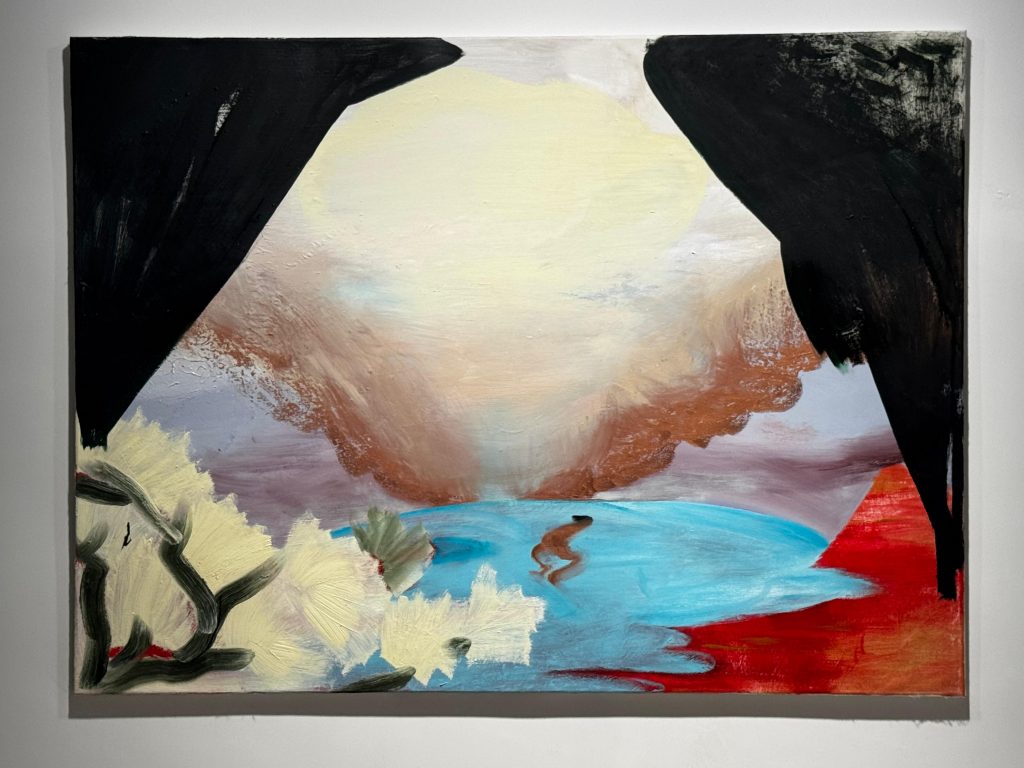
Yi, who grew up in a highly regimented, competitive, and capitalist South Korea travelled to learn and live in Munich, where she found creative freedom. Her surrealist process, shaped by subconscious experience and inner sensation, is about offering release and freedom from control. In her work, the boundary between figure and background dissolves. The forms are never full there, yet not quite absent; manifesting softly and unsolidly. It is a dreamscape invoking simultaneous unreality and the undeniable subjective interior: a meditative space or psychological ecosystem that is perhaps closest to Buddhist reflections about the relationship between our thoughts, the mind, and the external world. This is a tripartite conversation that Yi presents as a library of the heart, where entities like landscapes, shapes, and animals are all part of the ineffable consciousness.
Finally, Liang, as the youngest and a poster child of Gen Z, has no doubt grown up in perhaps the most disconcerting and alienating time in human history. She works mostly with painting and ceramics, highlighting the entangled relationships between the “social systems” of human beings, flora, and fauna. It is not surprising that Liang likes to examine small organisms, like, insects, fragments of plants, and objects shaped by industrial or environmental forces. These are often-overlooked forms that Liang launched into dominant visual presences, charged with meaning. The insignificant and inconsequential are repositioned as central carriers of knowledge and value.
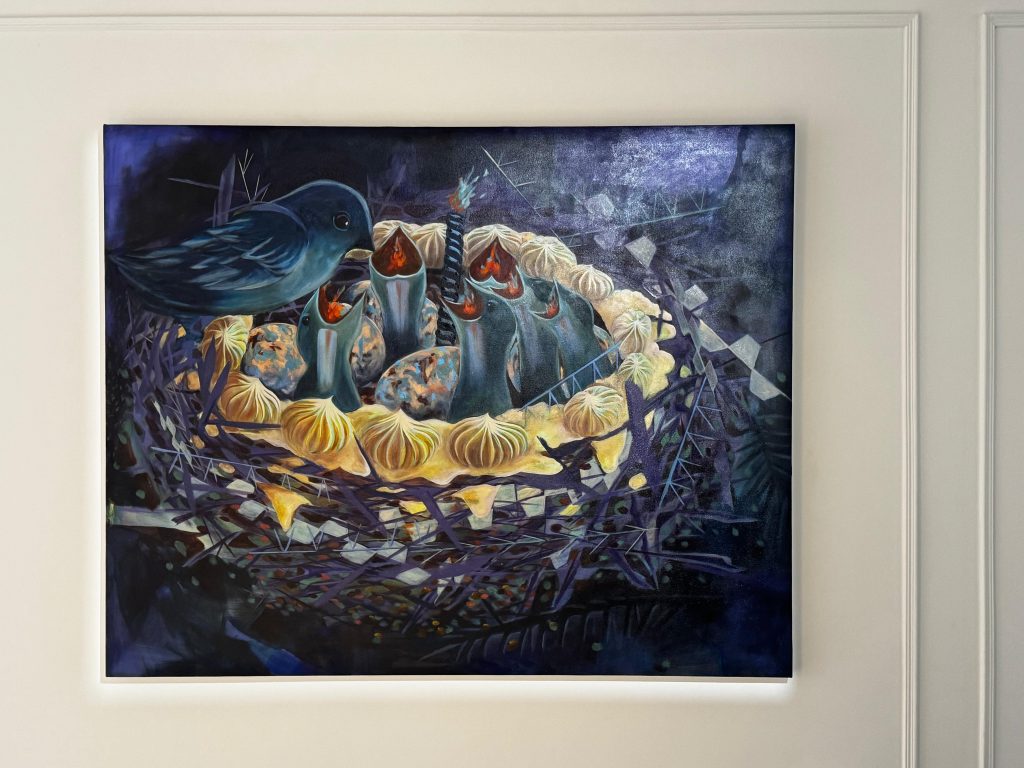
Spiritual practice, and indeed the creation of art, have both been acts of agency in a world where agency itself has always felt constricted; especially compared to the powerful men (and they are almost all men) that seem do heinous things, even by the standards of cynical realpolitik, with little to no accountability. We are now in the world of Kenix Xiaoqing Liang, whose art is now more relevant than ever, especially in light of the grave geopolitical situation engulfing the West and the entire world. Gen Z and Gen A are living a mode of existence shaped by flux and change, which is reflected in Liang’s work. There is no future to speculate on; but rather, Liang celebrates the strategies of weathering tribulations that already bind communities together and provide internal resilience. Dominance and control are no longer in vogue with a younger generation that see through the artifice and constructs of our world, and seek more authentic systems. Her art celebrates, quite literally, the little guy.
Perhaps one work that stands out for its broader commentary on the fragility of the human condition is a tapestry alongside Hiroshi Nagai’s work, which is a vision of a self-constructed universe; Le vent pousse la mer. The boat to the right of the tapestry is tiny in proportion to the vast waters and the great, ethereal form that moves across the striking ocean and sky. This boundless mindscape is both a tribute to the natural world, but also how the world of Zao’s making translates internal experience into colorful form. Second Nature reveals how intimate the interplay between the “outer” world and the “inner” world are: how they shape each other; how our internal conversations and reflections are always influenced by our social and cultural contexts, but also how we create the realities that we experience—there is no hard and fast border or boundary.
Second Nature is a beautifully curated exhibit by three incredibly talented artists with profound messages for our contemporary times. We are what we create.
See more
Yogācāra (Stanford Encyclopedia of Philosophy)
Related features from BDG
The Liminal Year: Compassion at the Tipping Point
Toward a Socially Responsible Mindfulness
The Only Thing Left Is Magic